This manual is for PHI FPX 1200 Assessment 1, start to submission. The Personal Philosophy of Problem Solving asks you to describe your own approach to solving problems: how you define a problem, the steps and habits you rely on, the values that guide your decisions, an example from your work or life that shows the approach in action, and how you want it to develop. The grade turns on specificity about you. A general description of problem-solving steps scores lower than an honest account of how you actually work, with an example. Below is the method our tutors use, a structure that maps to the criteria, and an annotated sample excerpt. Prefer to hand it off? A premium original sample for this exact assessment comes back in 24 to 48 hours, revised free until it meets the guide. Capella's catalog lists the course as PHI-FPX1200, and some courserooms print PHI1200; both point to this same Assessment 1. In current courserooms this assessment typically appears as "Personal Philosophy of Problem Solving".
One honesty note before the manual: Capella revises courses and scoring guides over time, so always write to the exact scoring guide attached to your assessment in the courseroom. The course identity above is verified on capella.edu; the method and structure below are our tutors' approach to it, not Capella's official rubric text.
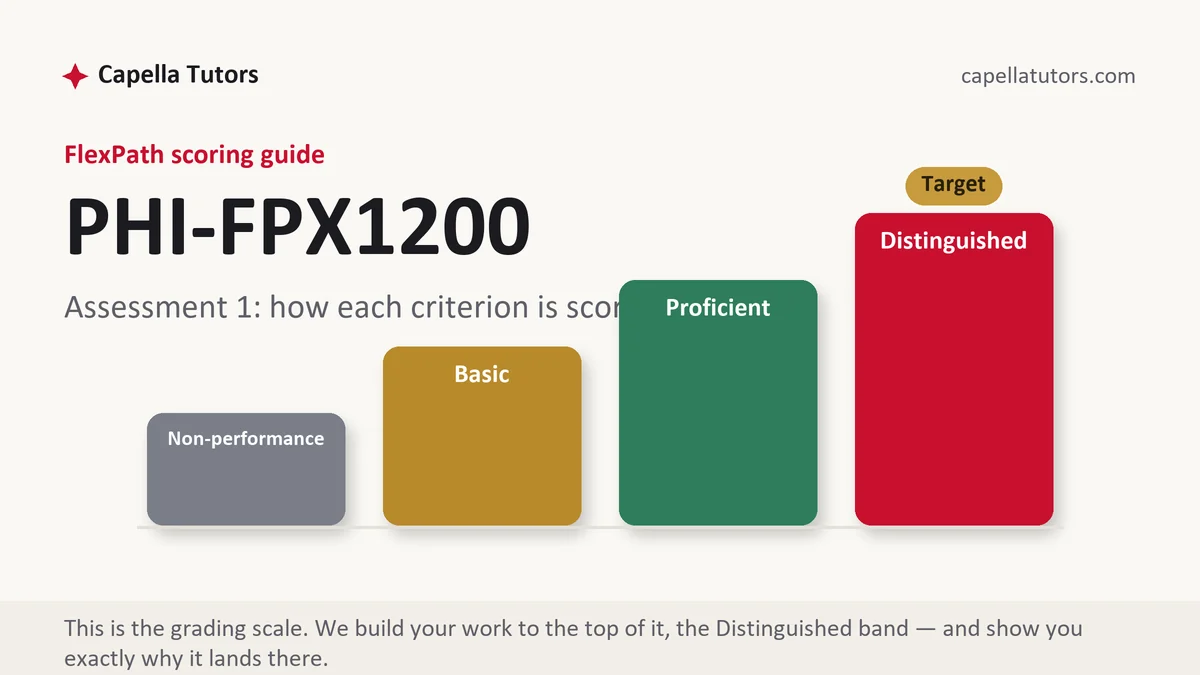
How PHI FPX 1200 Assessment 1 is scored
FlexPath does not use letter grades. Each criterion in the scoring guide lands on one of four levels, and the level descriptions are the real writing brief:
| Level | What it means on a personal problem-solving philosophy |
|---|---|
| Distinguished | Your approach is described clearly and specifically, connected to a recognized problem-solving process, illustrated with a real example, and reflected on with a goal for growth. |
| Proficient | The approach is clear, but the example or the reflection is brief. |
| Basic | The paper describes problem solving in general. |
| Non-performance | The example or the reflection is missing. |
This is a short, reflective piece in most versions. Write in the first person and keep it concrete.
The PHI FPX 1200 Assessment 1 method, step by step
-
Describe how you start
How you recognize and define a problem.
-
Name your steps
Gathering information, generating options, choosing, acting and checking.
-
Name the values behind your choices
Fairness, efficiency, care for others.
-
Give an example
One real problem you solved and how.
-
Connect to a model
A recognized process, such as the IDEAL model, with a source if asked.
-
Reflect on growth
One part of your approach you want to strengthen.
A structure that maps to the criteria
Word counts are planning targets our tutors use, not Capella rules; follow the length and format your scoring guide states.
| Section | What it must do | Guide |
|---|---|---|
| Introduction | Your role and why problem solving matters to it. | ~50 words |
| Your approach | Steps, habits and values. | ~125 words |
| Example | A real problem and how you solved it. | ~100 words |
| Growth | What you want to develop. | ~50 words |
Annotated sample excerpt
An original model excerpt from our team, written to show the register that reaches the top of the guide. Learn the moves, then write your own version.
When a family told me their mother was missing doses of her heart medication at home, I started by asking what a typical day looked like rather than repeating the instructions.1 Listening showed the real problem was timing, since the doses clashed with her afternoon nap, so we moved them to meals and set up a pill organizer her daughter refilled on Sundays.2 That habit of defining the problem before solving it is the core of how I work, and the part I want to strengthen is following up sooner to check whether a solution held.3
- 1Shows the first step of the approach in a real situation.
- 2Describes how the definition changed the solution.
- 3Names the habit and a goal for growth.
The full premium sample for your exact assessment, written fresh to your scoring guide and topic, is free to request. Study it, revise it into your own voice, and submit work you understand.
The five mistakes that cost Distinguished
- Generic steps. Describe how you actually work.
- No example. Show the approach in action.
- Third person. Write about yourself.
- No reflection. Name what you want to improve.
- Too long. Keep to the length your guide sets.
Pre-submission checklist
- Approach described specifically
- Steps and values named
- Real example
- Connection to a model if asked
- Goal for growth
- First person, appropriate length
Want the problem-solving philosophy written?
Send the scoring guide and any materials from your courseroom. Our team returns a premium original problem-solving philosophy in 24 to 48 hours, revised free until it meets the guide.