Upload the scoring guide and whatever you have about your site, and a doctoral-register draft comes back inside 24 to 48 hours, argued to the Distinguished descriptors rather than to the instructions, with revisions carried until every criterion clears. On your transcript this course reads NURS FPX 9000, Doctor of Nursing Practice 1, worth 2 program points, the first of the five courses in the Doctoral Capstone group of Capella's FlexPath DNP, a degree the catalog builds from thirteen 2-point courses for at least 26 program points, with a minimum of 1,000 supervised practicum hours behind it. In Capella's catalog the course code is written NURS-FPX9000.
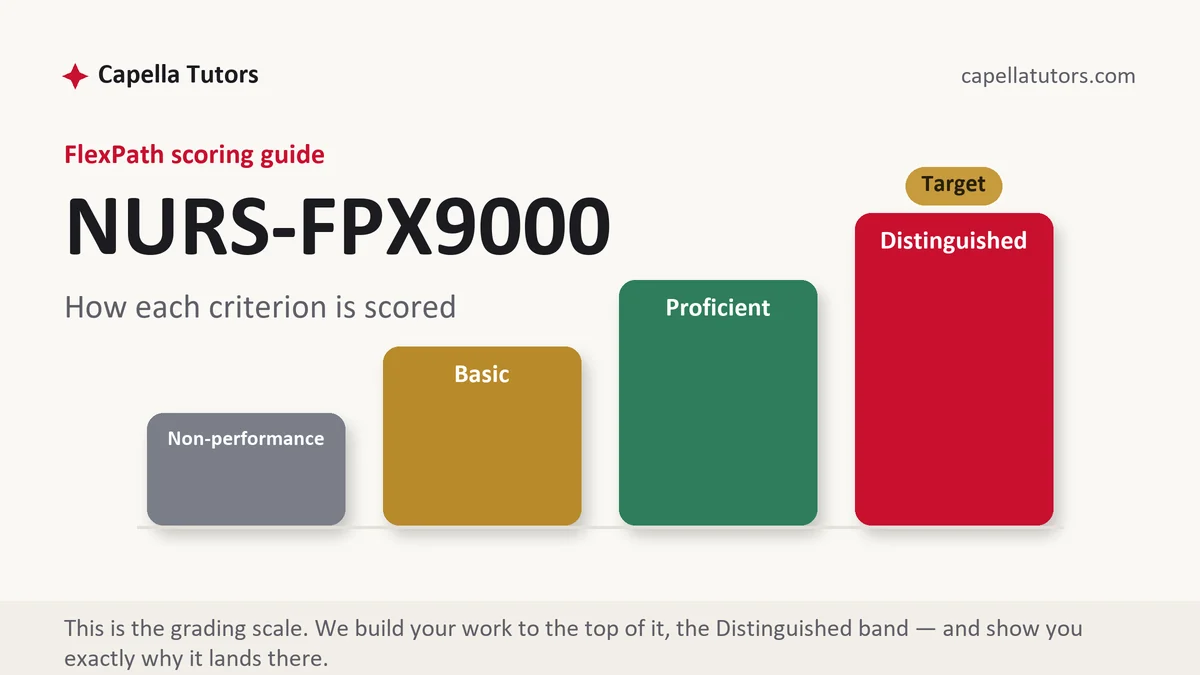
What NURS FPX 9000 actually grades
This is the course that decides whether the other four are possible. The criteria at this stage are not asking for an intervention, a synthesis or an evaluation plan. They are asking for a problem: one measured deficit, in one countable population, at one named setting, with a magnitude that existed before you took an interest in it. The assessments in this course usually ask you to state that problem, describe the practice setting closely enough that a reader who has never been there can picture the workflow, establish that the problem matters where you propose to work on it, and show that the people who control the site know you are coming. Your scoring guide decides which of those becomes its own criterion and which get folded together.
Measurement is where first attempts fail, and the failure is nearly always the same. A rate is meaningless until it carries a numerator, a denominator and a window, in that order, and doctoral evaluators read for all three. Say you intend to work on catheter-associated urinary tract infections on a 34-bed medical surgical unit. Eleven infections is a count, and a count moves with census, so it cannot be compared to anything or deliberately improved. Eleven infections across 2,940 catheter days in the twelve months ending in March is 3.74 per 1,000 catheter days, and that figure can be benchmarked, tracked weekly, and moved on purpose.
The third strand is scope, and it is graded whether or not a criterion names it. A practice doctorate translates evidence that already exists into a change at a real site and then evaluates what the change did, so a problem worth proposing here is one the published literature has already answered somewhere else. The site gets assessed alongside the problem, usually quietly: whether the data you need is data somebody there already pulls, whether the unit carries enough volume for a change to become visible inside the window your program allows, and whether your preceptor sits high enough to authorize what you intend to do. Capella expects you to secure that preceptor yourself and to work inside a professional practice setting on an initiative of the kind the catalog describes, a pilot study or a quality improvement project.
How we help in this course
Our work in 9000 concentrates on four artifacts, because everything downstream is built from them. The problem statement gets rewritten until one sentence carries a population, a setting, a measure, a magnitude and a timeframe. The background section gets built so that the deficit you named is visibly recognized in published evidence and not just in your experience of it. The setting description gets written from operational detail, and the significance argument gets converted out of adjectives and into events, days or dollars per year. Send the report your unit already runs and the draft's numbers will be yours, not a textbook's.
The delivery terms are the studio's standard ones, applied at doctoral register: one premium original sample per deliverable inside 24 to 48 hours, eight people on the pipeline with a scoring-guide pass and a separate APA and originality pass, and free revisions until the criteria are satisfied. Faculty comments re-enter the same cycle at no charge. One doctoral adjustment is worth naming: because faculty have two business days to evaluate a submitted attempt and doctoral attempts tend to use the whole window, we work backward from the date you plan to submit rather than forward from the date you ask.
The assessments, one by one
Assessment 1
Assessment 1 opens Doctor of Nursing Practice 1, the first course of the Doctoral Capstone group, and the deliverable it usually asks for is the smallest and hardest object in the degree: one practice problem, named at one site, measured before you propose to touch it. Read the full Assessment 1 manual.
Assessment 2
Assessment 2 usually takes the deficit you named and builds the case around it: published evidence that the problem is recognized beyond your building, significance expressed in what it costs this organization in a year, and a feasibility argument naming who can authorize the work, who will execute. Read the full Assessment 2 manual.
Assessment 3
Assessment 3 usually asks you to assemble the course's work into one document the rest of the capstone sequence can be built from: the measured problem, the setting, the baseline with its method, the site's agreement, and the plan for the practicum work that will carry the project. Read the full Assessment 3 manual.
How to actually write NURS FPX 9000: where to begin
Open the scoring guide before you open a database. Copy each criterion into a document, paste its Distinguished wording underneath, and treat those blocks as the outline. At this stage the criteria usually gather into four clusters: the problem and its measurement, the setting and its stakeholders, the evidence that the problem is real and answerable, and the plan for the practicum work that will carry it.
Draft the problem statement next, in one sentence, and expect to rewrite it eight times. A version that holds up reads roughly like this: on a 34-bed medical surgical unit in a 240-bed community hospital, indwelling catheter necessity was documented on 41 percent of 2,940 catheter days in the twelve months ending in March, while the unit recorded 3.74 catheter-associated urinary tract infections per 1,000 catheter days over the same period. Notice what that sentence refuses to do. It does not name a solution, it does not blame a discipline, and it does not use the word improve. Every later criterion in every later course has something to attach itself to, because the sentence contains a number and a definition.
Then convert the rate into consequence, because significance criteria are graded on arithmetic and not on concern. Eleven infections a year, multiplied by a published attributable cost estimate and by a published excess length-of-stay figure, gives you an annual burden in dollars and in bed days that a chief nursing officer can act on. Name each estimate's source and year, say whether you adjusted for inflation, and show the multiplication. Then say what the estimate cannot capture. A candidate who writes that the cost figure excludes the readmissions the site does not track is demonstrating exactly the judgment the top column describes.
| Section | What goes in it | What Distinguished looks like |
|---|---|---|
| Practice problem statement | Population, setting, measure, magnitude and timeframe compressed into one sentence. | A measured gap rather than a topic, quantified before any intervention is mentioned. |
| Setting and population | The unit described operationally: volume, staffing pattern, patient mix, and who owns the workflow. | Detail specific enough to explain why this problem occurs here and not on the unit next door. |
| Local baseline | Numerator, denominator, window, and the named report or audit the figure came out of. | A baseline drawn from data the site already produces, with its blind spots stated. |
| Significance and background | Guideline or surveillance context, plus the annual cost of the problem at this site. | Consequence expressed in events, bed days or dollars, sourced, with the conversion shown. |
| Stakeholders and feasibility | Who authorizes, who executes, who pulls the data, and what each of them stands to lose. | Named roles with their likely objection anticipated and answered in advance. |
| Practicum plan and references | Hours, the preceptor's role, the practice setting, and current APA in both directions. | Activities tied to project milestones rather than to shifts worked, referenced cleanly. |
Developing the synthesis
The synthesis this course needs is narrower than the one the design course will demand, and it has a single job: to show that the deficit you measured is one the literature already recognizes and already has a workable answer for. Read each source in the order a journal presents it, which means design and sample before findings, because those two decide how much the findings are worth. A single-site pre-post study of 60 patients and a multi-site randomized trial of 2,400 do not carry equal weight, and a draft that cites both in the same sentence without saying so has told the evaluator it cannot tell them apart. When a model or framework enters the paper, attribute it to the people who built it and cite the work where they built it, not the course reader that reproduces the diagram. Doctoral criteria treat secondhand attribution as a defect.
Citations that survive faculty review
Four source types do four different jobs at this stage. Surveillance and measure definitions, principally CDC and National Healthcare Safety Network specifications and CMS quality reporting documentation, tell you what your numerator and denominator are allowed to contain, and a rate calculated on a definition you invented cannot be compared to anything. Clinical practice guidelines from the relevant specialty body establish what the standard of care is, which is what your measured gap is a gap from. Peer-reviewed research retrieved through the Capella library, CINAHL, MEDLINE and PubMed, weighted toward systematic reviews and the trials behind the guideline, supports the claim that the problem responds to intervention. Internal site documents, named rather than quoted anonymously, supply the local figures, and they need a note on permission and on how you de-identified them. Run the reference list against the in-text citations in both directions in current APA, then read the paper once more looking only at whether every number has a visible origin.
The mistakes that land Basic instead of Distinguished
- A topic where a problem belongs. Nurse burnout is a subject; 22 of 58 unit nurses scoring in the high emotional exhaustion band on the March survey is a problem.
- A count presented as a rate. Without catheter days, patient days or encounters underneath it, the figure cannot be compared across months or moved deliberately.
- Significance built entirely from national numbers. The evaluator wants to know what this deficit costs the organization that agreed to host you.
- A site picked for access rather than for data. Working there is a convenience; being able to retrieve the outcome measure every week is a requirement.
- A framework named and left unattributed. At this level the model has to be credited to its authors, in the article or edition where they published it.
NURS FPX 9000 questions students actually ask
Can my own workplace be the project site?
Usually yes, and it is the most common arrangement, but the dual role has to be handled on paper rather than ignored. You are simultaneously an employee who reports to someone and a doctoral student asking that same someone to authorize a change in practice, and criteria at this stage often ask you to say how you will keep those roles separate: who consents to what, whether staff can decline to participate without consequence, and what happens to your project if you change jobs mid-degree. Write the mitigation into the plan rather than waiting to be asked. What no page can tell you is whether your specific employer permits it, since that is governed by the site's own research or improvement policy and by your program handbook, so ask the compliance office in writing early and keep the reply.
How do I get a baseline when nobody will give me the report?
Collect one yourself, prospectively, and describe exactly how you collected it. A four-week chart audit of twenty records a week gives you eighty observations, which is enough to state a proportion with a stated margin of error, and it has an advantage over a borrowed report: you know the definition because you wrote it. Say who pulled the charts, how they were selected, what counted as a hit, and what you could not see. An audited baseline with its method disclosed is treated as evidence. A number quoted from a conversation with a manager is not, because nobody reading it can tell what it counted.
How many practicum hours should I have by the end of this course?
The requirement the catalog states is the degree total, a minimum of 1,000 supervised practicum hours, not a per-course quota, and how those hours are expected to distribute across the sequence is set by your program and your faculty rather than by any outside site. The arithmetic worth knowing is that 1,000 hours across a thirteen-course degree averages about 77 hours per course, and almost nobody levels it that way, so hours pile up in the project courses where the work actually happens. Start logging in the first week of this course, record activities against project milestones rather than against shifts, and get your preceptor's sign-off while the week is still recent. Confirm what counts with your faculty, since that judgment is theirs.
One last thing about this course specifically, since it is the handoff that costs students whole sessions. What leaves 9000 is the input to NURS FPX 9010, Doctor of Nursing Practice 2, where the evidence synthesis and the project design get built: a problem sentence with a number in it, a setting description, a baseline with a defined denominator, and a site that has agreed in writing. When the problem sentence is vague, the second course spends its twelve weeks rewriting the first course instead of designing anything, and the whole five-course group slides by a session. FlexPath bills flat inside those 12-week sessions and lets you carry up to two courses at once, so a slide costs money as well as calendar; ask your enrollment advisor what can run alongside a capstone course.
Problem statement due?
Send the scoring guide, your unit's numbers, and what the site has agreed to. We will write it to the top column and show the arithmetic. First premium sample free.