This manual is for NURS FPX 9000 Assessment 1, start to submission. The Project, Preceptor, and Practicum Interest Form (PPPIF) opens the DNP project sequence: you complete the form with your learner information, your faculty mentor, your proposed preceptor and their qualifications, a description of the project site, and the practice problem and possible intervention you intend to pursue. It is a form, but the problem statement in it is the seed of the whole project, and the catalog notes that this course requires university approval of your topic prospectus. A precise, measurable problem at a real site makes every later assessment easier. Below is how to complete it well, what to check, and an annotated sample excerpt. Prefer to hand it off? A premium original sample for this exact assessment comes back in 24 to 48 hours, revised free until it meets the guide. Capella's catalog lists the course as NURS-FPX9000, and some courserooms print NURS9000; both point to this same Assessment 1. In current courserooms this assessment typically appears as "Project, Preceptor, and Practicum Interest Form (PPPIF)".
One honesty note before the manual: Capella revises courses and scoring guides over time, so always write to the exact scoring guide attached to your assessment in the courseroom. The course identity above is verified on capella.edu; the method and structure below are our tutors' approach to it, not Capella's official rubric text.
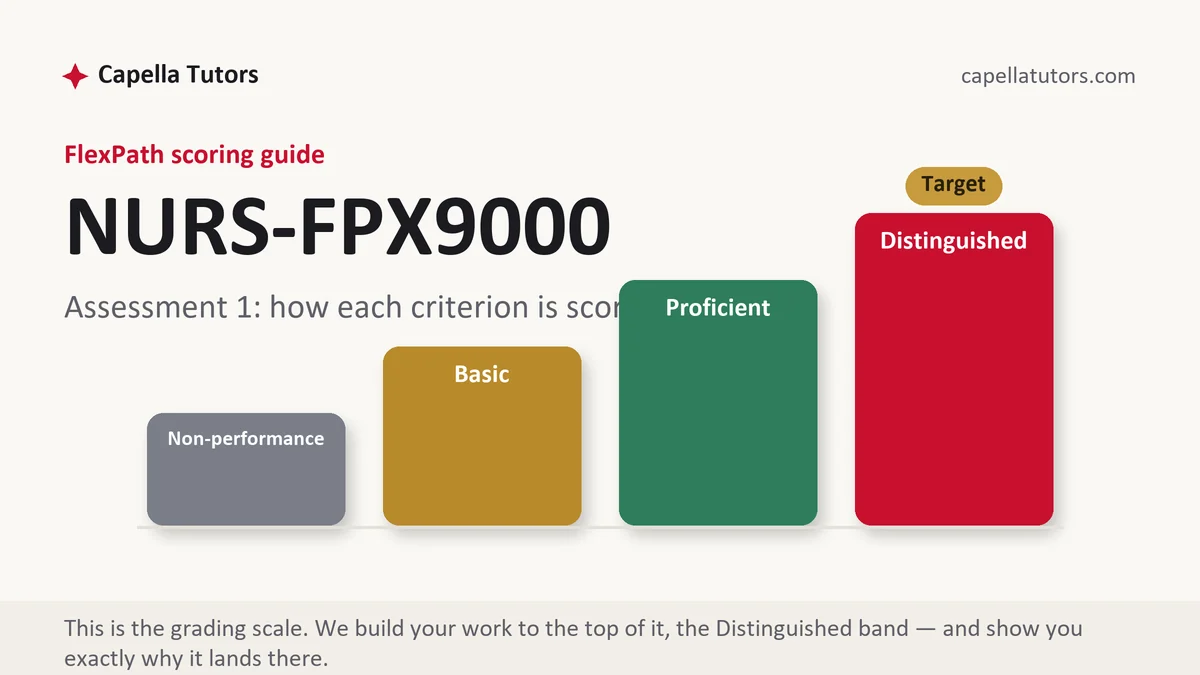
How NURS FPX 9000 Assessment 1 is scored
FlexPath does not use letter grades. Each criterion in the scoring guide lands on one of four levels, and the level descriptions are the real writing brief:
| Level | What it means on the PPPIF |
|---|---|
| Distinguished | Every section is complete, the proposed preceptor meets the program's requirements, the site is described with its population and willingness to host the project, and the practice problem is specific, measurable and within your scope. |
| Proficient | The form is complete, but the problem statement is broad or the site description is thin. |
| Basic | Sections are incomplete or the problem is stated as a topic rather than a gap. |
| Non-performance | The form is missing required information. |
Confirm your preceptor's credentials and the site's agreement before you submit. A preceptor or site that falls through later delays the whole sequence.
The NURS FPX 9000 Assessment 1 method, step by step
-
Use the current form
Download the PPPIF from your courseroom so the fields match what faculty review.
-
Confirm the preceptor
Name, credentials, role and contact details, and check them against the program's preceptor requirements.
-
Describe the site
The organization, the unit or service, the population served, and who has agreed to host the project.
-
State the practice problem as a gap
What is happening, what should be happening, and how you know: one measure with a current value.
-
Name a possible intervention
An evidence-based direction, stated tentatively, that you will develop in later assessments.
-
Check and submit
Every field complete, names and credentials spelled correctly, and the form saved in the format requested.
A structure that maps to the criteria
The PPPIF is a form; the parts below are what faculty check. Keep entries precise rather than long.
| Section | What it must do | Guide |
|---|---|---|
| Learner and mentor information | Your details and your faculty mentor. | every field |
| Proposed preceptor | Credentials, role and agreement. | every field |
| Project site | Organization, unit, population and host contact. | short description |
| Practice problem | The gap stated with a measure and current value. | ~100 to 150 words |
| Possible intervention | An evidence-based direction to develop. | ~75 to 100 words |
| Submission check | Every field complete, correct file. | before you submit |
Annotated sample excerpt
An original model excerpt from our team, written to show the register that reaches the top of the guide. Learn the moves, then write your own version.
On the 28-bed medical unit at the project site, 18 percent of patients discharged with a new anticoagulant last quarter called the unit or returned to the emergency department within two weeks with questions about dosing, according to the unit's callback log.1 Discharge teaching for these medications is currently delivered by the discharging nurse without a standard tool or a check of understanding.2 I propose to address the gap with a structured teach-back protocol for anticoagulant discharge teaching, to be refined with my preceptor, the unit's clinical nurse specialist, during the next course.3
- 1States the problem with a setting, a measure and a source.
- 2Describes current practice so the gap is visible.
- 3Offers a tentative, evidence-based intervention and names the preceptor's role.
The full premium sample for your exact assessment, written fresh to your scoring guide and topic, is free to request. Study it, revise it into your own voice, and submit work you understand.
The five mistakes that cost Distinguished
- A topic instead of a problem. "Patient education" is a topic; a measured gap is a problem.
- An unconfirmed preceptor. Check credentials and agreement first.
- A site that has not agreed. Confirm the host before submitting.
- Committing to an intervention too firmly. Keep it tentative; later assessments develop it.
- Incomplete fields. Faculty return incomplete forms.
Pre-submission checklist
- Current PPPIF from the courseroom
- Preceptor credentials confirmed against requirements
- Site described and agreement confirmed
- Practice problem stated as a measured gap
- Possible intervention named tentatively
- Every field complete
Want help shaping the DNP project from the start?
The form and the agreements are yours to arrange. The written assessments that follow in the DNP sequence are work we support, with premium original samples in 24 to 48 hours, revised free.