This manual is for NURS FPX 9000 Assessment 3, start to submission. Assessment 3 usually asks you to assemble the course's work into one document the rest of the capstone sequence can be built from: the measured problem, the setting, the baseline with its method, the site's agreement, and the plan for the practicum work that will carry the project. It is graded on coherence as much as on content, because the reader is checking that the pieces still describe the same project when they sit next to each other. Set out below is the assembly method our doctoral tutors use, a structure drawn from the criteria, and an annotated sample excerpt. Rather have it done? A premium original sample for this exact assessment arrives inside 24 to 48 hours, with free revisions until every criterion is satisfied. Capella's catalog lists the course as NURS-FPX9000, and some courserooms print NURS9000; both point to this same Assessment 3. In current courserooms this assessment typically appears as "Topic Report With CITI Training".
One honesty note before the manual: Capella revises courses and scoring guides over time, so always write to the exact scoring guide attached to your assessment in the courseroom. The course identity above is verified on capella.edu; the method and structure below are our tutors' approach to it, not Capella's official rubric text.
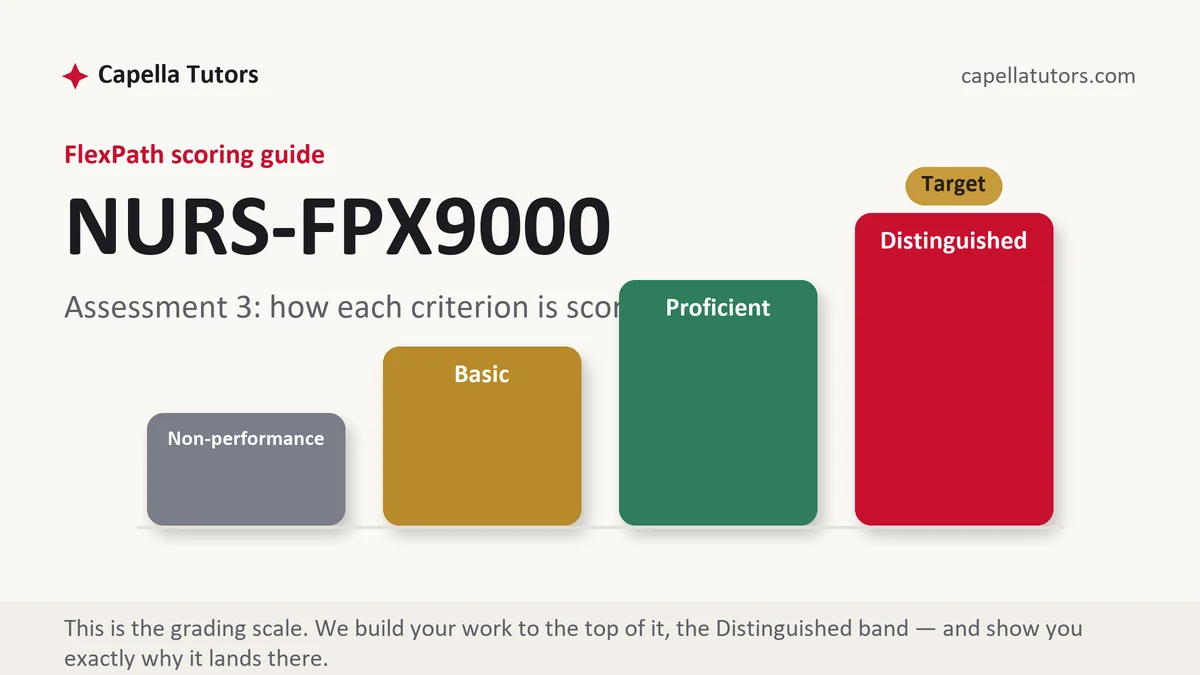
How NURS FPX 9000 Assessment 3 is scored
Four descriptors, one per criterion, and no averaging between them. The descriptor language tells you what the finished section has to do:
| Level | What it means on an assembled project foundation |
|---|---|
| Distinguished | Problem, setting, baseline and practicum plan read as one project, worded consistently throughout, with the constraints that could derail it stated in advance and a milestone schedule someone else could hold you to. The top descriptor wants the plan to survive a reader who was not there. |
| Proficient | Every required component is present and internally sound. The document is a set of good sections rather than a single argument. |
| Basic | Earlier submissions pasted together, with the problem worded three different ways and the practicum plan described in weeks rather than in milestones. |
| Non-performance | A component the criterion required is missing, commonly the site agreement or the practicum plan. Absence, not weakness, is what lands here. |
Consistency is the criterion nobody expects to be graded on. The population you defined, the measure you counted and the window you counted it in have to appear in identical words in every section, because a reader who meets three versions of your denominator cannot tell which one the project will actually use. Run a search on your own numbers before you submit and reconcile every appearance.
The NURS FPX 9000 Assessment 3 method, step by step
-
Rebuild the document from the guide rather than from your old files
Open a blank document, lay the criteria in as headings with their top descriptors underneath, then move earlier text into place paragraph by paragraph. Pasting whole submissions and editing afterward is how the seams survive, and evaluators read the seams first.
-
Reconcile every number that appears more than once
List each figure in the document with the page it sits on and the source it came from. Denominators drift when a section was written a month apart from its neighbor, and a baseline quoted as 39 percent in one place and 39.2 in another tells a reader the arithmetic was never rechecked.
-
Convert the practicum into milestones with dates
Hours logged against shifts are a timesheet; hours logged against milestones are a plan. Write what will be finished, in which week, with the preceptor signing in the week it closes. Milestones also give the next course something to inherit rather than a promise to interpret.
-
Put the site agreement on the page as a document, not as goodwill
Who signed, in what role, on what date, and what exactly they agreed to allow. A verbal yes from a manager is not an agreement a doctoral reader can rely on, and the difference becomes expensive at the point where a review body asks for evidence of site permission.
-
Declare the constraints you already know about
The report that runs weekly instead of daily, the analyst available one afternoon, the definition that cannot separate a refusal from an omission. Constraints written down now read as judgment; the same constraints surfacing in the implementation course read as a project that was never scoped.
-
Read the whole document once as a stranger, then self-score
Read it end to end without stopping to edit, asking only whether a reader outside your program could restate the project in three sentences. Then score each criterion D, P, B or N and rewrite anything below the top. Submit with days in hand, since two business days of evaluation is normal at this level.
A structure that maps to the criteria
Lengths below are our planning defaults for an assembled foundation document, not Capella requirements; your scoring guide decides the real proportions.
| Section | What it must do | Guide |
|---|---|---|
| Overview of the project | Problem, site and intent in three sentences a reader outside the program could repeat back accurately. | ~150 words |
| Problem, setting and baseline | The measured deficit, the operational description of the setting, and the baseline with its method and blind spots. | ~450 words |
| Evidence and significance in brief | The standard of care, the recognition of the deficit in the literature, and the local cost, compressed without losing the arithmetic. | ~300 words |
| Site agreement and governance | Who agreed, when, in what role, what they permitted, and which review pathway the project will enter. | ~200 words |
| Practicum plan and milestones | Activities tied to deliverables with dates, the preceptor's role, and the sign-off cadence. | ~300 words |
| Constraints and references | Known limits on data, access and volume, with current APA matched in both directions. | ~200 words |
Annotated sample excerpt
A model paragraph written by our doctoral team to show the altitude the top descriptor asks for. Borrow the structure, not the content.
The project will run at a single federally qualified health center whose diabetes registry shows a documented monofilament foot examination in 486 of 1,240 adult charts, 39.2 percent, across the twelve months ending in February, the same registry the center reports to its board each quarter.1 Practicum activity is logged against milestones rather than clinic sessions: denominator validation in weeks one to three, structured interviews with the two lead providers and the informatics analyst in weeks four and five, and the site's written authorization signed by the associate medical director, who serves as preceptor, before any measurement begins.2 Two constraints are recorded now rather than discovered later. The registry cannot distinguish an examination a patient declined from one never offered, and the analyst supports reporting requests one day a week, which fixes the practical cadence of any weekly measure at Thursday.3
- 1One sentence establishes site, population, measure, magnitude, window and data source, in the same words the rest of the document uses. Consistency is what makes an assembled paper read as one project.
- 2Practicum written as deliverables with weeks attached, and the preceptor identified by the authority the role actually carries rather than by name alone.
- 3Volunteers two limits that will shape the design, one about what the measure cannot see and one about operational cadence. Declared constraints score; discovered ones cost a session.
The full premium sample for your exact assessment, written fresh to your scoring guide and issue, is free to request. Study it, revise it into your own voice, and submit work you understand.
The five mistakes that cost Distinguished
- Three wordings of one problem. When the population shifts slightly between sections, the reader cannot tell which version the project will be measured against.
- A practicum plan made of weeks. Week four with no deliverable attached is a calendar entry, and calendars are not evidence of doctoral work.
- Site permission described as enthusiasm. Somebody's support is not somebody's signature, and only one of the two survives a review pathway.
- Constraints left out because they are inconvenient. Every limit you omit becomes a surprise in the implementation course, where surprises cost weeks.
- Numbers that disagree with each other. Two versions of the same denominator in one document undermines every figure in it, including the correct ones.
Pre-submission checklist
- Every criterion has its own labeled section, built from the guide rather than from old files
- All recurring figures reconciled, with one source named for each
- Problem, population and window worded identically wherever they appear
- Practicum activity tied to milestones with dates and a sign-off cadence
- Site authorization described as a document with a signer, a role and a date
- Known constraints on data, access and volume declared in the paper
Assembling the foundation document?
Send the guide and everything you have written so far, in whatever state it is in. We rebuild it against the criteria, reconcile the numbers, convert the practicum into dated milestones, and hand back a document the next capstone course can build on. Free revisions until every criterion clears.