This manual is for NURS FPX 9000 Assessment 2, start to submission. Assessment 2 usually takes the deficit you named and builds the case around it: published evidence that the problem is recognized beyond your building, significance expressed in what it costs this organization in a year, and a feasibility argument naming who can authorize the work, who will execute it and who will pull the numbers. It is an argument submission rather than a measurement one, and the criteria reward arithmetic and anticipation over concern. Below is our doctoral method for it, a structure keyed to the criteria, and an annotated sample excerpt. If you would rather delegate it, a premium original sample for this exact assessment lands within 24 to 48 hours and is revised free until the guide is met. Capella's catalog lists the course as NURS-FPX9000, and some courserooms print NURS9000; both point to this same Assessment 2. In current courserooms this assessment typically appears as "VCI Summary".
One honesty note before the manual: Capella revises courses and scoring guides over time, so always write to the exact scoring guide attached to your assessment in the courseroom. The course identity above is verified on capella.edu; the method and structure below are our tutors' approach to it, not Capella's official rubric text.
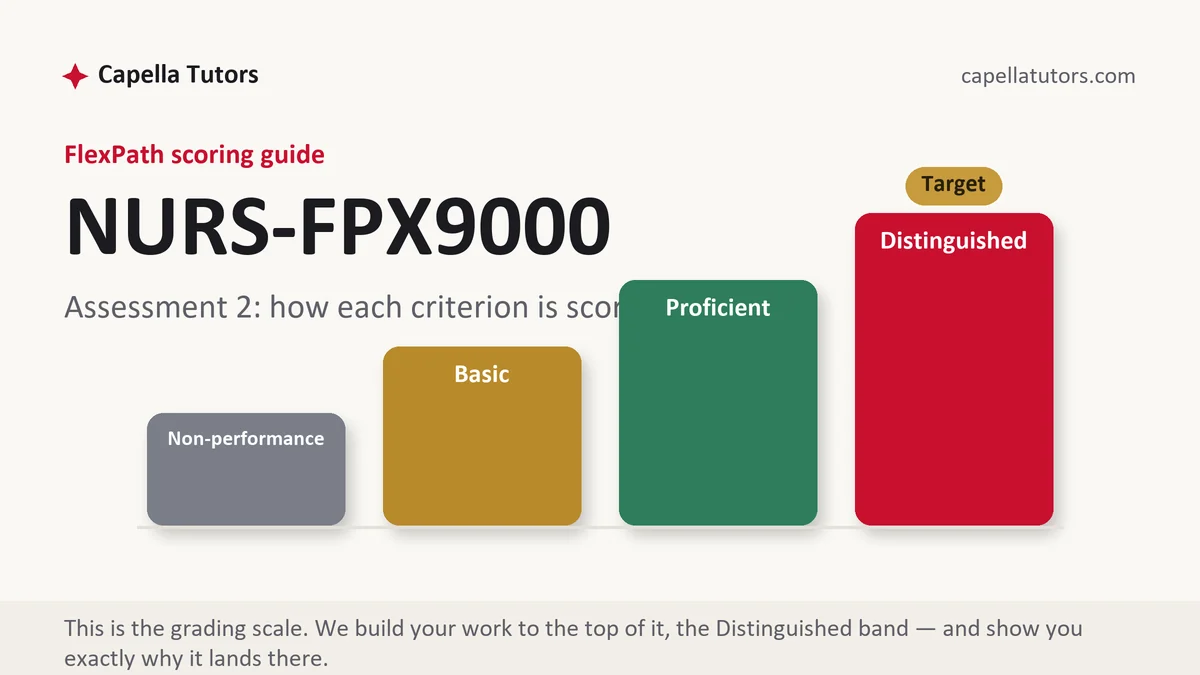
How NURS FPX 9000 Assessment 2 is scored
Nothing in FlexPath resolves to a percentage. Each criterion is judged on its own against four descriptors, and those descriptors are the specification you are writing against:
| Level | What it means on a background and significance case |
|---|---|
| Distinguished | The deficit is shown to be recognized in guideline and research literature, priced at this site with the multiplication visible, and the stakeholder map anticipates the objection each named role will raise. The top descriptor always asks for one move past sufficiency. |
| Proficient | Background and significance are established and the stakeholders are identified. Nothing is missing, and nothing is anticipated either. |
| Basic | Prevalence statistics assembled into a case for concern, with the cost to this organization left as an adjective rather than a figure. |
| Non-performance | Something the criterion demanded is not on the page, most often the feasibility or authorization discussion, easy to defer and expensive to omit. |
Three claims collapse into one another in weak drafts, and separating them is most of the work. That the problem exists is a measurement claim, settled by your baseline. That it is recognized is an evidence claim, settled by guidelines and published research. That it matters here is an economic claim, settled by arithmetic on your own volumes. A submission that argues the second and calls it the third scores in the middle every time.
The NURS FPX 9000 Assessment 2 method, step by step
-
Lay the criteria out and label each one by claim type
Write each criterion as a heading with its top descriptor underneath, then mark it evidence, economics or feasibility. Sections that carry two claim types at once are where drafts blur, and a heading that cannot be labeled usually means the criterion is asking for something you have not identified yet.
-
Read the guideline before you read the studies
A specialty guideline or a national surveillance specification tells you what the standard of care is, and your measured gap is a gap from that standard. Research tells you whether the gap responds to intervention. Reading them in that order stops you from assembling a pile of studies that never quite say what the expected practice was.
-
Price the deficit in a currency your site already uses
Bed days, avoidable encounters, staff hours or variable cost per case, whichever your finance or quality office reports. Multiply your own volume by a sourced per-event estimate, name the source and its year, say whether you adjusted for inflation, and show the working. An unshown calculation is treated as an assertion.
-
Name the people, then name what each of them loses
Authorizer, executor, data owner, and the person whose workflow lengthens by ninety seconds. The last one is the one who decides whether your project survives contact with a Tuesday. Write the objection each will raise and your answer to it, in the paper, before anybody raises it.
-
Test feasibility against the calendar and the data pull
Ask three questions and answer them in writing: can this site produce the outcome measure at the interval you need, does the unit carry enough volume for a change to become visible inside your program's window, and does your preceptor sit high enough to authorize what you intend. A no to any of them is cheaper to find now than in the implementation course.
-
Score yourself against the verbs, not the topics
Analyze, justify and evaluate are three different demands, and a paragraph that describes where the criterion says justify will sit at Basic no matter how well written it is. Read each section against its verb, mark the level honestly, and rewrite anything below the top before you submit.
A structure that maps to the criteria
Word targets below are our planning defaults for an argument-weighted doctoral submission, not requirements; your guide decides where the weight sits.
| Section | What it must do | Guide |
|---|---|---|
| Restatement of the problem | The measured deficit in one sentence, worded identically to the version the rest of the project will carry. | ~150 words |
| Background in the literature | Guideline expectation first, then research showing the deficit is recognized and answerable, sorted by design strength. | ~400 words |
| Significance at this organization | Local volume multiplied by a sourced per-event estimate, with the arithmetic shown and the limits of the estimate stated. | ~350 words |
| Stakeholder analysis | Each role named with its authority, its interest, its likely objection and your answer to that objection. | ~300 words |
| Feasibility and constraints | Data availability, measurement cadence, volume, authorization, and what would stop the project. | ~250 words |
| References | Guidelines, surveillance specifications and peer-reviewed studies in current APA, matched in both directions. | as needed |
Annotated sample excerpt
One original model paragraph from our team, pitched at doctoral register. Study how it moves rather than what it says, then run the same moves on your own site.
On the 26-bed medical unit of the host community hospital, 218 of 604 antibiotic courses begun in the year to March continued past 72 hours without a documented review against culture results, 36.1 percent, counted from the pharmacy dispensing record rather than from chart review.1 Prospective audit with feedback is named as a core element of hospital antimicrobial stewardship in the current national guidance, so the deficit measured here is a recognized failure of an established expectation rather than a local peculiarity.2 Priced on this unit's own figures, 218 unreviewed courses at the hospital's reported excess of 2.1 inpatient days per avoidable exposure is about 458 bed days a year, and at the finance office's 1,140 dollars variable cost per medical bed day that is roughly 522,000 dollars, before any allowance for resistance or for the Clostridioides difficile events the infection prevention team already tracks separately.3
- 1Carries the measurement forward in the exact words the rest of the project uses, and names the data source, so the argument that follows is anchored rather than free-floating.
- 2Establishes the standard of care first and the gap second. A background section built from prevalence studies alone never shows what practice was supposed to look like.
- 3Shows the multiplication with local volumes and a named unit cost, then states what the estimate excludes. Volunteering the exclusion is the move the top descriptor pays for.
The full premium sample for your exact assessment, written fresh to your scoring guide and issue, is free to request. Study it, revise it into your own voice, and submit work you understand.
The five mistakes that cost Distinguished
- Concern presented as significance. Serious, growing and alarming are adjectives; 458 bed days a year is an argument a chief nursing officer can act on.
- Background assembled from prevalence alone. Without the guideline expectation there is no standard for your measured gap to be a gap from.
- Stakeholders listed as job titles. A list is not an analysis until each role carries an interest, an objection and your answer to it.
- Feasibility asserted rather than tested. Whether the outcome measure can be pulled weekly is a question with a yes or no answer, and someone at the site knows it.
- Cost estimates lifted without their year. A per-event figure from a decade ago, used unadjusted and unnamed, invites the one question you cannot answer at defense.
Pre-submission checklist
- The problem sentence appears word for word as it did in the earlier work
- A guideline or surveillance specification establishes the expected practice
- Research sorted by design strength, with the strongest evidence carrying the claim
- Local arithmetic shown line by line, every estimate sourced and dated
- Each stakeholder carries an interest, an objection and an answer
- Feasibility answered as yes or no on data, volume, cadence and authorization
Building the case and short on numbers?
Send the criteria, your baseline and whatever your quality or finance office publishes. We will price the deficit on your own volumes, show the working, and map the stakeholders with their objections answered. Eight people on the pipeline, 24 to 48 hours, revisions free until the guide is satisfied.