Post us the prompt with its criteria and an original premium sample lands within 24 to 48 hours, drafted at executive register against the Distinguished descriptors, its workforce and capital arithmetic reconciled before it reaches you. The registrar records this one as NURS FPX 8020, Doctoral Executive Leadership in Contemporary Nursing, carrying 2 program points, part of the doctoral core in the FlexPath Doctor of Nursing Practice at Capella, a degree the catalog puts at least 26 program points alongside a minimum of 1,000 supervised practicum hours. In Capella's catalog the course code is written NURS-FPX8020.
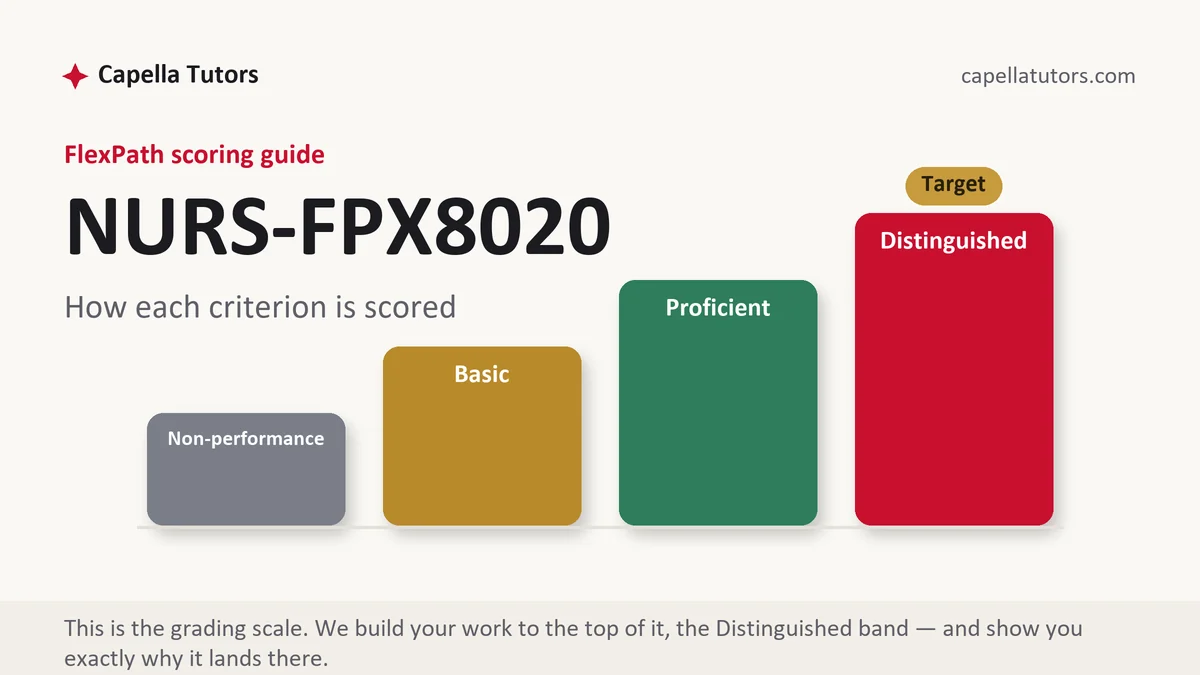
What NURS FPX 8020 actually grades
Nurses arrive in this course having already written about leadership at the master's level, and the register they bring is the first thing the criteria punish. Unit leadership solves problems inside a budget somebody else set. Executive leadership sets the budget, defends it to people who control capital, and answers for a workforce measured in thousands rather than in shifts. The deliverables ask for enterprise artifacts and grade whether you produced one: in current versions, an appraisal of an organization's strategic plan, a nursing strategic plan, and a quality improvement proposal, followed by further assessments the courseroom sets. Write any of those as a summary of the literature and you have described executive practice instead of performing it.
The distinction that costs the most criteria is governance against management. A board approves strategy, sets risk appetite, appoints and monitors, and receives assurance. Management executes and reports. Proposals that ask a board to standardize a handoff tool, or ask the chief nurse to approve a policy the board owns, tell an evaluator the writer has never watched either body work. Get the routing right and the argument gains credibility: name the committee, what it decides, what it merely receives, and which of those you are asking for.
Then the numbers, because contemporary nursing leadership is a labor economics job. Vacancy and turnover, agency and travel spend, overtime premium, span of control, and the ratio of worked hours to volume are the levers an executive actually pulls, and they interact. Cutting agency spend without a pipeline moves the cost into overtime. Widening span of control without a dyad partner moves it into turnover. The criteria reward writing that carries those trade-offs on the page rather than proposing a single intervention as though it had no second-order effect, and reward a candidate who reads an operating statement and a quality dashboard as one document.
How we help in this course
Drafts for 8020 get written as executive documents rather than as essays about executives. The desk starts from the decision being requested, builds the workforce or capital model underneath it, then writes the narrative down from the ask, which is the reverse of how most coursework gets produced. Give us your organization type, approximate headcount, your current vacancy and turnover figures if you have them, and the committee structure you are writing into, and the argument sits inside your real governance rather than a generic hospital's.
Delivery follows the studio standard: an original premium sample within 24 to 48 hours, targeted on the Distinguished descriptors, through an eight-person pipeline whose last two stations are independent quality reviews, one testing every criterion against the draft and one testing arithmetic, APA and originality. Rewrites are free until your evaluator signs it off, and returned faculty comments re-enter that cycle at no cost, which matters in an executive course where a single unreconciled figure invites the reader to distrust the whole model.
The assessments, one by one
Assessment 1: Strategic Plan Appraisal
An appraisal of an organization's current strategic plan and position. Read the full Assessment 1 manual.
Assessment 2: Strategic Plan Development
A nursing strategic plan with measurable objectives, owners, resources and evaluation. Read the full Assessment 2 manual.
Assessment 3: Quality Improvement Proposal
A costed quality improvement project built on a QI model, with defined measures. Read the full Assessment 3 manual.
How to actually write NURS FPX 8020: where to begin
Read the scoring guide as the specification for an artifact, not as a topic list. Copy each criterion into a blank document, paste the Distinguished wording under it, and decide what object you are producing before you write a sentence, since a brief, a strategic plan and a business case have different shapes. The clusters in a doctoral executive course tend to be: analyze the internal and external position with evidence, propose a strategy or structure at enterprise scale, model the resources and the workforce consequences, address governance and policy, and evaluate with measures a board would accept. In current courserooms the assessments include "Strategic Plan Appraisal", "Strategic Plan Development" and "Quality Improvement Proposal" among others, and your scoring guide decides the exact format of each.
Then build the workforce case with numbers you can defend. Take a nursing division of 1,400 registered nurses running 18 percent annual voluntary turnover, which is 252 separations. Price replacement conservatively and show the components, so orientation salary for the new hire and the preceptor, coverage during the vacancy, recruitment, and the productivity ramp, and suppose that reaches $56,000. Annual exposure is about $14.1 million. A retention package of $900,000 covering a residency cohort, clinical ladder differentials and stay interviews has to remove roughly sixteen separations to break even, and removing twenty-eight avoids near $1.57 million. Print the sensitivity: at $40,000 replacement cost those same twenty-eight avoid $1.12 million, so the case narrows and survives. That is the shape of an argument an executive committee funds.
Finish on governance and policy, since the criteria here almost always reach past the organization. Say which external constraint frames your proposal, whether a state scope of practice statute, staffing legislation, accreditation requirements, or a payment program that ties reimbursement to measured performance. Then state the internal route: which committee recommends, which approves, the reporting cadence, and what triggers escalation. Close with the risk you are asking the organization to accept and the one you are asking it to retire, because a board reads every proposal as a transfer of risk, and naming that transfer yourself reads as Distinguished.
| Section | What goes in it | What Distinguished looks like |
|---|---|---|
| The ask | The decision requested, its cost, its timing, and the consequence of declining it. | A first paragraph a director could act on without reading further. |
| Position analysis | Internal performance and external pressure: workforce, market, payment, regulation. | Internal data and external evidence brought into one argument rather than two sections. |
| Strategy or structure | The proposal at enterprise scale, with the operating model or governance change it implies. | Second-order effects named, including what moves when this moves. |
| Workforce and resource model | Headcount, turnover, premium pay, and the capital or operating dollars required. | Components disclosed, arithmetic reconciled, and a sensitivity test on the weakest assumption. |
| Governance and policy | The approving body, the reporting line, and the external statute or standard that binds it. | Approval routed correctly, with governance and management responsibilities kept apart. |
| Measures and references | The indicators, their cadence, the owner, current APA in text and list. | Measures a board committee already reviews, on a cycle that already exists. |
Developing the synthesis
The executive nursing evidence base is broad and uneven, and saying so is part of the grade. Work associating leadership style with nurse outcomes, transformational leadership in particular, is voluminous, largely cross-sectional and reliant on self-report instruments, so it establishes association and rarely direction. Magnet recognition studies report better outcomes in recognized hospitals while struggling with an obvious selection problem, since organizations that pursue recognition differ before they earn it. Turnover cost estimates vary by an order of magnitude because the components counted differ, which makes the estimate you adopt a decision to defend rather than a fact to cite. Resolve one of those openly: state that the leadership-style evidence cannot show causation, then argue from mechanism and from your own local data. Report design and sample before findings, separate statistical significance from operational materiality, and attribute competency frameworks to their publishers rather than to the textbook that summarized them. End by naming what your case cannot prove and why the recommendation holds regardless.
Citations that survive faculty review
Four families of source carry an executive argument. Peer-reviewed health services research, nursing administration journals and management literature published within about five years, sourced through the Capella library, CINAHL and Business Source, support claims about structure, workforce and outcomes. Competency and standards documents define the role, principally the AONL nurse executive competencies, the American Nurses Association administration standards, and Magnet or Pathway requirements where your argument leans on them. Regulatory and payment material sets the constraint, including your state board's scope of practice rules, accreditation standards, and current federal payment rules whose percentages change annually, so cite the rule year. Organizational documents you name, such as a published quality report or a committee charter, carry the local claims. Any figure lacking a citation, a named report or a declared assumption reads as invented, and one is enough to make a reader audit the rest.
The mistakes that land Basic instead of Distinguished
- Unit-level thinking in an enterprise document. A proposal scoped to one ward answers a question nobody at this level asked.
- Asking the wrong body to decide. Routing an operational change to the board, or a governance matter to a director, reads as inexperience.
- An imported turnover cost with no components. A headline replacement figure without its parts cannot be defended in a budget meeting.
- A single intervention with no second-order effect. Every workforce lever pushes cost somewhere else, and pretending otherwise invites the obvious question.
- Leadership style as the whole argument. Naming a style is not a strategy, and the evidence behind it is weaker than most drafts admit.
NURS FPX 8020 questions students actually ask
What actually separates an executive brief from a manager's report?
The decision sits at the top instead of at the end. A manager's report walks the reader through background, then analysis, then arrives somewhere; an executive brief opens with what is being asked for, what it costs, what happens if the answer is no, and which risk the reader accepts either way. Everything after that first block exists to let a skeptical director test the ask, not to prove you did the reading. Two habits carry most of the effect: put a number in the first two sentences, and name the alternatives you rejected with the reason. Boards approve or decline, they do not synthesize, so a document that makes them synthesize gets deferred, and a deferral in a governance cycle is often a quarter gone.
How do I cost a retention program a finance officer will believe?
Build it from your own separations and publish the replacement-cost assumption instead of importing a headline figure. Count separations rather than positions, split voluntary from involuntary, and state the components you priced: orientation salary for the new hire and the preceptor, coverage during the vacancy, recruitment spend, and the productivity ramp. Then run the arithmetic in both directions. A program costing $900,000 that removes twenty-eight separations at $56,000 each avoids about $1.57 million, close to a 1.7 to 1 return, and the honest next sentence says what happens at $40,000 or at fourteen separations. A finance officer trusts a smaller number with visible components far more than a large number with a citation.
Can I write this course without an executive title?
Yes, and most students here are writing about a level they have not yet held. The criteria grade whether you reason at that altitude, not whether you occupy the chair. Get concrete about your own organization instead: find who chairs the board quality committee, read the last published quality or community benefit report, learn which service lines are growing and which are watched, and ask a director how capital requests are ranked. Those four facts are usually obtainable and they let you write about a real governance structure rather than a generic one. Where you cannot get a figure, say so and construct a defensible substitute with the assumption labeled, which reads as executive judgment rather than as a gap.
Executive deliverable due?
Send the prompt, the criteria, and whatever workforce figures you can share. We build the model first, the narrative second. First premium sample, no charge.