This manual is for NURS FPX 8020 Assessment 3, start to submission. The Quality Improvement Proposal asks you to take one quality problem in your organization, often one that the strategic plan from Assessment 2 targets, and propose an improvement project for leadership to approve: the problem and its data, the evidence for the intervention, the quality improvement model you will use, the team and stakeholders, the measures, the timeline and the cost. The grade turns on whether a quality committee could approve and run it. Measures must be defined, the model must actually structure the work, and the budget must be visible. Below is the method our tutors use, a structure that maps to the criteria, and an annotated sample excerpt. Prefer to hand it off? A premium original sample for this exact assessment comes back in 24 to 48 hours, revised free until it meets the guide. Capella's catalog lists the course as NURS-FPX8020, and some courserooms print NURS8020; both point to this same Assessment 3. In current courserooms this assessment typically appears as "Quality Improvement Proposal".
One honesty note before the manual: Capella revises courses and scoring guides over time, so always write to the exact scoring guide attached to your assessment in the courseroom. The course identity above is verified on capella.edu; the method and structure below are our tutors' approach to it, not Capella's official rubric text.
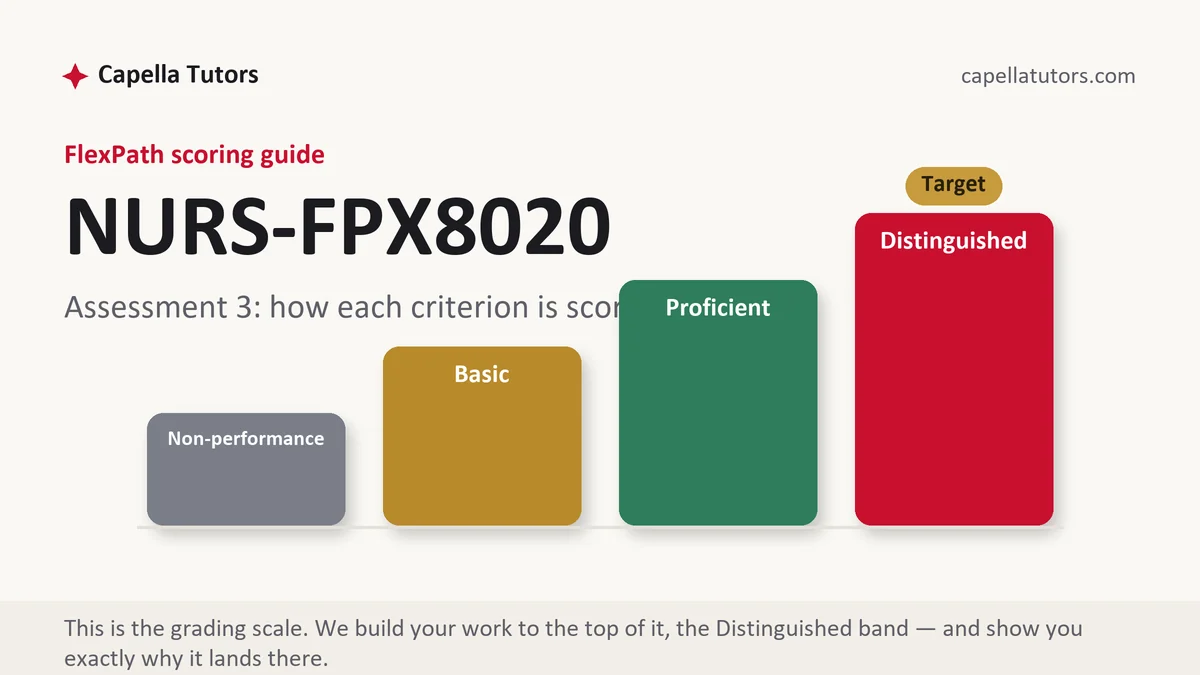
How NURS FPX 8020 Assessment 3 is scored
FlexPath does not use letter grades. Each criterion in the scoring guide lands on one of four levels, and the level descriptions are the real writing brief:
| Level | What it means on a quality improvement proposal |
|---|---|
| Distinguished | The problem is sized with organizational data, the intervention is evidence-based, a named QI model structures the project, team roles are clear, outcome, process and balancing measures are defined, and the timeline and budget are realistic. |
| Proficient | The proposal is sound, but measures are partly defined and the budget or timeline is thin. |
| Basic | The proposal describes a problem and a solution with little structure or measurement. |
| Non-performance | The QI model, the measures or the budget is missing. |
Choose a problem with data you can cite, such as medication reconciliation errors, readmissions or falls. A measurable baseline makes every later section stronger.
The NURS FPX 8020 Assessment 3 method, step by step
-
Define the problem with data
The current rate, the benchmark, the gap and what it costs in harm and money.
-
Choose an evidence-based intervention
Cite studies showing the intervention improved the measure in comparable settings.
-
Apply a QI model
PDSA, Lean or Six Sigma DMAIC, with each phase described for this project.
-
Name the team and stakeholders
Executive sponsor, project lead, frontline staff, pharmacy or IT as needed, each with a role.
-
Define the measures
An outcome measure, a process measure and a balancing measure, each with its data source and frequency.
-
Set the timeline and budget
Phases with dates, staff time and costs, and the expected return or savings.
A structure that maps to the criteria
Word counts are planning targets our tutors use for this proposal, not Capella rules; follow the length your scoring guide states.
| Section | What it must do | Guide |
|---|---|---|
| Introduction and problem | The quality problem with organizational data. | ~250 words |
| Evidence for the intervention | Studies supporting the chosen change. | ~250 words |
| QI model and plan | The model and its phases for this project. | ~250 words |
| Team and stakeholders | Roles and engagement. | ~150 words |
| Measures and evaluation | Outcome, process and balancing measures. | ~200 words |
| Timeline, budget and references | Phases, costs, expected return, then current APA. | ~200 words |
Annotated sample excerpt
An original model excerpt from our team, written to show the register that reaches the top of the guide. Learn the moves, then write your own version.
The outcome measure is the percentage of discharges with at least one unresolved medication discrepancy found at the pharmacist's 48-hour follow-up call, currently 34 percent on the two pilot units.1 The process measure is the share of admissions with a pharmacist-completed medication history within 24 hours, tracked weekly from the electronic record, because the intervention cannot work if the history is not taken.2 The balancing measure is time from discharge order to departure, since added reconciliation steps could delay discharge, and a rise of more than thirty minutes on average would prompt the team to adjust the workflow in the next PDSA cycle.3
- 1Defines the outcome measure precisely with a baseline.
- 2Adds a process measure that shows whether the intervention is being delivered.
- 3Includes a balancing measure with a threshold, which shows mature QI thinking.
The full premium sample for your exact assessment, written fresh to your scoring guide and topic, is free to request. Study it, revise it into your own voice, and submit work you understand.
The five mistakes that cost Distinguished
- No baseline data. Size the problem with your organization's numbers.
- A model named but not used. Show each phase of PDSA or DMAIC for this project.
- Only an outcome measure. Add process and balancing measures.
- No budget. Leaders approve costed proposals.
- A problem unrelated to the plan. Link to the strategic plan where the guide asks.
Pre-submission checklist
- Problem sized with organizational data
- Evidence-based intervention
- Named QI model applied phase by phase
- Team roles and stakeholders
- Outcome, process and balancing measures defined
- Timeline, budget and current APA references
Want the QI proposal written for your organization?
Send the scoring guide and your quality problem. Our team returns a premium original proposal in 24 to 48 hours, revised free until it meets the guide.