This manual is for NURS FPX 8020 Assessment 2, start to submission. Strategic Plan Development builds on the appraisal you wrote in Assessment 1 and asks you to develop a nursing strategic plan for the same organization: how the plan supports the organization's mission and vision, the environmental analysis behind it, the goals and measurable objectives, the stakeholders and how they will be engaged, the implementation steps and resources, and how progress will be evaluated. The grade turns on executive credibility. A plan with goals that cannot be measured, or with no owner and no money attached, reads as an aspiration rather than a strategy. Below is the method our tutors use, a structure that maps to the criteria, and an annotated sample excerpt. Prefer to hand it off? A premium original sample for this exact assessment comes back in 24 to 48 hours, revised free until it meets the guide. Capella's catalog lists the course as NURS-FPX8020, and some courserooms print NURS8020; both point to this same Assessment 2. In current courserooms this assessment typically appears as "Strategic Plan Development".
One honesty note before the manual: Capella revises courses and scoring guides over time, so always write to the exact scoring guide attached to your assessment in the courseroom. The course identity above is verified on capella.edu; the method and structure below are our tutors' approach to it, not Capella's official rubric text.
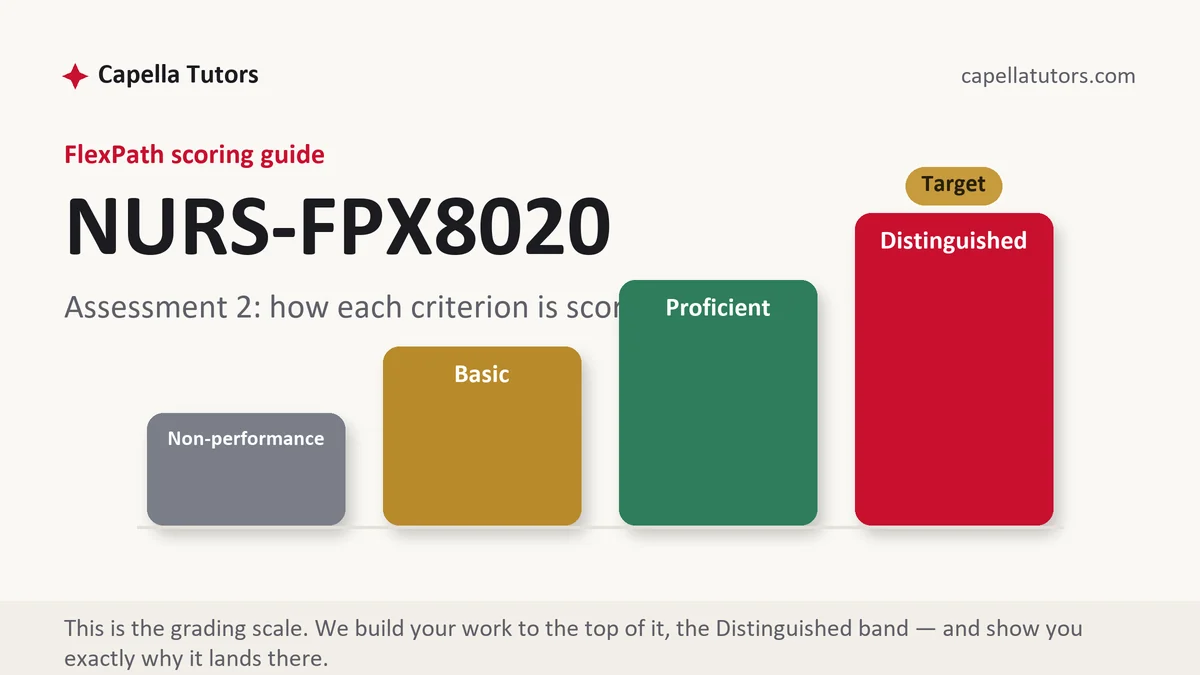
How NURS FPX 8020 Assessment 2 is scored
FlexPath does not use letter grades. Each criterion in the scoring guide lands on one of four levels, and the level descriptions are the real writing brief:
| Level | What it means on a nursing strategic plan |
|---|---|
| Distinguished | The plan follows from the Assessment 1 appraisal, aligns with the mission, rests on an evidence-based environmental analysis, sets SMART objectives with owners and resources, engages named stakeholders, and evaluates with defined measures and review dates. |
| Proficient | The plan is complete and logical, but objectives lack owners or resources and evaluation is general. |
| Basic | The plan restates good intentions with little analysis or measurement. |
| Non-performance | A required element, such as stakeholder engagement or evaluation, is missing. |
Keep the organization and the strategic gaps you found in Assessment 1. The plan should answer them, and the quality improvement proposal in Assessment 3 will build on one of its goals.
The NURS FPX 8020 Assessment 2 method, step by step
-
Start from the appraisal
Restate the two or three strategic gaps your Assessment 1 appraisal found, with the evidence for each.
-
Align with mission and vision
Show how each strategic direction serves the organization's stated mission, and where the current plan falls short.
-
Run the environmental analysis
A SWOT or similar framework built on data: workforce, quality metrics, finance, competition, regulation and population needs.
-
Write goals and SMART objectives
Two or three goals, each with objectives that carry a measure, a baseline, a target, a date and an owner.
-
Engage stakeholders and plan implementation
Who must support each goal, how you will involve them, the steps, the resources and the budget.
-
Set evaluation and governance
Measures, reporting cadence and who reviews progress, with the trigger for changing course.
A structure that maps to the criteria
Word counts are planning targets our tutors use for this plan, not Capella rules; follow the length your scoring guide states.
| Section | What it must do | Guide |
|---|---|---|
| Introduction | The organization, the appraisal findings and the plan's purpose. | ~150 words |
| Mission and vision alignment | How the plan advances the mission. | ~175 words |
| Environmental analysis | SWOT or similar, supported by data. | ~300 words |
| Goals and objectives | Goals with SMART objectives and owners. | ~300 words |
| Stakeholders and implementation | Engagement, steps, resources and budget. | ~275 words |
| Evaluation and references | Measures, cadence, governance, then current APA. | ~150 words |
Annotated sample excerpt
An original model excerpt from our team, written to show the register that reaches the top of the guide. Learn the moves, then write your own version.
Goal 1 is to reduce thirty-day readmissions for patients with heart failure, which the appraisal identified as the organization's most costly quality gap and which the current strategic plan does not mention.1 Objective 1.1: by June of next year, every patient with heart failure discharged from the two medical units receives a follow-up call within 72 hours, measured monthly from the discharge log, owned by the director of case management, with a baseline of 31 percent.2 Objective 1.2: reduce the thirty-day readmission rate for this group from 22 percent to 17 percent within eighteen months, reported quarterly to the quality committee, with the cost of two additional transition nurses included in next year's operating budget.3
- 1Ties the goal to the appraisal and to a gap in the existing plan.
- 2Writes an objective with a measure, baseline, target, date, data source and owner.
- 3Links the outcome objective to governance and budget, which is what makes the plan executable.
The full premium sample for your exact assessment, written fresh to your scoring guide and topic, is free to request. Study it, revise it into your own voice, and submit work you understand.
The five mistakes that cost Distinguished
- A plan unrelated to the appraisal. Answer the gaps Assessment 1 found.
- Goals without measures. Each objective needs a baseline, target and date.
- No owners or money. Executives approve plans with accountability and budgets.
- A SWOT without data. Support each entry with evidence.
- Evaluation as an afterthought. Name the measures and who reviews them.
Pre-submission checklist
- Same organization and gaps as Assessment 1
- Mission and vision alignment shown
- Environmental analysis supported by data
- SMART objectives with owners and resources
- Stakeholder engagement and implementation steps
- Evaluation measures, governance and current APA references
Want the strategic plan built from your appraisal?
Send the scoring guide and your Assessment 1 appraisal. Our team returns a premium original strategic plan in 24 to 48 hours, revised free until it meets the guide.