Upload the prompt with your scoring guide and the finished premium sample is back within 24 to 48 hours, built to the Distinguished descriptors, a second doctoral reader confirming that every claim about patients is tied to a number your organization already pulls. On the transcript the course reads NURS FPX 8008, Person-Centered Care in Doctoral Practice, worth 2 program points, a doctoral core course in Capella's FlexPath Doctor of Nursing Practice, which the catalog sets at 26 program points or more, with 1,000 supervised practicum hours as the floor. In Capella's catalog the course code is written NURS-FPX8008.
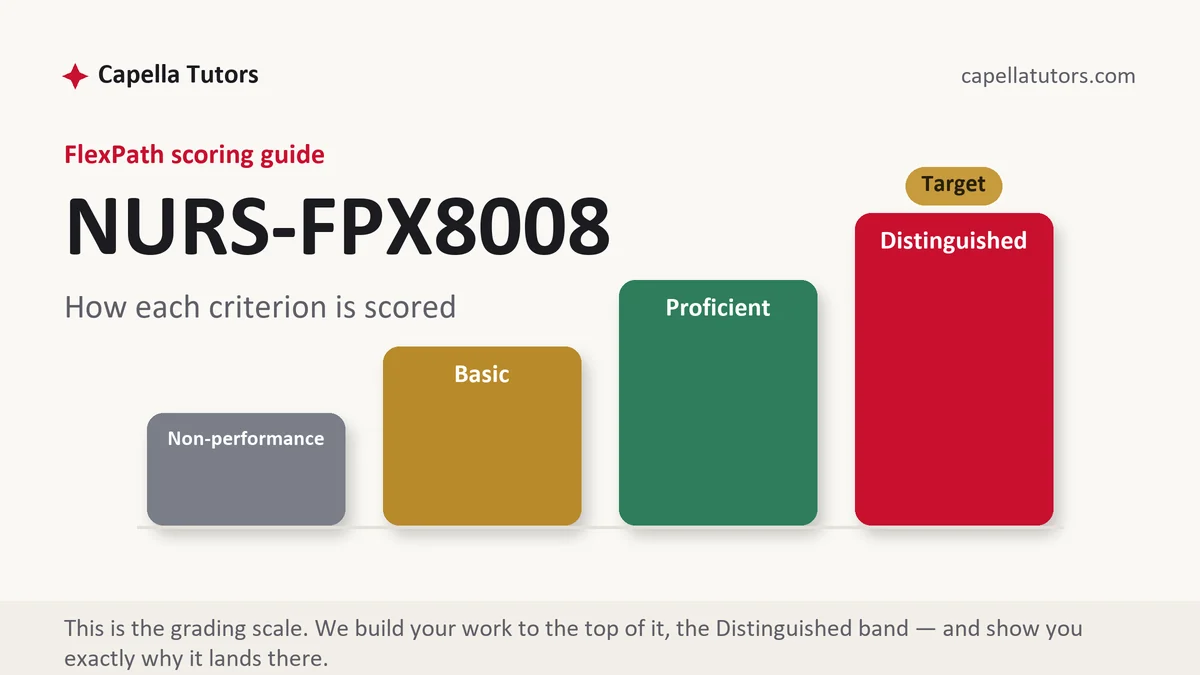
What NURS FPX 8008 actually grades
The trap here is that the subject sounds like something you have done for years. Person-centered care at doctoral level is not warmth, and it is not a paragraph about listening. It is a design problem: what must be built, funded, documented and monitored so a health system reliably acts on what a patient says matters, on a Tuesday night, when nobody on shift has met that patient before. The criteria want person-centeredness treated as a property of a delivery system rather than a virtue of an individual clinician, with the structure that produces it, the process that carries it, and the measure that would notice it stopping all named.
Most of the grade turns on measurement, because person-centeredness is the easiest quality in health care to assert and among the hardest to evidence. Donabedian's split between structure, process and outcome keeps that honest, and using it explicitly moves a criterion up a column. A patient and family advisory council is a structure. A standing requirement that a goals-of-care conversation be recorded within twenty-four hours of admission is a process. The share of eligible admissions carrying that record, against a stated denominator inside a stated window, is a rate you can trend. Whether the care that followed matched what was recorded is the outcome, and almost nobody collects it, which is why proposing to collect it reads as doctoral.
Two adjacent acronyms get conflated in submitted drafts. A patient-reported outcome measure asks the patient about their own health status, function or symptom burden; a patient-reported experience measure asks what happened during the encounter. Both come from the patient, they answer different questions, and a project aimed at experience cannot be evaluated with a function score. The last strand is access and equity argued from stratified data: results broken out by language and payer, interpreter use against interpreter need, and who is shut out when the intervention lives inside a portal. Cost and governance close it, because a doctoral proposal that cannot say what it costs and who signs it is a wish with citations.
How we help in this course
Our 8008 drafts are built backwards from the measure. Before any prose is written the desk fixes the population, the denominator, the observation window and the report the data will come out of, because a proposal resting on a measure nobody can pull loses the evaluation criterion however well the rest reads. Send your service line, the population size, whichever experience or outcome instrument you already field, and what a committee refused to fund before, and the argument gets built inside your constraints.
Terms match the rest of the studio: a premium original sample inside 24 to 48 hours, aimed at the Distinguished column, produced by an eight-person pipeline ending in two independent quality passes, one reading for criterion coverage and one for APA and originality, with rewrites at no charge until your evaluator agrees. Faculty comments re-enter the same cycle free. That matters here, since the comment returning most often on person-centered work is a request to name the measure, which rebuilds an argument rather than adds a sentence.
The assessments, one by one
Assessment 1
The opening deliverable in this course usually asks you to establish a population and a problem with data, then appraise the evidence behind whatever intervention you intend to propose. Read the full Assessment 1 manual.
Assessment 2
The middle deliverable in this course usually asks you to design the intervention as a workflow: who does what, at which point in the encounter, recorded where, escalated to whom, and costed well enough that an operations director could staff it. Read the full Assessment 2 manual.
Assessment 3
The closing deliverable in this course usually asks you to account for the parts that decide whether anything happens: how the work will be evaluated, what the results look like broken out by group, who is excluded by the design, which committee approves it, and what it costs. Read the full Assessment 3 manual.
How to actually write NURS FPX 8008: where to begin
Open the scoring guide before deciding what your project is about. Each criterion becomes a heading in a blank document, the Distinguished wording goes underneath it, and every later decision either attaches to a heading or gets dropped. The clusters in a doctoral person-centered course usually run like this: establish the population and the problem with data, appraise the evidence for an intervention rather than describing it, design that intervention as a workflow with named owners, specify the evaluation, then account for ethics, equity and the stakeholders who can stop it. The assessments in this course usually ask for some mix of those, and your scoring guide decides which, so read yours.
Put the baseline arithmetic in front of the prose, because it disciplines everything after. Say your service line admits 3,100 patients a year and a review of 120 randomly selected admissions finds a documented goals-of-care conversation in 41 of them. That is 34 percent, print the interval around it rather than hide it, and you hold a baseline instead of an impression. Set a target of 70 percent within twelve months and the consequence is arithmetical: about 1,116 more conversations a year, at eighteen minutes each roughly 335 hours, which is 0.16 of a full-time equivalent. Nobody funds sixteen percent of a position, so the real question is whose work this displaces, and asking it in the proposal rather than in the limitations separates a plan from an essay.
Close in both languages the organization speaks. One is payment and public reporting: experience results are surveyed, published and used in payment programs, and the measure set and the withheld percentage change with each annual rule, so cite the rule for the year you are writing in rather than a stale secondary summary. The other is operational: goal-concordant care changes what gets ordered, and a proposal that can price avoided low-value treatment gives a finance committee something to act on. Name the assumption most likely to be wrong, show the recommendation surviving a ten percent move against you, and say what you would stop doing to free the time you are requesting.
| Section | What goes in it | What Distinguished looks like |
|---|---|---|
| Population and problem | The population defined by criteria rather than by ward, its size, and the baseline measure with its source named. | A baseline pulled from a report that already exists, with its denominator, window and known gaps stated up front. |
| Evidence appraisal | The studies behind the chosen intervention, appraised for design and sample before findings are reported. | Convergence and conflict in the evidence both named, with the weakest link in the chain identified by you. |
| Intervention design | The workflow: who does what, at which point in the encounter, recorded where, escalated to whom. | A workflow written so an operations director could staff it, with the failure points already flagged. |
| Equity and access | Stratified results, language and literacy provision, and who the design excludes. | A disparity quantified rather than deplored, and a design element that specifically addresses it. |
| Evaluation plan | The process and outcome measures, the window, the analysis, and who reviews the result. | Measures chosen for pullability and specified in advance, with the detectable effect size acknowledged. |
| Governance and cost | The approving body, the human-subjects determination, the resource ask, current APA both ways. | An approval path with named committees and a cost the sponsor could defend in a budget cycle. |
Developing the synthesis
The literature behind person-centered care does not speak with one voice, and a doctoral reader is grading whether you noticed. Patient decision aids are its strongest part, with pooled work showing better knowledge and less decisional conflict and much weaker, inconsistent effects on which option people finally choose. Advisory councils and co-design are widely endorsed and thinly evaluated. Settle that tension in the open: say the case for a decision aid rests on knowledge and conflict rather than on utilization, then argue it on those grounds. Report design and sample before findings, keep statistical and practical significance in separate sentences, and attribute frameworks to their authors, so Donabedian's own paper rather than a slide that redrew it. End by saying what your evidence cannot show and why the recommendation stands anyway.
Citations that survive faculty review
Four source types do four jobs. Peer-reviewed health services and nursing research from roughly the last five years, through the Capella library, CINAHL and PubMed, carries every claim that an intervention changes experience or outcomes. Instrument documentation carries every claim about what a score means, and this is the one students skip: a survey's own quality assurance guidelines beat any study that merely used the survey. Current payment rules and the specifications behind published experience measures establish what the organization is held to. Standards bodies supply obligations, including the National Academies for the patient-centeredness aim, the National CLAS Standards for language access, and the American Nurses Association and AONL for the practice expectation. Give every number a visible origin, then run the two-way check between text and reference list in current APA.
The mistakes that land Basic instead of Distinguished
- A bedside vignette standing in for a system design. One encounter says nothing about the next four hundred patients.
- A measure with no denominator and no window. A percentage missing both cannot be trended or believed.
- Experience treated as outcome. Satisfaction up and function unchanged is a real result, and calling it clinical improvement overclaims.
- Equity asserted as a value. Without results broken out by group there is no disparity on the page, only a sentiment.
- No approval path. If the draft cannot name the deciding committee, the implementation criterion has nothing to grade.
NURS FPX 8008 questions students actually ask
Our experience scores barely moved. Can I still say the project worked?
You can say what the data supports, and at doctoral level that is the answer being graded. Survey-based experience scores on one service line are noisy: response rates are low, top-box scoring discards most of the distribution, and a two-point move on a few dozen returns is compatible with nothing having happened. Report the process measure you controlled, put the response count beside the experience score, and state plainly that the window was too short and the sample too small to detect an effect of the size you wanted. A doctoral evaluator reads that as measurement literacy. A confident claim built on eleven returns reads as the opposite, and it costs you the evaluation criterion.
Is shared decision making just informed consent with extra steps?
No, and the distinction is worth a paragraph in almost any deliverable here. Consent is a threshold: the patient is told the risks, benefits and alternatives and agrees, and the record partly exists to show the duty was discharged. Shared decision making is a method for reaching a choice when more than one option is defensible, so it begins by establishing that a genuine choice exists, elicits what the patient is trying to protect, then matches the options to that. Consent can be complete while the decision remains a poor fit for the person. Build your workflow around the preference-sensitive decisions in your population and name them, because decisions with one clinically correct answer do not need the machinery.
How do I keep this from reading like a bedside paper?
Change the unit of analysis in the first sentence and keep it changed. A bedside paper describes one encounter and generalizes; a doctoral deliverable describes a population, a workflow and a control. Useful test: delete every anecdote and see whether an argument survives. Name the population and its size, the process meant to produce person-centered care for all of them, the measure that would reveal that process failing, the committee owning the decision, and the cost. One patient story can appear once as labeled illustration, after the population data has already made the case. Leading with it tells the evaluator the work was written at the wrong altitude, and altitude is usually the gap between Proficient and Distinguished here.
Person-centered deliverable due?
Send the prompt, the criteria, and whichever experience or outcome instrument your organization fields. We build the measure plan and the argument on top of it. First premium sample free.