This manual is for NURS FPX 8008 Assessment 1, start to submission. The opening deliverable in this course usually asks you to establish a population and a problem with data, then appraise the evidence behind whatever intervention you intend to propose. The trap is familiar subject matter: person-centered care at doctoral level is a property of a delivery system rather than a virtue of a clinician, so warmth described well still scores in the Basic column. What follows is the working order our doctoral desk uses, a plan tied to the criteria, and an annotated sample excerpt. Would you rather delegate it? A premium original sample for this exact deliverable lands inside 24 to 48 hours, revised free until every criterion is met. Capella's catalog lists the course as NURS-FPX8008, and some courserooms print NURS8008; both point to this same Assessment 1.
One honesty note before the manual: Capella revises courses and scoring guides over time, so always write to the exact scoring guide attached to your assessment in the courseroom. The course identity above is verified on capella.edu; the method and structure below are our tutors' approach to it, not Capella's official rubric text.
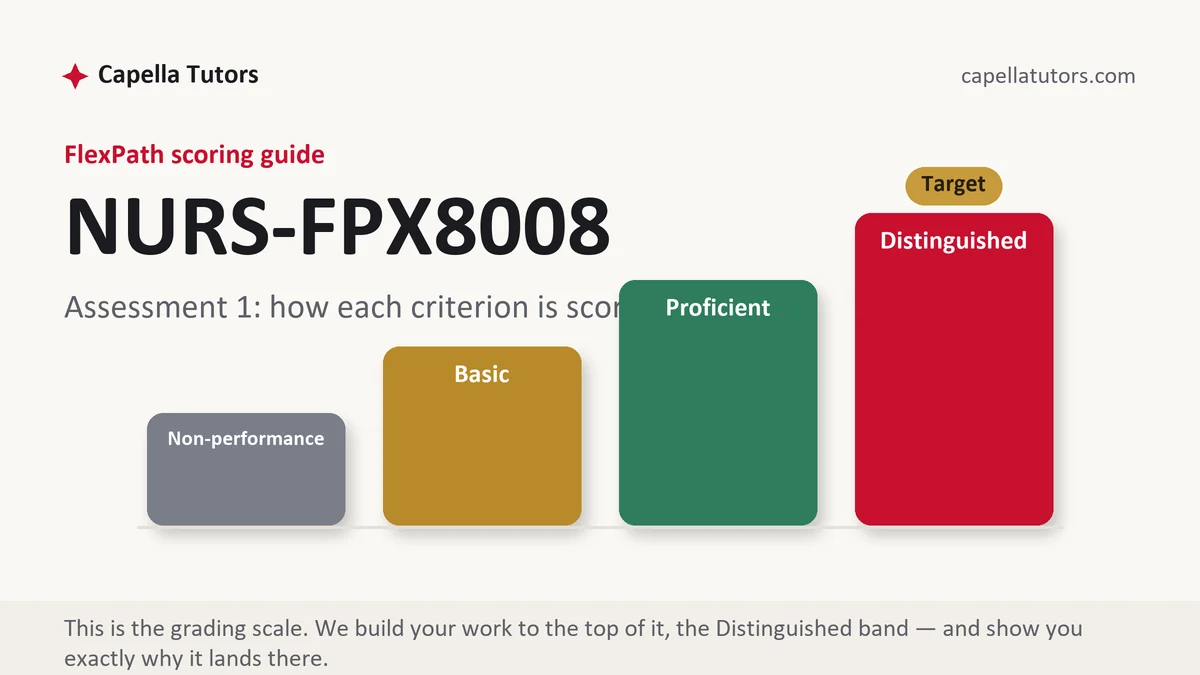
How NURS FPX 8008 Assessment 1 is scored
Every criterion receives its own level from a set of four, and the wording of each level is the instruction you are following:
| Level | What it means on a population and evidence deliverable |
|---|---|
| Distinguished | The population is defined by criteria rather than by ward, the baseline comes from a report that already exists, and the weakest link in the evidence chain is identified by the writer. That identification is where the criterion's extra reach usually sits. |
| Proficient | A clear population, a real problem, and evidence reported accurately. Solid, and written as though the literature agreed with itself. |
| Basic | A patient story generalized into a problem, with sources quoted for support rather than appraised. Readable, and pitched at the wrong altitude. |
| Non-performance | No baseline data anywhere, or no appraisal of the evidence at all, which leaves a whole criterion with nothing to read. |
Altitude is the reliable diagnostic here. Delete every anecdote from your draft and see whether an argument survives; if it does not, the deliverable is written from the bedside rather than from the system.
The NURS FPX 8008 Assessment 1 method, step by step
-
Define the population by criteria, not by location
Say who is included, who is excluded, and how many there are. A ward is a place, while a population is a rule you could hand to an analyst, and only the second one produces a denominator you can trend.
-
Pull a baseline from a report that already runs
Find the existing extract, name it, and take the number out of it with its denominator and window attached. A figure with a visible origin survives review; an impression stated confidently does not.
-
Sort structure from process from outcome
An advisory council is a structure, a requirement that a conversation be recorded within a set window is a process, and whether the care delivered afterward matched what was recorded is an outcome. Using that split explicitly moves criteria up a column.
-
Keep the two patient-reported families apart
An outcome measure asks the patient about health status, function or symptom burden; an experience measure asks what happened during the encounter. Both come from the patient and answer different questions, and a project aimed at experience cannot be evaluated with a function score.
-
Appraise the intervention evidence before describing it
Design and sample first, findings second, and the disagreement in the literature settled rather than reported. Decision aids improve knowledge and reduce decisional conflict far more consistently than they change which option people choose, and saying so is the appraisal.
-
Name the weakest link yourself
Every chain from evidence to your population has one joint that will not bear weight. Identify it, state what you would monitor because of it, then self-score each criterion and submit early in the week rather than late.
A structure that maps to the criteria
The counts below are our tutors' planning allocation for a doctoral deliverable of ordinary length, not a Capella rule; give more space to whichever criterion your scoring guide details most.
| Section | What it must do | Guide |
|---|---|---|
| Population | Inclusion and exclusion criteria, the size of the group, and the data source that identifies its members. | ~200 words |
| Problem with a baseline | The current performance with its denominator, window and report of origin, plus the known gaps in that data. | ~300 words |
| Why it matters at system level | The consequence for the population rather than for one encounter, argued from the numbers already on the page. | ~200 words |
| Evidence appraisal | The studies behind the intervention, design and sample before findings, with convergence and conflict both named. | ~400 words |
| The weakest link | The joint between evidence and your population that will not hold, and what you would watch because of it. | ~200 words |
| References | Instrument documentation cited to its publisher, frameworks to their authors, current APA matched both ways. | as needed |
Annotated sample excerpt
An original model passage from our doctoral desk, written to show the altitude the criteria expect. Take the sequence, then write your own on your own population.
The population is adults discharged home from any of the three campuses in this system after a medical admission of two nights or longer, which was 8,940 discharges last year, identified from the same extract the transitions team uses each week.1 A person-centered discharge is defined here as a process measure: whether the discharge record names at least one goal in the patient's own words and the follow-up plan matches it, present in 1,204 of a random 3,000 audited discharges, or 40.1 percent, with wide variation between campuses that the extract cannot explain.2 That variation is the reason this proposal treats discharge as a system design problem rather than as a teaching problem, since three sites running the same policy at 28, 41 and 52 percent are not describing differences in staff commitment.3
- 1The population is a rule with a size and a named source, not a ward. An analyst could reproduce this list from the sentence alone.
- 2Defines the concept as a measurable process before measuring it, then reports the baseline with its denominator and admits what the data cannot explain.
- 3Uses the spread between sites to argue for a design reading of the problem. This is the altitude shift that separates the top two columns here.
The full premium sample for your exact assessment, written fresh to your scoring guide and issue, is free to request. Study it, revise it into your own voice, and submit work you understand.
The five mistakes that cost Distinguished
- A bedside vignette carrying the argument. One encounter says nothing about the next four hundred patients in the same population.
- A ward used as a population. Without inclusion criteria there is no denominator, and without a denominator there is no baseline.
- Experience and outcome measures used interchangeably. They come from the same person and answer different questions.
- Evidence quoted rather than appraised. A supportive sentence lifted from a study is not an appraisal of the study.
- A literature made to agree. Reporting only the convergent findings hides the conflict a doctoral reader is checking for.
Pre-submission checklist
- The population has inclusion criteria, a size, and a named identifying source
- The baseline carries a denominator, a window, and the report it came from
- Structure, process and outcome are labeled where each is discussed
- Patient-reported outcome and experience measures are distinguished explicitly
- Every study is introduced by design and sample before its findings
- The weakest link in the evidence chain is named, with what you would monitor
Population and evidence section due?
Send your service line, its size, whichever instrument your organization already fields, and the criteria. We fix the denominator and the data source before drafting, then return a premium original sample written to the Distinguished descriptors in 24 to 48 hours, revised free until it gets there.