This manual is for NURS FPX 8008 Assessment 2, start to submission. The middle deliverable in this course usually asks you to design the intervention as a workflow: who does what, at which point in the encounter, recorded where, escalated to whom, and costed well enough that an operations director could staff it. Person-centeredness is being treated as something a system produces reliably at three in the morning, which is why an intervention described in aims rather than in steps cannot reach the top column. Here is our doctoral desk's method, a structure mapped to the criteria, and an annotated sample excerpt. Prefer we build it? A premium original sample built to your scoring guide comes back in 24 to 48 hours, with rewrites free until it clears. Capella's catalog lists the course as NURS-FPX8008, and some courserooms print NURS8008; both point to this same Assessment 2.
One honesty note before the manual: Capella revises courses and scoring guides over time, so always write to the exact scoring guide attached to your assessment in the courseroom. The course identity above is verified on capella.edu; the method and structure below are our tutors' approach to it, not Capella's official rubric text.
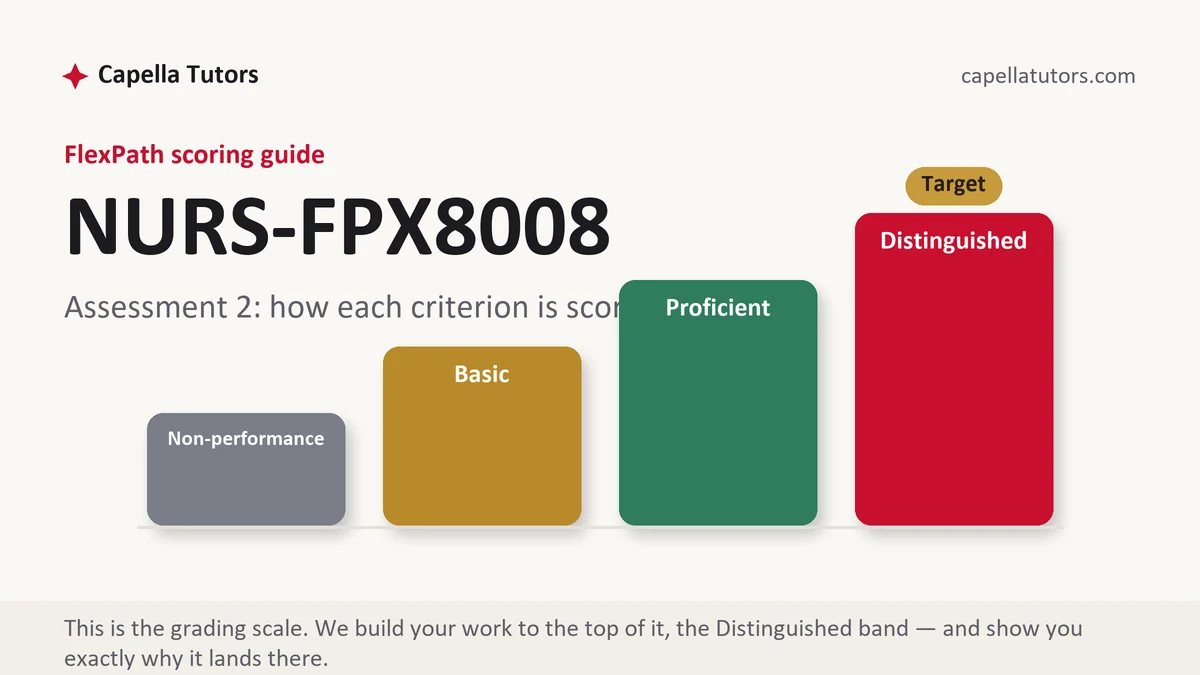
How NURS FPX 8008 Assessment 2 is scored
Four levels, applied criterion by criterion, with the top description always asking for one thing the level beneath it leaves out:
| Level | What it means on an intervention design |
|---|---|
| Distinguished | The workflow is written so an operations director could staff it, the failure points are flagged by the author, and the design says what existing work it displaces. Naming the displacement is the reach the criterion is describing. |
| Proficient | A clear intervention with steps and owners that a reader could picture running. Sound, and silent about what it costs the people already busy. |
| Basic | Aims where steps belong: staff will engage patients in shared decision making, supported by education and a new form. |
| Non-performance | No owners and no trigger points anywhere, so the implementation criterion has nothing to evaluate. |
Shared decision making is the concept most often flattened in this deliverable. Consent is a threshold that records a duty discharged, while shared decision making is a method for choosing between options that are each defensible, and only the second one needs a workflow.
The NURS FPX 8008 Assessment 2 method, step by step
-
Identify the preference-sensitive decisions in your population
List the choices where more than one option is clinically defensible and the right answer depends on what the patient is trying to protect. Decisions with one correct answer do not need this machinery, and building it around them wastes the deliverable.
-
Write the workflow as steps with owners
Each line names the trigger, the person, the action, and the field where it is recorded. If a step cannot be assigned to a role that exists on the schedule, it will not happen, and a reviewer will see that before you do.
-
Put the arithmetic under the staffing claim
Volume times minutes gives hours, and hours divided by a working year gives a fraction of a post. Nobody funds a fraction, so the honest question is whose work this displaces, and asking it in the design rather than in the limitations is what separates a plan from an essay.
-
Design for the shift that has never met the patient
The test of a person-centered process is whether it holds on a Tuesday night with agency staff on the unit. That means the record, not the relationship, has to carry what matters to the patient, in a field somebody will actually open.
-
Flag the failure points before a reviewer does
Name the three places this workflow breaks: the step that lands on the busiest role, the field nobody reads, the handover where the information leaves the system. Then say what catches each one.
-
Test the design against a ten percent adverse move
Show the recommendation surviving a shortfall in volume, uptake or staffing, and say what you would stop doing to free the time you are requesting. Then score yourself criterion by criterion and get it in early in the week.
A structure that maps to the criteria
The numbers below are the planning split our tutors use for a doctoral design deliverable of normal length rather than a Capella instruction; reweight toward whichever criterion your guide emphasizes.
| Section | What it must do | Guide |
|---|---|---|
| The decision in scope | The preference-sensitive choice this design serves, why it qualifies, and how often the population faces it. | ~200 words |
| The workflow | Step by step with triggers, owners, documentation fields, and the escalation route when a step is skipped. | ~400 words |
| Staffing arithmetic | Volume, minutes per encounter, hours per year, the fraction of a post, and the work that gets displaced. | ~250 words |
| Tools and records | The decision aid or template used, cited to its publisher, and where its output lives in the record. | ~200 words |
| Failure points | The three places this breaks in practice, each with the control that catches it. | ~250 words |
| Cost and references | The resource ask with its assumption stated, the sensitivity check, and current APA in both directions. | ~200 words |
Annotated sample excerpt
A model design passage from our team, written so a reader could staff it rather than admire it. Study the moves, then write your own.
When a patient in the advanced kidney disease clinic reaches an estimated filtration rate below 20, the clinic coordinator schedules a modality conversation within four weeks and flags it on the visit list; the nurse practitioner runs the conversation using the published modality decision aid and records the patient's stated priority in the structured note field, and the field is required before the visit can close.1 That is 214 patients a year at roughly 35 minutes each, or 125 hours, which is 0.06 of a full-time equivalent and therefore not a hiring request but a scheduling one.2 The step most likely to fail is the flag, because the coordinator role already carries authorization work on the same list, so the flag is generated by the laboratory result rule rather than by a person remembering.3
- 1Trigger, owner, action, timeframe and the exact field, with a hard stop that makes the record carry the information rather than the relationship.
- 2Converts the workflow into hours and then into a fraction of a post, which turns a proposal into something a manager can accept or refuse.
- 3Names the weakest step and redesigns it in the same sentence. Volunteering the failure point is a top-column move that costs one line.
The full premium sample for your exact assessment, written fresh to your scoring guide and issue, is free to request. Study it, revise it into your own voice, and submit work you understand.
The five mistakes that cost Distinguished
- Aims written where steps belong. Engaging patients more fully is an intention, and intentions cannot be scheduled.
- A step with no owner. Work assigned to the team is work assigned to nobody once the unit is busy.
- Shared decision making applied to settled questions. Where one option is clearly correct, the machinery adds burden and nothing else.
- A new form as the intervention. Documentation records a process; it does not create one.
- No displacement named. Time requested without saying where it comes from reads as a wish rather than a plan.
Pre-submission checklist
- The decision in scope is preference-sensitive and its frequency is stated
- Every workflow step names a trigger, an owner, and a documentation field
- Volume and minutes are converted into hours and a fraction of a post
- Any tool or decision aid is cited to the body that publishes it
- Three failure points are flagged, each with the control that catches it
- A displacement is named and the design survives a ten percent adverse move
Intervention design due and it still reads as intentions?
Send the population, the decision you are targeting, and the criteria. We build the workflow with owners and triggers, run the staffing arithmetic, and return a premium original sample in 24 to 48 hours through an eight-person pipeline with two independent quality passes.