This manual is for NURS FPX 8008 Assessment 3, start to submission. The closing deliverable in this course usually asks you to account for the parts that decide whether anything happens: how the work will be evaluated, what the results look like broken out by group, who is excluded by the design, which committee approves it, and what it costs. A doctoral proposal that cannot say what it costs and who signs it is a wish with citations, and equity asserted as a value rather than quantified as a gap is the other reliable way to lose a criterion here. Below is our doctoral desk's method, a plan tied to the criteria, and an annotated sample excerpt. Want it handled? A premium original sample aimed at this assessment returns inside 24 to 48 hours, revised at no cost until the guide is answered. Capella's catalog lists the course as NURS-FPX8008, and some courserooms print NURS8008; both point to this same Assessment 3.
One honesty note before the manual: Capella revises courses and scoring guides over time, so always write to the exact scoring guide attached to your assessment in the courseroom. The course identity above is verified on capella.edu; the method and structure below are our tutors' approach to it, not Capella's official rubric text.
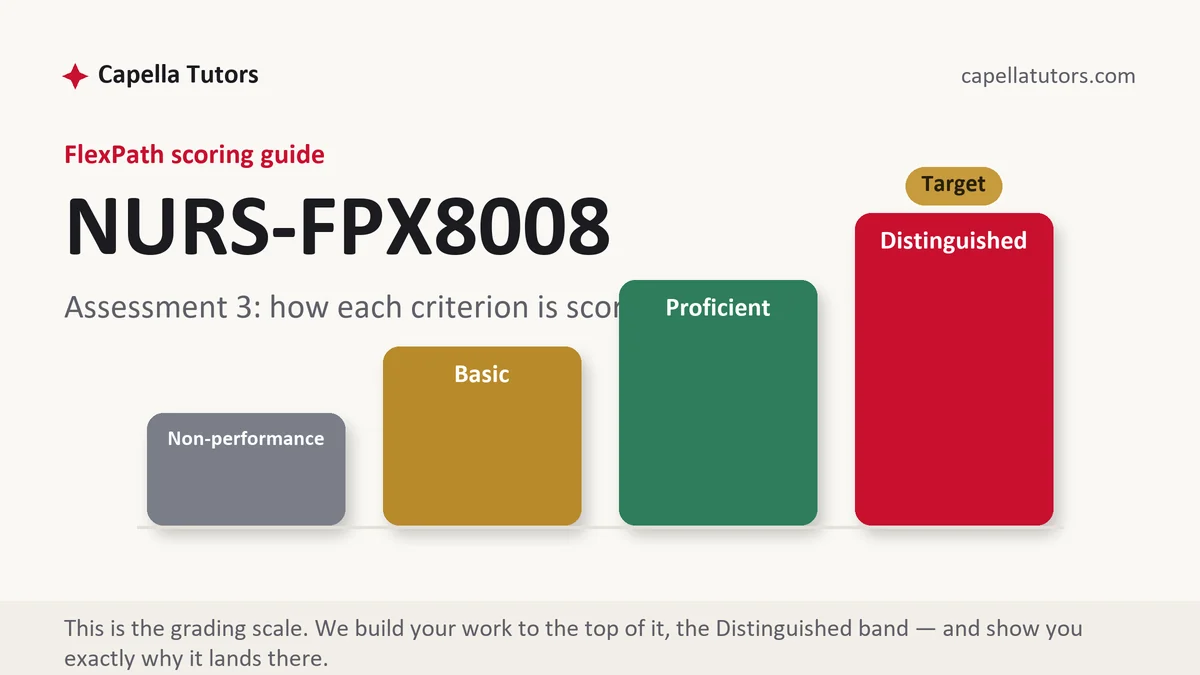
How NURS FPX 8008 Assessment 3 is scored
Each criterion stands alone and lands on one of four levels. Treat the top description as a list of things that must be visible on the page:
| Level | What it means on evaluation, equity and governance |
|---|---|
| Distinguished | Measures are chosen for pullability and specified in advance, a disparity is quantified rather than deplored, and the approval path names real committees with a cost a sponsor could defend. The quantifying is usually the reach the criterion wants. |
| Proficient | A complete evaluation plan with equity addressed and an approval route sketched. Competent, and resting on numbers nobody has confirmed exist. |
| Basic | Satisfaction will be monitored, equity is affirmed as a commitment, and approval is described as obtaining support from leadership. |
| Non-performance | No human-subjects determination, no named approving body, or no measure at all, any one of which empties a criterion. |
Measurement honesty is graded as heavily as measurement itself. A two-point move in a survey score on a few dozen returns is compatible with nothing having happened, and saying so reads as literacy rather than as weakness.
The NURS FPX 8008 Assessment 3 method, step by step
-
Choose measures you have confirmed can be pulled
Before specifying anything, find out which report holds the number, who runs it, and at what frequency. Specify the measure in advance, including its denominator and window, because a measure chosen after the results are in is not an evaluation.
-
Put the process measure beside the experience measure
You control the process and only influence the experience. Reporting both, with the response count printed next to the survey result, is how a doctoral writer prevents a noisy score from carrying the conclusion.
-
Stratify before you claim equity
Break the results out by language, payer, and whatever else your population makes salient, then report interpreter use against interpreter need. A gap that has not been counted is a sentiment, and the criterion can only grade a number.
-
Say who the design excludes
An intervention that lives inside a patient portal excludes the people without one, and naming that group with its size is stronger than any statement of commitment. Then attach one design element that specifically addresses it.
-
Route the approval and the determination
Name the committees in order, say which one holds the money and which holds the practice standard, and record the human-subjects determination from the office that issues it. Quality improvement and research take different routes, so the label you chose earlier decides this section.
-
Price it, then stress it
Give the resource ask with the assumption most likely to be wrong stated openly, show the recommendation holding under a ten percent adverse move, and cite payment or public reporting rules for the year you are writing in. Then mark yourself against each criterion and send it early in the week.
A structure that maps to the criteria
These allocations are the planning figures our tutors use for a doctoral evaluation and governance deliverable of usual length, not Capella rules; move words toward the criterion your guide describes at greatest length.
| Section | What it must do | Guide |
|---|---|---|
| Evaluation design | Process and outcome measures with denominators and windows, specified in advance, each tied to the report it comes from. | ~300 words |
| Analysis and its limits | How results will be compared, the response counts expected, and the size of effect this design could actually detect. | ~250 words |
| Stratified results | The breakdowns you will run, the disparity as it stands today in numbers, and interpreter or literacy provision against need. | ~300 words |
| Who is excluded | The group the design leaves out, its size, and the element added specifically to reach it. | ~200 words |
| Governance and approval | Committees in sequence, the human-subjects determination, and who owns the result after the project ends. | ~250 words |
| Cost and references | The ask, the assumption behind it, the sensitivity check, and current APA matched both ways. | ~200 words |
Annotated sample excerpt
An original model passage from our doctoral desk, written to show a disparity being counted instead of deplored. Borrow the sequence, then count your own population.
Of 2,410 prenatal visits in this clinic last year, 1,383 involved patients whose preferred language is Spanish, and a qualified interpreter is documented in 611 of those encounters, or 44.2 percent, against a clinic policy that requires one whenever the clinician is not language-certified.1 The experience survey returns 96 responses for the year and only 11 in Spanish, so the score cannot support any statement about how this half of the population experiences care, and the process measure carries the argument instead.2 The redesign therefore adds a scheduling rule that assigns interpreter time when the visit is booked, and the group it still misses is the 174 patients whose preferred language is neither English nor Spanish, for whom the rule falls back to a telephone service with a longer wait.3
- 1The disparity is counted, with a denominator and the standard it is measured against. A sentence affirming a commitment to equity would have scored nothing here.
- 2Refuses to let a thin survey carry a conclusion, prints the response count, and moves the argument onto the measure the writer controls.
- 3Names the group the design still excludes and its size, then says what happens to them anyway. Stating who you miss is stronger than claiming to reach everyone.
The full premium sample for your exact assessment, written fresh to your scoring guide and issue, is free to request. Study it, revise it into your own voice, and submit work you understand.
The five mistakes that cost Distinguished
- Equity claimed rather than counted. Until the results are broken out by group, nothing on the page is a disparity.
- A survey score with no response count. Eleven returns cannot support a claim about a population, and printing the count is the whole fix.
- Measures chosen after the fact. An evaluation specified once results are in is a description of what happened, not a design.
- Leadership support in place of an approval path. If no committee is named, the implementation criterion has nothing to grade.
- A resource ask with no assumption stated. A cost figure whose basis is invisible cannot be defended in a budget cycle.
Pre-submission checklist
- Every measure names its denominator, window, and the report it is pulled from
- Process and experience measures are reported together, with response counts
- At least one disparity is quantified against a standard rather than described
- The excluded group is named with its size and a fallback for reaching it
- Committees are named in sequence and the human-subjects determination is recorded
- The cost states its assumption and survives a ten percent adverse move
Evaluation and governance section standing between you and submission?
Send the criteria, your population, and whichever experience or outcome instrument your organization fields. We confirm what can actually be pulled, quantify the disparity, and route the approval path, then return a premium original sample in 24 to 48 hours with free rewrites until your evaluator agrees.