Upload the prompt, the scoring guide, and any draft you already hate, and you get a premium original sample back within 24 to 48 hours, written at the register the criteria describe, with the claim in every sentence matched to the evidence standing behind it and free revisions until the guide is met. The course is NURS FPX 8004, Advanced Doctoral Writing for Nurses, 2 program points inside the FlexPath Doctor of Nursing Practice, which the catalog builds from thirteen two-point courses to a minimum of 26 program points. The GuidedPath version of the same degree counts at least 52 quarter credits instead, since two Capella quarter credits convert to one program point. Two of those points go to prose rather than to content, which tells you where faculty expect to spend their comments. In Capella's catalog the course code is written NURS-FPX8004.
What NURS FPX 8004 actually grades
This course grades sentences, and for nurses used to being marked on clinical content that inversion is the hard part. The criteria are asking whether your prose behaves like scholarship: whether a claim is pitched at the strength its evidence supports, whether the reader can tell what is your reasoning and what came from a source, whether a paragraph advances an argument or merely reports. A submission can be clinically correct throughout and still sit in the Basic column, because the object under evaluation is the writing itself. Nothing about the course is cosmetic. Every habit it grades is a habit your project chapters will be graded on later, which is why it appears near the front of the sequence.
The second target is architecture. Doctoral papers carry a thesis rather than a topic, and the criteria look for that structurally: a purpose statement that names what the paper will establish, paragraphs that begin with the claim they intend to support, transitions that carry logic instead of chronology, and a conclusion that does something other than restate. One idea per paragraph is the working rule, and most drafts break it three times a page. When a single paragraph carries a background fact, a study finding, a personal observation, and a recommendation, no criterion can be satisfied cleanly, because each has been half-answered in four places.
The third target is mechanics, graded harder here than anywhere else in the program. Current APA is expected to be correct rather than approximately correct, heading levels are expected to describe the document's actual structure, paraphrase is expected to be genuine rather than reworded, and attribution is expected on every borrowed idea rather than only on quotations. The assessments in this course usually ask you to produce a piece of scholarly writing and then account for the choices in it, so the reflective element is graded too. Your scoring guide decides how much of each.
How we help in this course
Drafts for 8004 come back with two documents rather than one. The sample itself is written in doctoral register, and alongside it comes a register sheet showing each place a claim was deliberately weakened or strengthened to match the design behind it, with the source noted. That second document is the teaching artifact, because register is a transferable skill and you will be writing to these standards for the rest of the degree. Send us a paragraph of your own writing and we match your rhythm, so the sample sounds like a more disciplined version of you rather than like a stranger.
Terms are the studio's usual ones. A premium original sample per deliverable inside 24 to 48 hours, aimed squarely at the Distinguished descriptors in the guide you upload, produced by the eight-person pipeline with both quality passes, and revised free until the guide is satisfied. In this course one full pass is a mechanical audit: every in-text citation checked against the reference list, every heading level checked against the structure it claims to describe, every quotation checked for whether a paraphrase would have been stronger.
The assessments, one by one
Assessment 1
The opening deliverable in this course usually asks for a piece of scholarly writing built on a practice problem you already own, together with some account of the choices you made while writing it. Read the full Assessment 1 manual.
Assessment 2
The middle deliverable in this course usually moves from writing correctly to writing synthesis: paragraphs organized around what a body of evidence supports rather than around the authors who produced it, with agreement, conflict and silence all visible on the page. Read the full Assessment 2 manual.
Assessment 3
The closing deliverable in this course usually asks for a finished scholarly argument in doctoral register: a claim you are prepared to defend, evidence carried at its true strength, implications scaled to what the studies allow, and mechanics that will survive a line-by-line read. Read the full Assessment 3 manual.
How to actually write NURS FPX 8004: where to begin
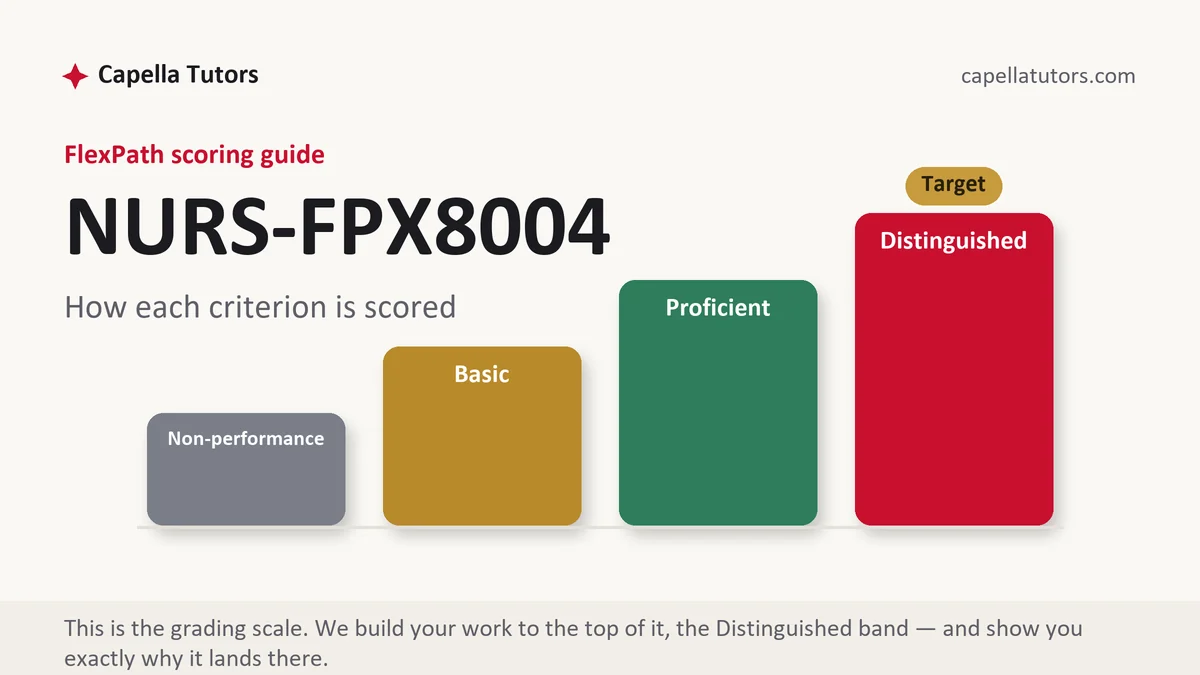
Read the scoring guide as a list of behaviors, not topics. In a writing course the criteria describe things your sentences must do, so translate each one into a visible act before drafting. A criterion about synthesis is satisfied by paragraph shape and cannot be bought by adding two more citations. A criterion about scholarly voice is satisfied by verb choice and hedging, not by longer words. FlexPath scores each criterion as Non-performance, Basic, Proficient or Distinguished, and in this course the Proficient submission is usually clean while the Distinguished submission is clean and also visibly in control of its own claims. Write the translation down before you draft, then check the finished document against your own list rather than against the guide, which you will by then be too close to read.
Build the evidence table next, before any prose exists. One row per source, and columns for design, setting, sample size, what was measured, the direction and size of the effect, and the limitation that matters most. Filling that grid takes an hour and saves three, because it exposes immediately where your evidence is thin and which claims you cannot make. It also makes the register work mechanical: with design sitting in a column next to the finding, the correct verb for that sentence is no longer a judgment call.
Then calibrate one sentence at a time. Take a claim like hourly rounding reduces patient falls, and ask what design produced it. If the source is a single medical unit reporting 22 falls in the six months before rounding and 14 in the six months after, the honest sentence is that falls on one medical unit fell from 22 to 14 across two six-month periods following the introduction of hourly rounding, and that without a comparison unit the change cannot be attributed to rounding alone. The second version is longer, weaker in tone, and stronger as scholarship, and writing three sentences that way will teach you more than reading a chapter on voice. Finish with a reverse outline: one margin sentence per paragraph, read as a list. If the list does not argue, the paper does not either, and no amount of polishing at sentence level will rescue it.
| Section | What goes in it | What Distinguished looks like |
|---|---|---|
| Purpose statement | What the paper will establish, for whom, and why it matters to nursing practice now. | A purpose narrow enough to be achieved in the page count, and achieved by the final paragraph. |
| Background and problem | The practice problem, its scale, and the gap in current practice the paper addresses. | Scale carried by a cited figure with its population named, not by an adjective. |
| Synthesis of evidence | Claims first, sources grouped underneath by whether they agree, conflict, or leave a gap. | Paragraphs organized around findings rather than around authors, with conflict named and adjudicated. |
| Argument and implications | What follows for practice, at what level of confidence, with the limits stated. | Implications scaled to the evidence, and one implication explicitly withheld for lack of support. |
| Voice, register, mechanics | Verb strength matched to design, person-first language, current APA throughout. | Hedging that varies by sentence because the evidence varies, rather than a uniform layer of caution. |
| References and attribution | Every source in the list present in the text, every borrowed idea attributed, frameworks cited to origin. | A list with no orphans in either direction and no secondary citations doing primary work. |
Developing the synthesis
Synthesis is the criterion most often failed by writers who did all the reading. The failure is structural: the paragraph is organized around sources, so it becomes a queue of authors, each with a sentence, and the reader is left to assemble the point. Reorganize around claims. The first sentence states what the evidence collectively supports, the middle sentences bring studies in as agreement, disagreement or silence, and the last sentence says what is still unknown. Delete every author name from a finished paragraph and read it again. If an argument survives, the synthesis is real. If a list survives, it is not.
Nursing evidence also arrives in incompatible shapes, and the register has to absorb that. A cluster-randomized trial, a retrospective chart review, and a qualitative study of ten nurses cannot be reported in the same voice, and flattening them is the commonest register error in submitted drafts. Write the sentence that carries a number honestly: an interval crossing no effect is consistent with no difference rather than a trend, and a percentage arrives with its denominator attached. When two good studies disagree, say which you find more persuasive and why, on grounds of design rather than recency. That one sentence of adjudication often separates Proficient from Distinguished.
Citations that survive faculty review
The mechanical faults faculty mark here are a short and predictable list. Three or more authors take et al. from the first citation onward in current APA, article titles are sentence case while journal names are italic title case, and a digital object identifier appears as a full https link with no label and no retrieval date. Five heading levels exist, and levels four and five run into the paragraph text rather than standing alone, so a misused level tells the reader your structure differs from the one you wrote. Keep secondary citation for emergencies, since an instrument attributed through someone else's summary reads as a gap in scholarship. Person-first language is graded as substance, so people with diabetes rather than diabetics, participants rather than subjects. Then run the two-way check between text and list, because an orphan entry costs a criterion unrelated to your thinking.
The mistakes that land Basic instead of Distinguished
- One study per paragraph. That shape is a summary and no rewrite at sentence level converts it.
- A verb stronger than the design. Saying an observational study proved something invites a comment on every claim you make afterwards.
- Quotation standing in for paraphrase. Quoted material shows you found the source, not that you understood it.
- Headings that describe a structure the paper does not have. Faculty read the headings first, so a mismatch frames everything after it.
- Uniform hedging. Softening every sentence equally hides which claims you are actually confident about.
NURS FPX 8004 questions students actually ask
What actually makes writing sound doctoral?
Calibration, mostly. Doctoral prose says exactly as much as its evidence licenses and no more, which is why it reads as cautious to people who mistake confidence for authority. Three habits produce the effect. Verbs carry the strength of the design, so an observational finding is associated with an outcome while only a trial reduces it. Subjects are precise, so a claim belongs to a population and a setting rather than to nursing in general. Uncertainty is stated by the author rather than discovered by the reader. Length has nothing to do with it, and neither does vocabulary. A long sentence full of abstract nouns usually signals that the writer has not decided what the claim is.
How do I turn a literature summary into a synthesis?
Change what the paragraph is organized around. A summary is organized around sources, so each paragraph belongs to one study and the reader is left to work out the pattern. A synthesis is organized around claims, so the first sentence states what the body of evidence supports and the studies enter afterward as agreement, disagreement, or absence. The practical test is mechanical. If you can delete the author names from your paragraph and it still makes an argument, you have written a synthesis. If deleting them leaves a list, you have written a summary, and the criterion will read it as one no matter how many sources the paragraph contains.
Why does my paraphrase still get flagged for similarity?
Because swapping words is not paraphrasing. Patchwriting keeps the original sentence architecture and substitutes synonyms into it, which a similarity tool detects and a doctoral reader recognizes. Real paraphrase starts from a different unit of thought. Read the passage, close it, write what it established in your own sentence order, then reopen it only to check accuracy and add the citation. Expect the result to be a different length than the original and to combine points the source separated. Similarity reports also flag reference lists and standard instrument names, which is normal, so read what was matched before you rewrite anything.
Draft written and the register still wrong?
Send the draft and the criteria. You get a doctoral rewrite plus the register sheet showing every claim we moved and why. First premium sample free.