This manual is for NURS FPX 8004 Assessment 3, start to submission. The closing deliverable in this course usually asks for a finished scholarly argument in doctoral register: a claim you are prepared to defend, evidence carried at its true strength, implications scaled to what the studies allow, and mechanics that will survive a line-by-line read. By this point the criteria assume you can write clean paragraphs, so what is graded is control, meaning whether you can see your own overreach before an evaluator does. What follows is our doctoral desk's method, a plan mapped to the criteria, and an annotated sample excerpt. Want the drafting done for you? A premium original sample for this exact assessment lands in 24 to 48 hours, revised free until the guide is satisfied. Capella's catalog lists the course as NURS-FPX8004, and some courserooms print NURS8004; both point to this same Assessment 3.
One honesty note before the manual: Capella revises courses and scoring guides over time, so always write to the exact scoring guide attached to your assessment in the courseroom. The course identity above is verified on capella.edu; the method and structure below are our tutors' approach to it, not Capella's official rubric text.
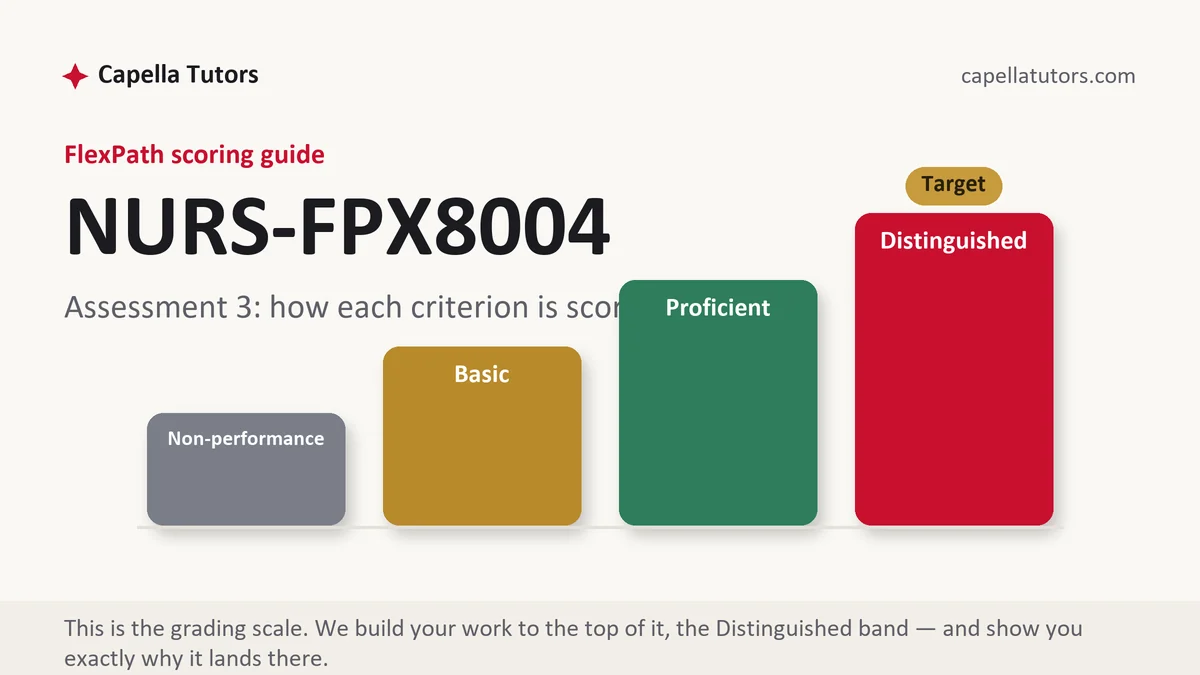
How NURS FPX 8004 Assessment 3 is scored
Four descriptions per criterion, assessed independently, with the top one always asking for something the one below it does not. Treat the wording as your revision list:
| Level | What it means on a finished scholarly argument |
|---|---|
| Distinguished | The argument is carried by calibrated claims, hedging varies because the evidence varies, and a convenient conclusion is refused in the writer's own words. That refusal is usually where the criterion's extra reach lives. |
| Proficient | A coherent argument, correctly supported and correctly formatted, that never quite shows the writer weighing their own certainty. |
| Basic | Assertions at a uniform pitch, implications running ahead of the evidence, and mechanics treated as a final tidy rather than as a graded criterion. |
| Non-performance | An element the guide requires does not appear, or attribution is missing on borrowed ideas that were not quoted. |
Mechanics carry more weight in this deliverable than anywhere else in the sequence. Headings that describe a structure the paper does not have will frame everything an evaluator reads afterward, because faculty read the headings first.
The NURS FPX 8004 Assessment 3 method, step by step
-
Write the claim you are willing to defend
One sentence, unhedged, that somebody could reasonably dispute. If the sentence holds a subject area rather than a position, the paper will describe instead of argue, and description has a ceiling in the middle of the guide.
-
Match every verb to the design behind it
An observational finding is associated with an outcome, a trial can reduce one, and a single-site project before and after a change shows what happened there. Put the design in a column next to the finding and the correct verb stops being a judgment call.
-
Name the population inside the claim
A claim belongs to a group in a setting, not to nursing at large. Adding the population and the setting costs six words and removes the most common reason a doctoral evaluator writes overgeneralized in a margin.
-
Vary the hedging on purpose
Strong evidence takes plain declarative sentences, weak evidence takes qualifiers, and applying the same layer of caution everywhere hides which claims you actually stand behind. Uneven hedging is the signature of a writer who has read their own sources.
-
Refuse one conclusion in writing
Find the implication you would most like to draw and cannot, then say so and say why. Volunteering that limit earns a criterion, while leaving it for the evaluator to discover loses one, and the sentence takes twenty seconds to write.
-
Run the mechanical audit last
Three or more authors take et al. from the first citation in current APA, article titles are sentence case, a digital object identifier appears as a bare https link, and person-first language is graded as substance. Then check text against list in both directions and submit early in the week.
A structure that maps to the criteria
Word figures here are the planning split our tutors use for a doctoral argument of typical length, not a requirement from Capella; move them toward whatever your guide emphasizes.
| Section | What it must do | Guide |
|---|---|---|
| Introduction and claim | Establish why the question is live, then state the disputable claim plainly in the final sentence of the opening. | ~200 words |
| Grounds | The evidence carrying the claim, each piece introduced by design and population, with verbs pitched to match. | ~400 words |
| Qualification | Where the claim weakens, which populations it does not reach, and the conclusion you are declining to draw. | ~250 words |
| The strongest objection | The best case against you, stated in its own terms, then answered with evidence rather than with tone. | ~250 words |
| Implications | What a practice leader should do given the confidence available, and what should wait for better evidence. | ~200 words |
| Mechanics and references | Heading levels matching the real structure, attribution on every borrowed idea, current APA verified both ways. | as needed |
Annotated sample excerpt
An original model passage from our doctoral desk, showing calibration doing the work that emphasis usually gets asked to do. Study the moves, then write yours.
Within this primary care panel of 1,240 patients aged 75 and older, 318 hold prescriptions for five or more chronic medications, and 96 of those regimens include at least one agent from a standard list of medications considered potentially inappropriate in older adults.1 Nurse-led medication review is associated with fewer such agents at six months in observational primary care work; whether it changes hospitalization is not established, and both trials that measured it closed early for recruitment.2 This paper therefore argues for a review workflow on the grounds of prescribing appropriateness alone, and declines the utilization argument that would make the proposal considerably easier to fund.3
- 1The claim is bounded to one panel with a count and a denominator, so nothing here can be read as a statement about older adults in general.
- 2Two designs, two verb strengths, in adjacent clauses. Associated with belongs to observational work, and the failed trials are reported as absence of evidence rather than as evidence of absence.
- 3Refuses the convenient conclusion in the writer's own sentence and names what refusing it costs. This is the move the top column is usually describing.
The full premium sample for your exact assessment, written fresh to your scoring guide and issue, is free to request. Study it, revise it into your own voice, and submit work you understand.
The five mistakes that cost Distinguished
- A verb outrunning its design. One overstated finding invites scrutiny of every claim that follows it.
- Claims with no population attached. A sentence about nursing in general cannot be supported by a study of one setting.
- Quotation doing the work of paraphrase. A quotation proves you located the passage, nothing about whether you understood it.
- Headings that misdescribe the paper. Faculty read them first, so a mismatch colors every judgment afterward.
- Mechanics left to the last hour. Attribution and heading levels are graded criteria here, not formatting chores.
Pre-submission checklist
- The claim is one disputable sentence and appears in the opening section
- Every finding names its design and population before its result
- Hedging differs sentence to sentence because the evidence does
- One conclusion is refused in writing, with the reason given
- The strongest objection is stated fairly and answered with evidence
- Heading levels match the real structure and APA checks pass in both directions
Final writing deliverable and no margin left?
Send the criteria and whatever draft exists. You get a premium original sample in 24 to 48 hours, written to the Distinguished descriptors, plus a pass that checks every citation against the list and every heading against the structure it claims. Rewrites are free until your evaluator agrees.