This manual is for NURS FPX 8004 Assessment 2, start to submission. The middle deliverable in this course usually moves from writing correctly to writing synthesis: paragraphs organized around what a body of evidence supports rather than around the authors who produced it, with agreement, conflict and silence all visible on the page. Most students who lose this criterion did all the reading and then arranged it by source, which is a summary no matter how many citations it carries. Below is how our doctoral desk builds it, a section plan tied to the criteria, and an annotated sample excerpt. Prefer it handled for you? A premium original sample for this exact assessment returns in 24 to 48 hours, revised free until the guide is met. Capella's catalog lists the course as NURS-FPX8004, and some courserooms print NURS8004; both point to this same Assessment 2.
One honesty note before the manual: Capella revises courses and scoring guides over time, so always write to the exact scoring guide attached to your assessment in the courseroom. The course identity above is verified on capella.edu; the method and structure below are our tutors' approach to it, not Capella's official rubric text.
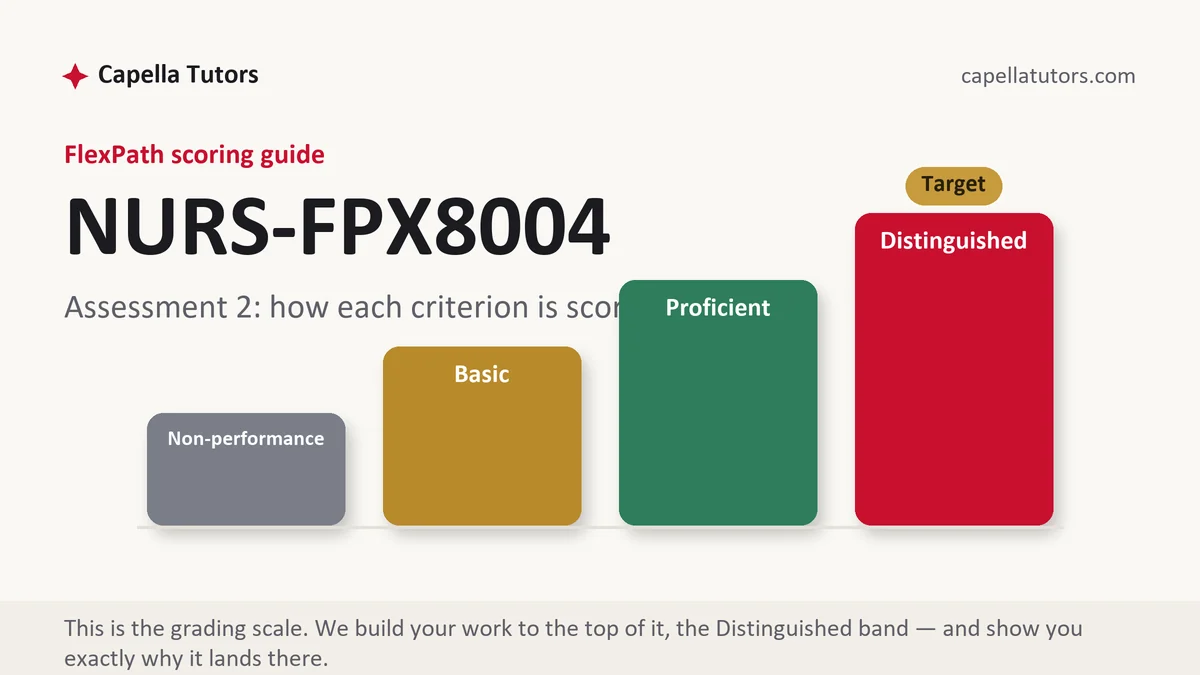
How NURS FPX 8004 Assessment 2 is scored
Criteria are scored one by one against four descriptions, with no weighting and no partial credit hidden between them. The wording tells you what a paragraph has to do:
| Level | What it means on a synthesis |
|---|---|
| Distinguished | Paragraphs are built around claims, disagreement between good studies is adjudicated on design, and the gap in the evidence is named by the writer. The extra step is described in the criterion; make it on purpose. |
| Proficient | Sources are grouped by theme and the pattern is stated. Genuinely useful, and still short of a paragraph that argues without its author names. |
| Basic | One study per paragraph in a queue, with the reader left to assemble the point. The most common ceiling in this course, and it cannot be fixed at sentence level. |
| Non-performance | A body of evidence the guide requires is missing, or the paragraphs report only what each study said with no claim attached anywhere. |
There is a mechanical test for the top two columns. Delete every author name from a finished paragraph and read what remains. If an argument survives, you wrote synthesis; if a list survives, you wrote a summary.
The NURS FPX 8004 Assessment 2 method, step by step
-
Sort the evidence by claim, not by author
Take the findings out of their papers and put them on a page under the claims they bear on. Studies that support a claim, studies that complicate it and studies that never asked go in three piles. That sorting is the synthesis, and everything after it is transcription.
-
Write the claim sentence first, every time
Each paragraph opens with what the body of evidence supports, stated at the strength it can bear. The studies arrive afterward as agreement, disagreement or absence, and the paragraph closes on what is still unknown.
-
Keep incompatible designs in different voices
A cluster-randomized trial, a chart review and interviews with ten nurses cannot be reported in the same sentence pattern. Flattening them is the commonest register fault in submitted drafts, and it costs the criterion that watches claim strength.
-
Adjudicate the disagreement rather than reporting it
When two competent studies conflict, say which one you find more persuasive and why, on grounds of design rather than publication date. That single sentence of judgment is often the whole distance between the middle columns.
-
Handle absence as a finding
A null result from an underpowered study is not evidence of no effect, and a question nobody has asked is worth a sentence of its own. Naming the silence in the literature is a doctoral behavior; leaving the evaluator to notice it is not.
-
Run the deletion test, then the citation audit
Strip the author names from each paragraph and see whether an argument remains. Then check every in-text citation against the list and back again, and confirm each framework is credited to the publication that introduced it. Submit early in the week rather than late.
A structure that maps to the criteria
Treat the word counts as our tutors' planning allocation for a synthesis of standard length, not as a Capella instruction; redistribute toward whichever criterion your scoring guide weights most.
| Section | What it must do | Guide |
|---|---|---|
| Question and scope | The question the synthesis answers, the population it concerns, and the boundary of what was searched and read. | ~150 words |
| What the evidence supports | The claims the body of work carries, one per paragraph, each opening on the claim and closing on its limit. | ~450 words |
| Where it conflicts | The disagreements stated fairly, then settled on design and sample, with the losing reading given its due first. | ~300 words |
| Where it is silent | The questions nobody has answered, the populations nobody studied, and which of your conclusions depend on that silence. | ~200 words |
| What follows | The practice implication scaled to the evidence, with the confidence stated in words rather than implied by tone. | ~200 words |
| References and attribution | Two-way match between text and list, primary sources for instruments, no secondary citation carrying a primary claim. | as needed |
Annotated sample excerpt
A model paragraph written by our desk to show what claim-first organization looks like in practice. Read it for shape, then build your own from your own evidence table.
Peer support programs raise the likelihood that a clinician involved in a serious adverse event actually contacts someone for help, and the evidence for anything beyond that is thinner than the enthusiasm surrounding it.1 Three prospective cohorts in academic centers report higher uptake of support contact after a formal program was introduced, while the two studies that measured turnover or return to full duty found no difference at twelve months and neither was powered to detect one.2 Interview work explains part of the gap, since participants describe the value as being contacted at all, which uptake captures and turnover does not; the defensible reading is that these programs perform on the outcome they were designed around and remain untested on the outcomes cited when they are funded.3
- 1The claim arrives before any study does, and its scope is limited in the same sentence. Delete the rest of the paragraph and this line still argues something.
- 2Agreement and absence are grouped rather than listed, and the null result is qualified by power instead of being reported as proof of no effect.
- 3Brings qualitative evidence in to explain the conflict rather than to decorate it, then states the reading the writer will defend. No author names appear, and the paragraph still holds.
The full premium sample for your exact assessment, written fresh to your scoring guide and issue, is free to request. Study it, revise it into your own voice, and submit work you understand.
The five mistakes that cost Distinguished
- A paragraph per study. The queue shape is a summary, and no sentence-level rewriting converts it into an argument.
- Themes used as claims. A heading that names a topic instead of asserting something leaves the paragraph underneath it with nothing to prove.
- Conflict reported and abandoned. Saying studies are mixed without settling the question is a description of the literature, not a judgment about it.
- A null read as proof. Underpowered studies that found nothing are silence, and treating them as evidence of no effect is an appraisal error the criteria catch.
- Instruments cited through reviews. An attribution that runs through somebody else's summary reads as a hole in the scholarship.
Pre-submission checklist
- Every paragraph opens on a claim and closes on the limit of that claim
- The deletion test passes: names removed, argument intact
- Study designs are named before findings and never flattened into one voice
- At least one conflict is adjudicated explicitly on design grounds
- The silence in the evidence is stated, with the conclusions that depend on it
- Two-way citation check complete, frameworks credited to their originating publication
Read everything and it still reads as a list?
Send the sources and the criteria. We rebuild the paragraphs around claims, settle the conflicts on design, and return a premium original sample in 24 to 48 hours through an eight-person pipeline with two quality passes. Whatever your evaluator sends back re-enters the pipeline free.