This manual is for NURS FPX 8004 Assessment 1, start to submission. The opening deliverable in this course usually asks for a piece of scholarly writing built on a practice problem you already own, together with some account of the choices you made while writing it. The object under evaluation is the prose rather than the clinical content, which is the adjustment most nurses find hardest here: a paper can be correct in every particular and still sit in the Basic column. What follows is the working method from our doctoral desk, a section plan keyed to the criteria, and an annotated sample excerpt. Would you rather hand it over? A premium original sample built for this exact assessment arrives inside 24 to 48 hours, with free revisions until the guide is cleared. Capella's catalog lists the course as NURS-FPX8004, and some courserooms print NURS8004; both point to this same Assessment 1. In current courserooms this assessment typically appears as "Professional Practice Report".
One honesty note before the manual: Capella revises courses and scoring guides over time, so always write to the exact scoring guide attached to your assessment in the courseroom. The course identity above is verified on capella.edu; the method and structure below are our tutors' approach to it, not Capella's official rubric text.
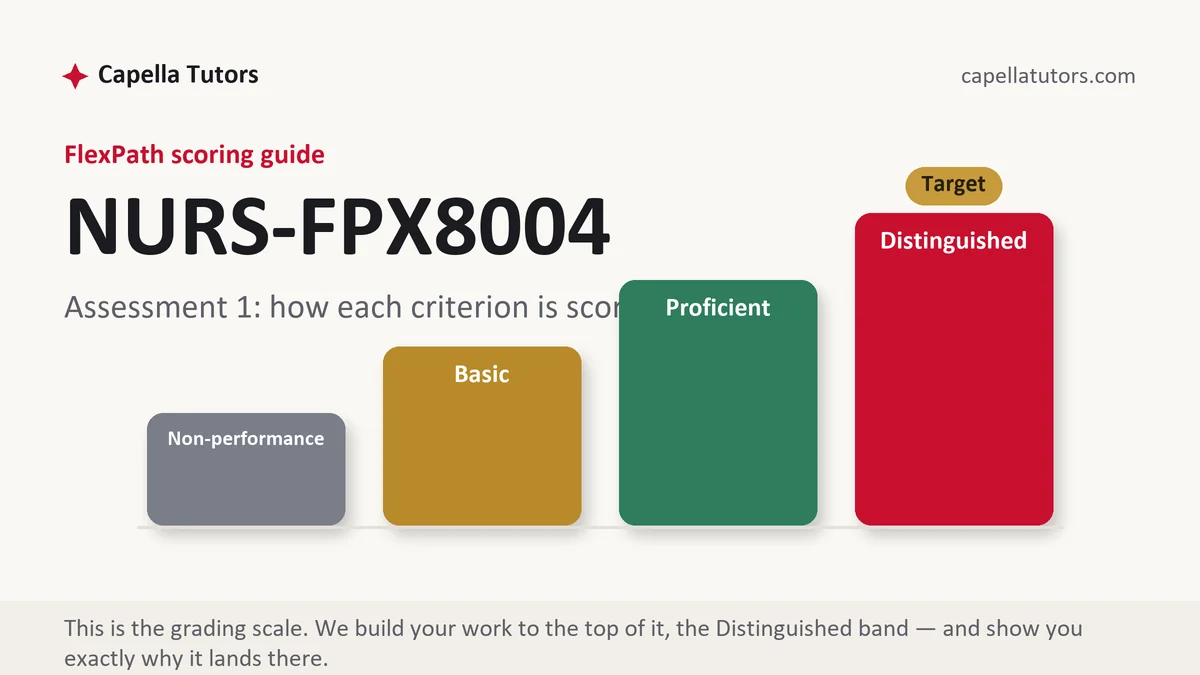
How NURS FPX 8004 Assessment 1 is scored
Every criterion is judged separately at one of four levels, and none of them average into a grade. Read the level text as a specification for sentences:
| Level | What it means on a scholarly writing deliverable |
|---|---|
| Distinguished | The purpose is narrow and achieved, every claim is pitched at the strength its evidence licenses, and the writer accounts for the choices behind the prose. The additional reach sits in the criterion wording; find it and make it deliberately. |
| Proficient | Clean, correct, organized writing that establishes what it set out to establish. Good work, without visible control over its own claim strength. |
| Basic | Accurate content in undisciplined prose: paragraphs carrying four ideas, verbs stronger than the studies behind them, hedging applied evenly to everything. |
| Non-performance | A required element is absent, most often the account of writing choices, which is easy to read past in the instructions. |
The distance between the middle columns is measured in verbs. A submission that says an observational study demonstrated something has told the evaluator where its ceiling is before the argument even begins.
The NURS FPX 8004 Assessment 1 method, step by step
-
Convert each criterion into a behavior your sentences perform
In a writing course the criteria describe acts rather than topics. Write next to each one the visible thing that satisfies it, since a synthesis criterion is answered by paragraph shape and never by adding two more citations. Draft against those translations, then check the result against the guide itself.
-
Pick a practice problem you can size
Choose something you can attach a number to from a report your unit already runs. A problem with a measurable size gives every later paragraph something to be proportionate to, and it keeps the paper from drifting into general commentary about nursing.
-
Write the purpose statement before the paper
One sentence naming what the paper will establish, for whom, and inside what boundary. If the sentence cannot be achieved in the page count you have, it is too wide, and a purpose the paper never reaches is visible to any reader who checks the last page against the first.
-
Build the evidence table before the prose
One row per source, with columns for design, setting, sample, what was measured, the direction of the effect, and the limitation that matters. An hour spent filling it saves three, because it shows immediately which claims your evidence cannot carry and which verb each sentence is entitled to.
-
Draft one idea per paragraph, claim first
Open each paragraph with the claim it intends to support, then bring the evidence in behind it. When a background fact, a study finding, a personal observation and a recommendation share one paragraph, four criteria are each half-answered and none of them is earned.
-
Reverse outline, then account for the choices
Write one margin sentence per paragraph and read the list on its own. If the list does not argue, the paper does not either, and sentence polishing will not rescue it. Then write the account of your writing decisions plainly, naming what you weakened and why. Send it early in the week, since an evaluation can take two business days.
A structure that maps to the criteria
The targets below are our tutors' planning split for a doctoral writing deliverable of ordinary length rather than a Capella rule; give more room to whichever criterion your guide describes in most detail.
| Section | What it must do | Guide |
|---|---|---|
| Purpose statement | Name what the paper establishes, for whom, and where its boundary sits, in one sentence the final page can be checked against. | ~120 words |
| Problem and its scale | The practice problem with a figure, its population, its denominator, and the source of the count rather than an adjective standing in for size. | ~250 words |
| Evidence, reported in register | Findings introduced by design and sample, with verb strength matched to what each study can support and conflicts named as conflicts. | ~400 words |
| Argument and implications | What follows for practice, at a confidence the evidence licenses, with at least one implication withheld for lack of support. | ~300 words |
| Account of writing choices | The decisions behind the prose: why a claim was softened, why a source was excluded, why the structure runs in this order. | ~200 words |
| References and attribution | Every borrowed idea attributed, frameworks cited to origin, current APA with no orphan entries in either direction. | as needed |
Annotated sample excerpt
An original model paragraph from our team, cut to show the register the top column describes. Take the moves, then write your own on your own problem.
This paper establishes that preoperative fasting on this surgical service runs far longer than current anesthesia guidance requires, and that the excess is produced by list scheduling rather than by clinical judgment.1 In a review of 96 elective cases across one month, the median interval without clear fluids was 11.4 hours against a guideline threshold of two, and 71 of those cases sat second or later on the day's list.2 Two writing decisions are worth naming here: the paper reports a median because four outliers above twenty hours distort the mean, and it compares practice to guideline text rather than to a peer hospital, because no comparable local data were available to me.3
- 1States what the paper will establish and where its boundary sits, so the last page can be audited against the first. A purpose is not a topic sentence about an area of interest.
- 2Size carried by a figure with its denominator, window and comparison, which is what the criteria mean by scale. An adjective in this slot reads as Basic every time.
- 3Accounts for two decisions inside the prose rather than in an appendix. The reflective element is graded, and volunteering a data limitation costs nothing while earning a criterion.
The full premium sample for your exact assessment, written fresh to your scoring guide and issue, is free to request. Study it, revise it into your own voice, and submit work you understand.
The five mistakes that cost Distinguished
- Clinical correctness offered as writing quality. The content can be flawless while the criteria under evaluation are all about prose.
- A purpose the paper never reaches. Any reader who compares the opening promise with the closing page can see it, and evaluators do.
- Four ideas in one paragraph. Nothing is fully answered, so nothing scores at the top of its criterion.
- Uniform caution. Softening every sentence equally conceals which claims you actually stand behind.
- The account of choices treated as filler. It is a graded criterion, and a paragraph of generalities about learning to write does not satisfy it.
Pre-submission checklist
- The purpose statement is one sentence and the final paragraph delivers it
- Every finding is introduced by design and sample before its result
- No paragraph carries more than one idea, and each opens on its claim
- One implication is explicitly withheld, with the reason stated
- The account of writing choices names specific decisions, not habits
- Current APA checked in both directions, with no secondary citation doing primary work
Content solid and the prose still marked down?
Send the prompt, the criteria, and a paragraph of your own writing so we can match your rhythm. You get a premium original sample in 24 to 48 hours plus a register sheet showing every claim we moved and the design behind it. Revisions run free until your evaluator is satisfied.