Send us the curriculum assessment you are stuck on and we build the outcomes, the alignment table, and the evaluation plan for you, delivered in 24 to 48 hours with free revisions until the criteria are met. The course is NURS FPX 6108, Curriculum Overview: Design, Develop and Evaluate, worth 2 program points in the Nursing Education specialization of the FlexPath MSN. The full program runs 27 points, billed in flat 12-week sessions with up to two courses open at once, which is why curriculum work tends to arrive at the same time as something else. Of the four specialization courses, this is the one that asks you to build rather than describe. In Capella's catalog the course code is written NURS-FPX6108.
What NURS FPX 6108 actually grades
Curriculum is a chain, and 6108 grades whether you can hold the whole chain in view at once. Program outcomes sit at the top, tied to professional competencies. Course outcomes hang from those. Unit or module objectives hang from the course outcomes. Learning activities serve the objectives. Assessments produce evidence that the objectives were met. Aggregated evidence answers to the accreditor. The criteria are written to test whether each link actually holds, which is why the word alignment appears so often in the scoring guides for this course.
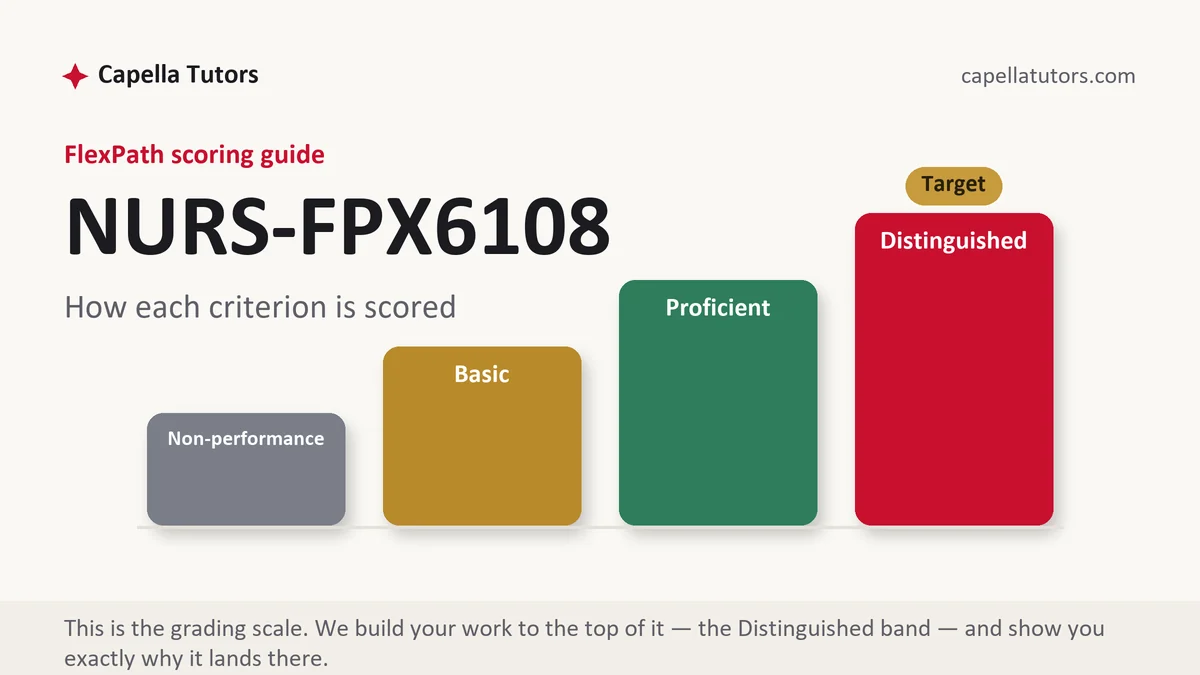
The distinction between Basic and Distinguished here is almost mechanical. Basic work describes a course: here are the topics, here are the weeks, here are the assignments. Distinguished work demonstrates alignment: this program outcome produces this course outcome, which produces these three objectives, each of which is taught by a named activity and measured by a named assessment against a stated benchmark. Description is cheap and evaluators see it instantly. Mapping is expensive, and it is the whole assignment.
The evaluation half of the course title carries its own weight. The assessments in 6108 generally expect you to say how the curriculum will be judged after it runs, not only how it was designed. That means formative review during delivery, end-of-course data, aggregated outcome data across cohorts, and a systematic plan that an accreditation site visit would recognize. Learners who treat evaluation as a closing paragraph lose an entire criterion; the ones who score treat it as a second design problem.
How we help in this course
The deliverables here are structural, and structure is what we are good at. Our writers on this desk have built course shells, written measurable objectives against competency sets, and produced the matrices that accreditation self-studies live on. When you hand off a 6108 assessment, you get outcomes written with defensible verbs, a table that travels from program outcome to graded evidence without a broken row, and an evaluation plan with numbers in it. You also get the gap analysis, since finding a misalignment and naming it is usually where the top column hides.
Order flow is unchanged from the rest of the studio. A research analyst reads your scoring guide and maps every criterion to a section before drafting starts, a subject-matched writer builds the deliverable, and it clears scoring-guide QA followed by APA and originality QA. Turnaround is 24 to 48 hours, revisions run until you hit your target, and the first premium sample is free. Include your courseroom template if the assessment supplies one, because curriculum tables score very differently depending on whether faculty expect their own format.
Building a curriculum map this week?
Send the scoring guide and the course you are mapping. Your first premium sample is free, delivered within 24 to 48 hours.
The assessments, one by one
Assessment 1
Send the scoring guide and we assemble the practicum setup document for you, site access, mentor, curriculum artifacts, objectives, and the meeting record, back in 24 to 48 hours with revisions until it clears. Read the full Assessment 1 manual.
Assessment 2
Hand this one off and you get outcomes with defensible verbs, an alignment table that reaches graded evidence, and an evaluation plan with numbers in it, delivered in 24 to 48 hours and revised free until the criteria clear. Read the full Assessment 2 manual.
Assessment 3
We take this one to your scoring guide and return it inside 24 to 48 hours, revised free until the criteria clear. Read the full Assessment 3 manual.
Assessment 4
Send the scoring guide and we develop the course with you, outcomes, modules, methods, assessments, and the forces acting on all of it, returned in 24 to 48 hours and revised free until the criteria clear. Read the full Assessment 4 manual.
Assessment 5
Send the scoring guide and we build the evaluation plan, the model, the data sources, the thresholds, the review cycle, and the loop that closes, back in 24 to 48 hours with revisions until the criteria clear. Read the full Assessment 5 manual.
How to actually write NURS FPX 6108: where to begin
Start in the scoring guide, and copy each criterion into a blank document as its own heading before you think about content. The instructions describe a curriculum scenario; the criteria decide the grade. In 6108 the criteria usually cover four jobs: justify a curriculum need or revision, write outcomes and objectives that can be measured, demonstrate alignment across the levels, and design an evaluation that produces evidence over time. Give each one its own section and answer it there.
Then pick one real course and open its syllabus. A course you completed, a course your facility teaches, a nurse residency module you help deliver. Real syllabi come with problems, an objective nothing measures, a graded discussion nobody can trace to an outcome, a verb that promises evaluation and gets tested with recall. Those problems are the raw material of the analysis criteria. An invented course has no problems, so it gives you nothing to analyze, which is exactly why fabricated curricula stall at Proficient.
Write the outcomes before the table. A usable objective has one measurable verb, a condition, and something an evaluator could observe: given a simulated postpartum hemorrhage, the learner will prioritize nursing interventions in order of urgency. Verbs like understand, appreciate, and be familiar with cannot be measured and get flagged every time. Watch the verb ladder while you write, since the level has to hold across the chain. If the course outcome says synthesize, no objective underneath it may stop at list, and if the program outcome sits at evaluate, a course full of identify objectives is a documented misalignment. Naming that mismatch in your own map is not a confession, it is the finding the criterion wants.
Now build the alignment table, and build it row by row rather than column by column. One row per objective, never one row per week. Five columns carry it: program outcome, course outcome, unit objective, learning activity, and assessment with its benchmark. Each row has to survive one question, does the thing in the last column produce evidence that the thing in the third column happened. If the objective says prioritize interventions and the assessment is a multiple-choice quiz on medication names, the row fails and you write that down. Two orphan types show up in almost every honest map: an objective with no assessment attached, which means the curriculum teaches something it never measures, and an assessment with no objective above it, which means students are graded on something the course never promised to teach. Finding one of each and proposing a fix is worth more than a table with forty tidy rows. Put a number in the benchmark cell as well, such as 80 percent of learners scoring at least 3 of 4 on the rubric criterion, because evaluation without a threshold is an opinion, and the evaluation criteria in this course read thresholds as the deliverable.
| Section | What goes in it | What Distinguished looks like |
|---|---|---|
| Context and need | The program, the learners, and the practice gap or standard driving the design or revision. | The need is evidenced, a pass rate, an employer complaint, a revised standard, not a general claim that nursing changes. |
| Program and course outcomes | Outcomes at both levels, tied to a competency set such as the AACN Essentials. | Every outcome is measurable, and the mapping to competencies is shown rather than asserted. |
| Unit design and objectives | Modules or units with objectives written in observable verbs, plus the activities that teach them. | Objective verbs match the cognitive level of the outcome above them, and the activities plausibly reach that level. |
| Alignment map | One row per objective, running from program outcome to assessment and benchmark. | The map names at least one broken link and proposes a specific repair for it. |
| Evaluation plan | Formative and summative evaluation, data sources, timing, and who reviews the results. | Benchmarks are numeric, the review cycle is scheduled, and accreditation language is used correctly. |
Developing the synthesis
The criterion verbs in 6108 are analyze, evaluate, and justify, so a literature section that stacks summaries scores Basic no matter how current the sources are. Build the argument out of disagreement instead. Curriculum research supplies plenty: concept-based designs are credited with better transfer of learning and less content saturation, while other studies report faculty struggling to teach them and students who feel underprepared for licensure content. Put both findings in one paragraph, then decide which applies to the program you are mapping, and say why. A large multi-program comparison outranks a single-school pilot on design strength, but the pilot may match your setting more closely, and stating that tradeoff out loud is the move evaluators reward. Close by naming what the evidence cannot settle, whether the gains hold once the founding faculty leave, and you have done the analysis the top column describes.
Citations that survive faculty review
Evidence tends to be scored on its own in this course, so handle citations as part of the design work. Use peer-reviewed sources from roughly the last five years, attach an author and date to every factual claim, match every in-text citation to the reference list, and leave nothing in the list uncited. Put the citation inside the sentence that does the reasoning rather than at the end of a paragraph. Assign each source a job in a specific section; a source with no job is visible padding. The Capella library, CINAHL, and PubMed carry the research spine, and the standards layer comes from the AACN Essentials for competency domains, NLN material for teaching and learning, CCNE or ACEN criteria for the evaluation sections, and QSEN competencies where safety and quality content is being mapped. Cite standards as organizational reports in APA 7 with the organization as author, and keep them in the sections where they belong instead of using them as general filler.
The mistakes that land Basic instead of Distinguished
- Describing a course week by week and calling it curriculum design, with no mapping anywhere in the document.
- Objectives built on unmeasurable verbs, understand and appreciate being the two that get flagged most.
- An alignment table that stops at the activity column, so no row ever reaches graded evidence.
- A perfect map with no gap named, which reads as decorative rather than analytical.
- Evaluation reduced to end-of-course surveys, with no benchmark, no aggregate data, and no review cycle.
NURS FPX 6108 questions students actually ask
Which course should I build my curriculum work around?
A real one, with a syllabus you can open. A course you took, a course your unit teaches, or a residency module you help deliver all work better than an invented elective, because real courses come with awkward objectives and mismatched assignments, and awkwardness is what the analysis criteria feed on. Pick something small enough to map completely, one course rather than a whole program.
How detailed does the alignment table need to be?
One row per objective, not one row per week, and enough columns that each row travels from program outcome to graded evidence. Five columns cover it: program outcome, course outcome, unit objective, learning activity, assessment and benchmark. Check your scoring guide for a required format first, then treat this as the floor. A table that ends at the activity column stops one step short of what the alignment criterion asks for.
Do I have to cite accreditation standards?
In the evaluation sections, yes, and name the accreditor your setting actually answers to rather than listing both. CCNE and ACEN criteria give you the systematic evaluation language, the AACN Essentials give you the competency domains that program outcomes map onto, and NLN material supports the teaching and learning side. Cite them as organizational reports in APA 7, and keep peer-reviewed sources carrying the design arguments.