This manual is for NURS FPX 6108 Assessment 3, start to submission. We take this one to your scoring guide and return it inside 24 to 48 hours, revised free until the criteria clear. Assessment 3 of NURS FPX 6108 usually asks you to compare curriculum theories, frameworks, and models and then select one for a named program, with the selection defended rather than announced. The criteria reward the comparison, not the summary: two frameworks put side by side, judged against the same program, and one chosen for stated reasons. Below are the method, a structure taken from the criterion language, and an annotated sample excerpt. Capella's catalog lists the course as NURS-FPX6108, and some courserooms print NURS6108; both point to this same Assessment 3. In current courserooms this assessment typically appears as "Curriculum Theory, Frameworks, and Models".
One honesty note before the manual: Capella revises courses and scoring guides over time, so always write to the exact scoring guide attached to your assessment in the courseroom. The course identity above is verified on capella.edu; the method and structure below are our tutors' approach to it, not Capella's official rubric text.
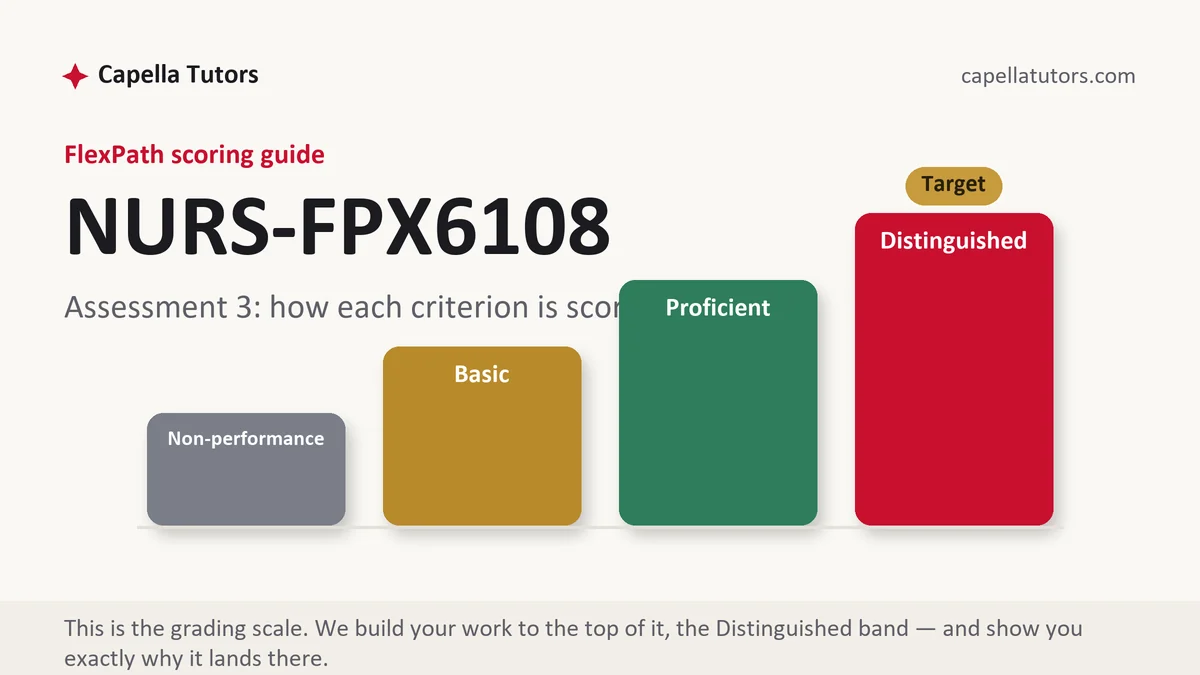
How NURS FPX 6108 Assessment 3 is scored
Each criterion resolves to one of four levels, and the level text tells you what a defended selection looks like:
| Level | What it means on a framework analysis |
|---|---|
| Distinguished | Two or three frameworks are compared on the same stated criteria, the selection is justified against the program's faculty, resources, and learners, and the cost of the framework not chosen is named out loud. |
| Proficient | Accurate accounts of the frameworks and a reasonable selection. The comparison runs in parallel paragraphs rather than against shared criteria, which is the gap to the top column. |
| Basic | A summary of each framework in turn, with a preference stated at the end and no comparison anywhere in between. |
| Non-performance | A framework is described but never applied to the program, or only one framework appears where the criterion asked for a comparison. |
Frameworks are not interchangeable, and saying so is the whole assessment. A behavioral objectives tradition in the line of Tyler produces tight measurement and thin room for ambiguity. An interpretive tradition such as the narrative pedagogy associated with Diekelmann produces depth of meaning and evaluation data that no accreditor will accept on its own. A concept-based design in the tradition Giddens describes reduces content saturation and asks faculty to teach in a way many were never taught. Each buys something and each charges for it.
The NURS FPX 6108 Assessment 3 method, step by step
-
Read the criteria and set your comparison criteria first
Before you write about any framework, decide what you are comparing them on and put that list in the paper: fit with the program's outcomes, faculty readiness, resource demand, evidence base, and the kind of evaluation data the design produces. A comparison without shared criteria is two summaries, and the criterion language is precise about the difference.
-
Name the program, its faculty, and its constraints
The framework has to be selected for somebody. Give the program size, the faculty count, how many are new to teaching, the course under revision, and the constraint that actually binds, whether that is contact hours, lab capacity, or a board approved course description you cannot alter. Selection arguments are only as good as the constraints they respect.
-
Cite the theory to its primary source
Faculty evaluators in this course read the reference list closely. Attribute the rationale for objectives, instruction, and evaluation to Tyler where you use it, the spiral and diagnosis of needs work to Taba, backward design to Wiggins and McTighe, narrative pedagogy to Diekelmann, and the Carnegie critique of nursing education to Benner and colleagues. A textbook chapter summarizing all of them is a legitimate secondary source for orientation and a weak one to hang a selection on.
-
Compare in a table, then argue in prose
Put the frameworks down the side and your comparison criteria across the top, and fill every cell, including the uncomfortable ones. Then write the argument the table makes. The table proves you compared; the prose proves you judged. Learners who submit only the table lose the analysis criterion, and learners who submit only prose usually never compared at all.
-
Select, then price the decision
State the selection in one sentence and follow it with what it costs. A concept-based revision asks faculty to give up content ownership and asks the program for development time it may not have. Name the faculty development hours, the timeline, and the risk if two senior faculty retire mid transition. A selection with a price attached is the mark of the top column.
-
Put the evidence in conflict and settle it
The literature disagrees usefully, and the analysis criterion wants that disagreement handled. Some studies credit concept-based designs with better transfer and less content overload, while others report faculty struggling with the shift and learners feeling exposed on licensure content. Adjudicate on design and population, a multi program comparison outweighs a single school pilot, then say which finding your program resembles, and close with what the evidence still cannot answer.
A structure that maps to the criteria
Planning figures our tutors use for a framework analysis of this shape rather than Capella rules; your scoring guide sets the real weighting.
| Section | What it must do | Guide |
|---|---|---|
| Program context and constraints | The program, the course under revision, faculty readiness, and the constraint that binds the design. | ~200 words |
| Comparison criteria stated | The dimensions you will judge frameworks on, declared before any framework is described. | ~150 words |
| Framework one | Its origins, its logic, and what it would produce in this program specifically. | ~250 words |
| Framework two | The same treatment, with the same criteria applied in the same order. | ~250 words |
| Comparison and selection | A filled table, the argument it supports, and the selection stated in one sentence. | ~300 words |
| Cost, risk, and evidence | Faculty development, timeline, retirement or turnover risk, and the literature adjudicated. | ~250 words |
| References | Current APA with curriculum theory attributed to primary sources. | as needed |
Annotated sample excerpt
Our writers produced this model to show how a defended selection reads. Take the shape of the argument rather than its sentences.
For a community college pharmacology course carrying 48 contact hours and a state approved description that cannot be reopened this cycle, the behavioral objectives tradition Tyler set out remains the better fit, and the reason is not fashion but arithmetic: the course has to demonstrate measurable achievement of 22 objectives to an accreditation visit in eighteen months, and eleven of its fifteen faculty teach part time.1 A concept-based revision of the kind Giddens describes would almost certainly reduce the content saturation that drives the current 38 percent failure rate on the second exam, but it asks adjunct faculty for roughly 40 hours of unpaid development each and asks the program to defend an unfamiliar evaluation structure to surveyors mid transition.2 The defensible move is to keep the behavioral frame for this cycle, retire six objectives that duplicate content taught in the prerequisite, and pilot two concept-based modules with the full time faculty as a documented step toward the next revision.3
- 1Names the constraint and the number that make the selection necessary, so the choice is argued from the program rather than from preference.
- 2Concedes the strength of the framework not chosen and prices it in faculty hours. A comparison that admits the cost of its own decision is what separates the top two columns.
- 3Ends on a specific, staged proposal, which turns a theoretical comparison into something a curriculum committee could vote on.
The full premium sample for your exact assessment, written fresh to your scoring guide and issue, is free to request. Study it, revise it into your own voice, and submit work you understand.
The five mistakes that cost Distinguished
- Two book reports. A summary of one framework followed by a summary of another, with no shared criteria, is the classic Basic submission here.
- A framework with no program. Theory described in general terms and never applied to a named course cannot satisfy an application criterion.
- Secondary sources for primary theory. Citing a survey textbook for Tyler or Taba is visible immediately and weakens the whole selection.
- A selection with no cost. Choosing a framework without naming what it demands of faculty and budget reads as an opinion rather than a decision.
- Literature in agreement. A review where every source supports the chosen framework signals selective reading, and the analysis criterion is where it shows.
Pre-submission checklist
- Program, course, faculty readiness, and binding constraint all named early
- Comparison criteria declared before the frameworks are described
- Each framework treated against the same criteria in the same order
- A filled comparison table plus the prose argument it supports
- Selection stated in one sentence, with its cost in hours, money, or risk
- Curriculum theory cited to primary sources in current APA, standards cited as organizational reports
Comparing frameworks and running out of week?
Send the scoring guide, the program, and the course under revision. We set the comparison criteria, treat each framework against them, build the table, and write the selection argument with its price attached. Delivery in 24 to 48 hours, revisions until the criteria clear, and the opening premium sample is free.