This manual is for NURS FPX 6108 Assessment 5, start to submission. Send the scoring guide and we build the evaluation plan, the model, the data sources, the thresholds, the review cycle, and the loop that closes, back in 24 to 48 hours with revisions until the criteria clear. Assessment 5 of NURS FPX 6108 usually asks for a systematic plan to evaluate a curriculum after it runs, which is a different problem from designing it. The criteria look for a named evaluation model, real data sources, numeric benchmarks, and evidence that findings change something. The method, the structure, and an annotated sample excerpt are set out below. Capella's catalog lists the course as NURS-FPX6108, and some courserooms print NURS6108; both point to this same Assessment 5. In current courserooms this assessment typically appears as "Curriculum Evaluation".
One honesty note before the manual: Capella revises courses and scoring guides over time, so always write to the exact scoring guide attached to your assessment in the courseroom. The course identity above is verified on capella.edu; the method and structure below are our tutors' approach to it, not Capella's official rubric text.
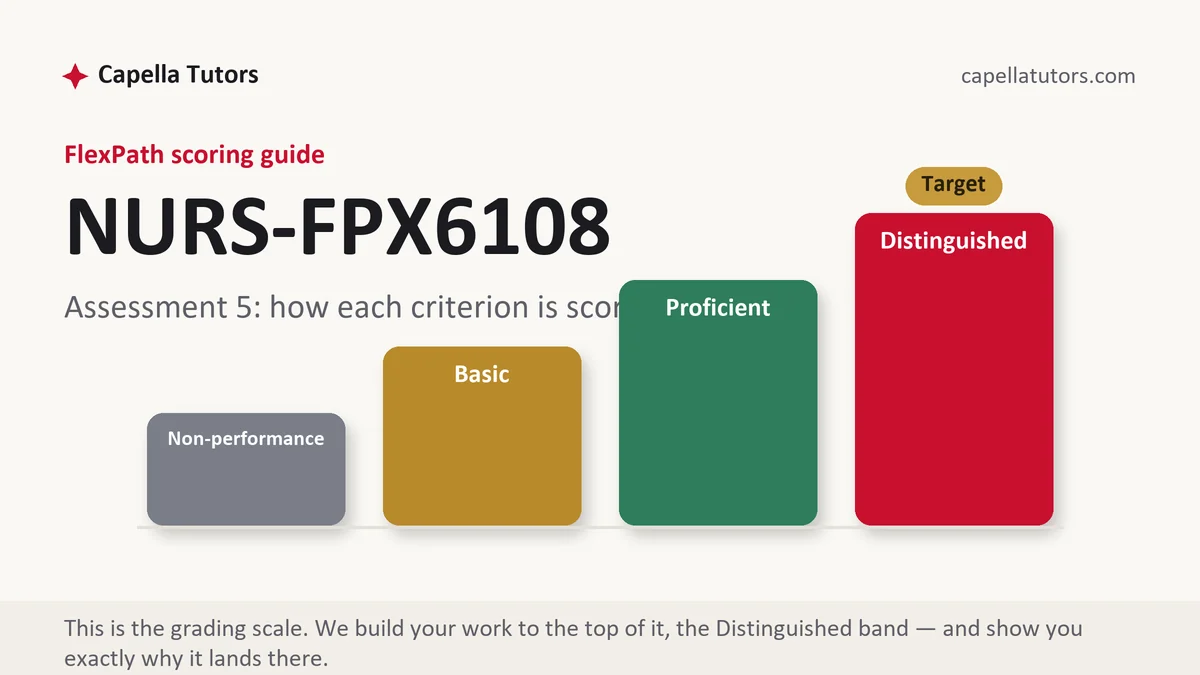
How NURS FPX 6108 Assessment 5 is scored
Every criterion lands on one of four levels, and the level wording is the design brief for the plan:
| Level | What it means on a curriculum evaluation plan |
|---|---|
| Distinguished | A named evaluation model organizes the plan, each element has a data source, an owner, a schedule, and a numeric benchmark, and the document shows a past finding that changed a specific curricular decision. |
| Proficient | A complete plan with appropriate data and benchmarks that an accreditor would recognize. The loop is described but never demonstrated with an actual finding and action. |
| Basic | End of course surveys and licensure pass rates listed as evaluation, with no model, no thresholds, and no schedule. |
| Non-performance | A required element is absent, most often the aggregation across cohorts or the review cycle, and the criterion falls to the floor. |
Choose the evaluation model deliberately and cite it. Stufflebeam's context, input, process, and product structure suits a whole curriculum because it forces you to evaluate the environment and the design as well as the results. Kirkpatrick's levels suit a discrete educational program because they separate reaction from learning, behavior, and results, and they make clear that satisfaction data sits at the weakest level. A plan with no model reads as a list, and a list cannot be defended at a site visit.
The NURS FPX 6108 Assessment 5 method, step by step
-
Let the criteria set the plan's architecture
Copy the criteria out and build the plan around them, keeping their verbs. Evaluation plans have a conventional shape that learners reproduce from memory, and reproducing a shape is not answering a criterion. Where the guide asks you to evaluate the effectiveness of the curriculum, that section reaches a judgment supported by data rather than describing how data would be collected.
-
Name the evaluation object precisely
Say what is being evaluated: a whole program, one course, or a discrete intervention such as a remediation pathway. Give it numbers: how many learners per cohort, how many cohorts of data exist, what the current result is. An evaluation plan for something unnamed cannot have thresholds, and thresholds are most of the grade.
-
Attach a model and use it as the outline
Pick the model, cite it to its source, then let its components become your headings. If you use the context, input, process, product structure, then say what counts as context data in this program, what counts as input, and so on. Using a model as an organizing frame is analysis. Mentioning one in the introduction and then ignoring it is decoration, and evaluators see the difference at a glance.
-
Separate formative from summative by purpose
The distinction is about function, not calendar position. The same instrument is formative when its results change the next teaching decision and summative when they fix a judgment. Say which of your measures are which, and for the formative ones name the decision they inform and the person who makes it.
-
Give every measure a source, an owner, a date, and a number
Build a table. Rows are the things being measured; columns are the instrument, the data source, the responsible person or committee, the frequency, and the benchmark. Include reliability evidence where the instrument is a scale rather than a count, because a benchmark set on an instrument with no published reliability is a number without a foundation. Aggregate across at least two cohorts before drawing conclusions, and say so.
-
Close the loop on paper, with a real example
The criterion that decides this assessment is usually the one about using results. Show one finding, the action it triggered, who approved the action, and the follow up measurement that told you whether it worked. If the program has no such example yet, write the first cycle prospectively, with dates. A plan that never reaches an action is data collection, and accreditation language for that is a finding of its own.
A structure that maps to the criteria
Word figures are our tutors' planning targets for an evaluation plan of this type, not Capella rules; your scoring guide decides the real weighting.
| Section | What it must do | Guide |
|---|---|---|
| Evaluation object and purpose | What is being evaluated, for whom, and the decision the evaluation is meant to inform. | ~200 words |
| Model and rationale | The evaluation model named and cited, with the reason it fits this object. | ~200 words |
| Data sources and instruments | Every measure with its instrument, source, and any published reliability evidence. | ~300 words |
| Benchmarks and thresholds | The number that counts as success for each measure, with the basis for that number. | ~250 words |
| Schedule, owners, and aggregation | Who collects, who reviews, how often, and how results aggregate across cohorts. | ~250 words |
| Closing the loop | One finding, the action taken, the approver, and the follow up measurement. | ~250 words |
| References | Current APA, evaluation models cited to primary sources and criteria as organizational reports. | as needed |
Annotated sample excerpt
This model paragraph from our writers shows a closed loop in prose. Study the sequence, then write the cycle your program can actually run.
The object is the dosage calculation remediation pathway that 41 of 118 first semester students entered last year after failing the 90 percent competency examination on first attempt.1 The process data showed the pathway working as designed, 38 of 41 completed all four modules, while the product data showed it failing at the point that matters: second attempt pass rate rose only to 71 percent against a benchmark of 90, and three students left the program.2 The curriculum committee's response in March was specific rather than general, replacing the self paced module set with two proctored practice sessions and a required calculation checkpoint in the prerequisite course, with the same benchmark re measured on the incoming cohort in October and reported back to the same committee.3
- 1Defines the evaluation object with counts and the existing result, which is what lets every later statement carry a threshold.
- 2Separates process data from outcome data and shows them disagreeing. An intervention that runs well and works poorly is exactly the finding an evaluation plan exists to surface.
- 3Names the action, the body that approved it, the re measurement, and the date it returns. That sequence is the closed loop the top column is describing.
The full premium sample for your exact assessment, written fresh to your scoring guide and issue, is free to request. Study it, revise it into your own voice, and submit work you understand.
The five mistakes that cost Distinguished
- Surveys called evaluation. Reaction data with no learning or outcome measure sits at the weakest level of any model, and a plan built on it cannot be defended.
- A model named and abandoned. Citing an evaluation framework in the introduction and then organizing the plan some other way costs the analysis criterion.
- Benchmarks with no basis. A threshold pulled from nowhere invites the question of where it came from, and licensure standards, accreditation expectations, or prior cohort data all answer it.
- One cohort, one conclusion. Findings drawn from a single cohort are noise, and aggregation across cohorts is usually written into the criterion.
- A loop that never closes. Data collected, reported, and filed with no action, approver, or re measurement is the failure this assessment is built to catch.
Pre-submission checklist
- Evaluation object named with cohort sizes and the current result
- A named evaluation model, cited to its source, used as the plan's organizing structure
- Every measure carrying an instrument, a source, an owner, a frequency, and a benchmark
- Reliability evidence noted for any scaled instrument used to set a threshold
- Formative and summative measures separated by the decision each one informs
- One documented loop: finding, action, approver, re measurement, and reporting date
Evaluation plan due and no data in front of you?
Send the scoring guide and whatever the program will let you use, pass rates, survey summaries, a systematic evaluation plan, even a single course report. We choose the model, build the measure table with benchmarks and owners, and write the closed loop. Delivery in 24 to 48 hours, revisions until the criteria clear, first premium sample free.