This manual is for NURS FPX 6108 Assessment 4, start to submission. Send the scoring guide and we develop the course with you, outcomes, modules, methods, assessments, and the forces acting on all of it, returned in 24 to 48 hours and revised free until the criteria clear. Assessment 4 of NURS FPX 6108 usually asks you to develop a single course and then account for the internal and external factors shaping it. The second half is the half learners skip, and it is where the analysis criteria live. What follows is the method, a criterion mapped structure, and an annotated sample excerpt. Capella's catalog lists the course as NURS-FPX6108, and some courserooms print NURS6108; both point to this same Assessment 4. In current courserooms this assessment typically appears as "Course Development and Influencing Factors".
One honesty note before the manual: Capella revises courses and scoring guides over time, so always write to the exact scoring guide attached to your assessment in the courseroom. The course identity above is verified on capella.edu; the method and structure below are our tutors' approach to it, not Capella's official rubric text.
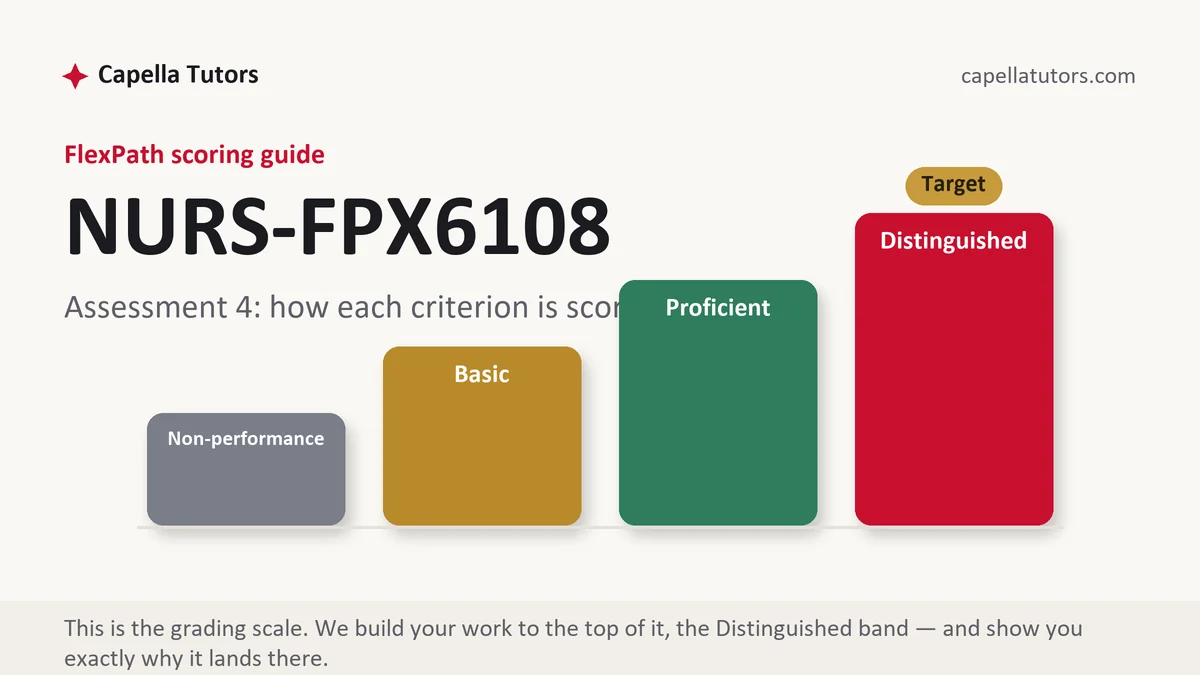
How NURS FPX 6108 Assessment 4 is scored
Each criterion resolves to one of four levels, and the level text describes exactly what to produce:
| Level | What it means on a course development deliverable |
|---|---|
| Distinguished | The course is built to the level of a usable syllabus, and each influencing factor is traced to a specific design decision it forced, including one decision the writer would not have made otherwise. |
| Proficient | A complete and defensible course with the influencing factors identified accurately. The factors are listed rather than traced to decisions, which is the step the top column requires. |
| Basic | A course outline with a paragraph acknowledging that regulations and resources matter, and no connection between the two halves. |
| Non-performance | The influencing factors section is absent, or the course is described in topics only with no outcomes or assessments. |
Sort the factors into internal and external before you write, because the criteria usually separate them. Internal factors are the ones the program controls or has to live with: mission, faculty expertise and workload, lab and clinical capacity, the prerequisite chain, the learning platform. External factors are imposed: state board rules on program approval and clinical hours, accreditation criteria, the licensure test plan, employer expectations, and clinical partner capacity. The strongest sections show an external factor and an internal one pulling in opposite directions.
The NURS FPX 6108 Assessment 4 method, step by step
-
Draw the criteria into two lists and keep them apart
One list for the development criteria and one for the analysis criteria. Learners who write the course first and then bolt on a factors section almost always fail to connect them. Build the factor list early instead, and let it constrain the design as you go, which is what the criterion wording assumes happened.
-
Scope one course, not a program
Pick a single course with a number and a credit value and stay inside it. Name the learners, the delivery mode, the prerequisite behind it, and the course it feeds. A course is small enough to build completely, and completeness is what the development criteria reward. A program sketch always reads as thin.
-
Build the course to syllabus depth
Outcomes, module objectives, teaching methods, graded assessments with weights, and a week by week or module by module sequence. If a colleague could not teach from your document, it is not finished. Keep the objectives observable and at the level the outcome requires, and write the assessment description precisely enough that the evidence it produces is obvious.
-
Trace each factor to a decision it forced
This is the move that carries the analysis criteria. Not the state board requires clinical hours, but the state board's clinical hour minimum is why this course keeps a two credit lab that the online delivery model would otherwise have absorbed into asynchronous work. Factor, then decision, then consequence. Write one of these sentences for every factor you name.
-
Respect the licensure and accreditation frames explicitly
Where the course content maps to the licensure test plan, say which client needs categories it serves. Where the design answers an accreditation criterion, cite the criterion set your program is reviewed against and use its language correctly. Bring the AACN Essentials in for competency domains and QSEN where the content is safety or quality. These are cited as organizational reports, and they support the design rather than replacing the research spine.
-
Name the factor you had to concede to
Every real course carries a compromise. Faculty workload capped the number of written assignments, platform limits ruled out the assessment you wanted, clinical partner capacity forced a simulation substitution. State the compromise, the pedagogical cost, and what you would change if the constraint lifted. Conceding honestly is reliably the difference between Proficient and Distinguished here.
A structure that maps to the criteria
Planning targets our tutors use for a course development deliverable of this type, not Capella rules; follow your scoring guide where it asks for more.
| Section | What it must do | Guide |
|---|---|---|
| Course identity and learners | Title, credits, delivery mode, prerequisite chain, and who takes it. | ~150 words |
| Outcomes and objectives | Course outcomes derived from program outcomes, with observable module objectives beneath them. | ~250 words |
| Teaching methods and sequence | Module sequence with the method chosen for each objective and the reason it fits. | ~250 words |
| Assessment plan | Graded assessments with weights, what each measures, and the evidence it produces. | ~250 words |
| Internal factors traced to decisions | Mission, faculty, capacity, and platform, each tied to a design decision it forced. | ~250 words |
| External factors traced to decisions | Board rules, accreditation criteria, licensure test plan, and employer expectations, each with its consequence. | ~250 words |
| Concession and references | The compromise you accepted, its pedagogical cost, and current APA references. | ~150 words |
Annotated sample excerpt
An original model from our team, written where the guide's strongest description lands. Study the factor to decision pattern and apply it to your own course.
The redesigned health assessment course moves to fully asynchronous delivery for 96 registered nurses across three time zones, and the factor that shaped it most was not the platform but the board rule requiring documented physical assessment competency before the practicum course that follows.1 That rule is why the course keeps a proctored, video recorded head to toe demonstration scored against a behaviorally anchored checklist, rather than the written case analysis the asynchronous model would have made far easier to administer.2 The cost is real and I am naming it: two faculty raters now spend an estimated 28 hours per term scoring recordings, which is the workload concession that forced the discussion requirement down from weekly to every other module.3
- 1Identifies the binding external factor by name and distinguishes it from the obvious one, which is the discrimination the analysis criterion rewards.
- 2Traces the factor to a specific design decision and to the alternative rejected. Factor, decision, and consequence in one sentence is the pattern to repeat.
- 3Prices the decision in faculty hours and names what else had to give. A documented internal concession is what lifts this criterion into the top column.
The full premium sample for your exact assessment, written fresh to your scoring guide and issue, is free to request. Study it, revise it into your own voice, and submit work you understand.
The five mistakes that cost Distinguished
- A course outline in place of a course. Topics and readings with no outcomes, objectives, or assessment plan cannot satisfy the development criteria.
- A factor list with no consequences. Naming regulations, resources, and stakeholders without tracing any of them to a decision is the most common Basic pattern on this assessment.
- Internal and external blurred. The criteria usually separate them, and a merged section leaves one of them unanswered.
- Accreditation language used loosely. Borrowing terms from a criterion set without using them the way the accreditor does is visible to faculty who write self studies.
- A design with no compromise. A course that appears to have met no constraint at all reads as hypothetical, and the judgment criterion goes unearned.
Pre-submission checklist
- One course scoped with credits, delivery mode, prerequisites, and learners named
- Outcomes derived from program outcomes, objectives observable and level matched
- Assessment plan with weights and the evidence each assessment produces
- Every internal factor traced to a specific design decision
- Every external factor traced to a decision, with regulation and accreditation language used correctly
- One compromise stated with its pedagogical cost and what would change if the constraint lifted
Course build plus factor analysis, in one week?
Send the scoring guide and the course you are developing, with any existing syllabus attached. We build it to syllabus depth, then trace every internal and external factor to the decision it forced. Delivery inside 24 to 48 hours, revisions until you hit your target, and the first premium sample carries no charge.