Hand us the prompt and the scoring guide and the deliverable comes back inside 24 to 48 hours as a premium original sample, written to the Distinguished descriptors in your rubric and read by a second person before it ships. The course is recorded as NSC FPX 1150, Science and Innovation, worth 3 points, one of the options in the Natural Science and Mathematics category of the FlexPath general education menu. That menu asks for 22.5 points at minimum, with no fewer than 2 points taken from each of its four categories, which means a student picks a route through it rather than working down a fixed list. In Capella's catalog the course code is written NSC-FPX1150.
What NSC FPX 1150 actually grades
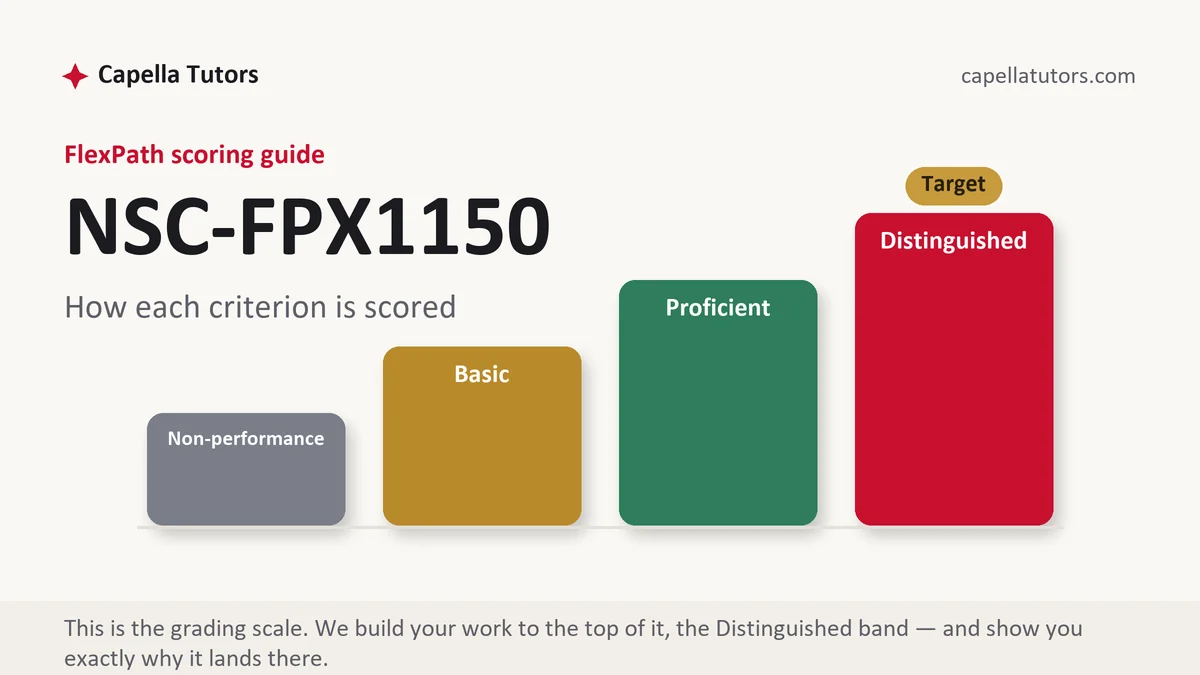
Science and Innovation is less about any particular science than about how scientific knowledge gets made and what happens when somebody turns it into a product. The assessments in this course usually give you a technology, a discovery, or a public claim and ask you to work backward to the evidence behind it. A response that summarizes what the innovation does has written a summary, and summaries score in the middle of the scale. The row is waiting for the connection: which observation started it, what was tested, who did the testing, what result would have killed the idea, and what the thing can now do that it could not do before.
Method vocabulary is graded, and graded strictly, so use it the way scientists use it. A hypothesis is a testable statement that can fail. A theory is an explanation that has survived a great deal of testing and organizes many observations, which is the opposite of a guess. A controlled comparison holds everything constant except the one factor under test, which is why a single before-and-after story is not evidence of anything. Replication turns one result into a finding, and peer review is a filter rather than a guarantee, which is why retractions exist. A paper that uses these words precisely reads as though the writer has been inside the process, and that impression is worth more here than enthusiasm about the technology.
The third strand is consequence. Innovation criteria ask what changed and for whom, and they want quantities wherever quantities exist. Take household lighting: a 60 watt incandescent bulb and a 9 watt LED both put out roughly 800 lumens, so the LED saves 51 watts. Run either one five hours a day for a year and the LED avoids about 93 kilowatt hours, which at 16 cents per kilowatt hour is close to fifteen dollars a year for one socket. Then write the other half, because every innovation has one: the LED costs more up front, contains electronics that complicate disposal, and its lifetime claim assumes operating conditions your lamp may not provide. Benefit stated with a number and cost stated with a number is what the top column describes.
How we help in this course
Our 1150 drafts start from the primary literature rather than from a product page. Tell us which innovation, discovery, or claim your prompt names and we will trace it to the research it rests on, state the mechanism in language a non-specialist can follow, and give the benefit and the trade-off in the same units so a reader can weigh them against each other. Where a claim turns out to be weaker than its publicity, the draft says so, because a criterion asking you to evaluate an innovation is asking for a judgment rather than a brochure.
Terms here are the ones the studio runs everywhere. A deliverable comes back within 24 to 48 hours, pitched at the top column, and eight people touch it before you see it. The research analyst starts from your scoring guide and locates the agency reporting and journal articles the criteria are pointing at, the subject writer builds the draft, a reviewer marks it against each row the way an evaluator will, an APA and originality check runs the citation list both ways, and an editor takes the last pass. Rewrites cost nothing until the guide is satisfied, and faculty comments come back into the queue free.
The assessments, one by one
Assessment 1
An opening assessment in a course on science and innovation usually hands you a technology or a discovery and asks you to work backward to the evidence behind it. Read the full Assessment 1 manual.
Assessment 2
A middle assessment in this course usually puts a public claim in front of you and asks whether the evidence behind it holds. Read the full Assessment 2 manual.
Assessment 3
A closing assessment in this course usually turns from what a technology does to what it costs and who carries the cost. Read the full Assessment 3 manual.
How to actually write NSC FPX 1150: where to begin
Take the scoring guide apart before you choose a topic, because the topic has to fit the rows rather than the other way round. Copy every criterion into a blank document, put the Distinguished sentence under each one, then test your candidate innovation against the list. If a row asks you to evaluate the evidence supporting a technology and your technology has three press releases and no published research behind it, change the technology now rather than in the last two hours before submission.
Then build the chain from science to thing. Every innovation worth writing about sits on top of a finding somebody made without knowing what it would become. Satellite positioning does not work without corrections drawn from relativity, because clocks in orbit and clocks on the ground do not keep the same time and the discrepancy accumulates into a positional error of kilometers a day if it is ignored. Write that chain in four steps: the underlying science, the observation or experiment that established it, the engineering decision that turned it into a device, and the constraint that still limits it. Four steps is usually the difference between a description and an analysis.
Then handle risk honestly. Innovation criteria almost always contain a row about consequences, and the trap is writing it as a paragraph of caution with no specifics in it. Name who bears the cost, name the timescale, and name the thing that would have to be measured to know whether the worry was justified. A statement that a technology raises privacy concerns is not gradeable. A statement that a system retains location records for a stated period, that the retention is what creates the exposure, and that shortening it is the change a regulator could actually require gives an evaluator something to score.
| Section | What goes in it | What Distinguished looks like |
|---|---|---|
| The claim | The innovation or discovery, stated as a specific claim about what it does and for whom. | A claim narrow enough to be checked, with the version and the date of the technology fixed. |
| The underlying science | The principle it depends on, and the experiment or observation that established that principle. | The original work named and dated, not a general appeal to physics or chemistry. |
| The evidence | What has been measured, by whom, under what conditions, and how many times. | Replicated results kept separate from single studies, and manufacturer data labeled as such. |
| Benefit | The improvement expressed in units, against a baseline that is named in the sentence. | A quantity with a baseline, a window, and a source, comparable to whatever it replaces. |
| Cost and risk | The money, materials, energy, labor, or exposure the innovation creates or shifts elsewhere. | Trade-offs quantified where possible and attributed to somebody specific where they are not. |
| Sources and format | Peer-reviewed science, agency technical reporting, and standards bodies, in current APA. | Primary studies cited for findings and agency data for scale, with no press release doing either job. |
Developing the synthesis
Synthesis in this course means putting two accounts of the same technology beside each other and explaining why they differ. Take electric vehicles. Life-cycle analyses generally find lower total emissions than an equivalent combustion vehicle across the life of the car, but the size of the advantage depends almost entirely on two inputs the analyses do not share: how the electricity is generated where the car is charged, and how the battery was manufactured and will be recycled. Two studies reaching different conclusions are often not disagreeing about the vehicle at all, they are using different grids. Saying that in one sentence is worth more than a page of argument for either side. Do the same wherever your sources conflict: identify the assumption that differs, say which assumption fits the situation your paper is about, and let the conclusion follow. Close by naming the measurement that would settle it, because a student who can say what evidence is missing has understood the method the course is teaching.
Citations that survive faculty review
A science and innovation paper needs three source types and gets into trouble when it substitutes one for another. Peer-reviewed research, reached through the Capella library and databases such as Academic Search or ScienceDirect, carries every claim about what has been demonstrated, and you should be able to state the method and the sample before you cite it. Technical and statistical reporting from agencies carries scale and chronology: the Department of Energy and the Energy Information Administration for energy figures, NASA and NOAA for observational data, NIST for measurement standards, and the Patent and Trademark Office for what was actually claimed and when. Standards and professional bodies such as IEEE carry definitions and specifications. What carries nothing is a company announcement, a keynote, or a magazine feature, all useful for finding the study and useless as the citation itself. Date everything, because a five-year-old figure in a fast-moving field is a factual error rather than an old source.
The mistakes that land Basic instead of Distinguished
- Citing the manufacturer for the manufacturer's claim. A vendor is a party to the question and cannot settle it.
- Calling a theory a guess. The word means close to the opposite in science, and using it loosely tells the evaluator you have not read a method section.
- An innovation with no science underneath it. Describing what a device does without the principle it exploits leaves the main row unanswered.
- Benefits with no baseline. Faster, cheaper, and cleaner are comparisons, and a comparison with nothing to compare against is an adjective.
- Ignoring the attempts that failed. Most innovations arrive after several that did not work, and the failures are where the interesting constraint lives.
NSC FPX 1150 questions students actually ask
What counts as an innovation I can write about?
Anything with published evidence behind it and a boundary you can draw around it. The safest choices are mature enough to have a literature and specific enough to have numbers: a battery chemistry, a water treatment method, a vaccine platform, a construction material, a diagnostic test. The risky choices are enormous categories such as artificial intelligence or renewable energy, which force you into generalities, and products announced in the past few months, which have publicity instead of evidence. If you cannot find two peer-reviewed articles about it in the library, the topic is not too advanced, it is too new, and the criteria will punish that rather than reward it.
How do I tell a scientific source from a persuasive one?
Ask what would have changed the author's mind. A scientific report states a method, gives the conditions, reports the inconvenient results alongside the rest, and stops where the data stops. A persuasive document states a conclusion and recruits evidence toward it, and the tell is usually the absence of limits: no sample size, no interval, no mention of what the study could not show. Two other habits help. Check whether the document says who paid for it, and check whether the figures it quotes are traceable to something you can open. A number appearing in three articles that all cite each other has one origin and no verification.
Does this course require math?
Arithmetic rather than mathematics, but the arithmetic has to be right and it has to be labeled. You will be converting units, calculating a percentage change, working an annual figure out of a daily one, and comparing quantities that were reported on different bases. The errors that cost marks are mundane: a percentage with no starting value, a watt confused with a watt hour, a monthly figure set against an annual one. Write the calculation into the sentence rather than presenting only the answer, because a reader who can follow the arithmetic will trust the conclusion, and an evaluator who cannot follow it has to assume the worst.
Innovation analysis due?
Send the prompt, the rubric, and the technology you were assigned. We will trace it back to the research it rests on and quantify both sides of it. No charge at all on the opening premium sample.