This manual is for NSC FPX 1150 Assessment 1, start to submission. An opening assessment in a course on science and innovation usually hands you a technology or a discovery and asks you to work backward to the evidence behind it. The assessment usually wants the chain from a finding to a device rather than a description of what the device does. Your scoring guide decides which technology is in scope and how far back the chain has to reach. You can also hand it across, and a premium original sample tracing your technology back to its founding research arrives inside 24 to 48 hours, revised free until the rows clear. Capella's catalog lists the course as NSC-FPX1150, and some courserooms print NSC1150; both point to this same Assessment 1.
One honesty note before the manual: Capella revises courses and scoring guides over time, so always write to the exact scoring guide attached to your assessment in the courseroom. The course identity above is verified on capella.edu; the method and structure below are our tutors' approach to it, not Capella's official rubric text.
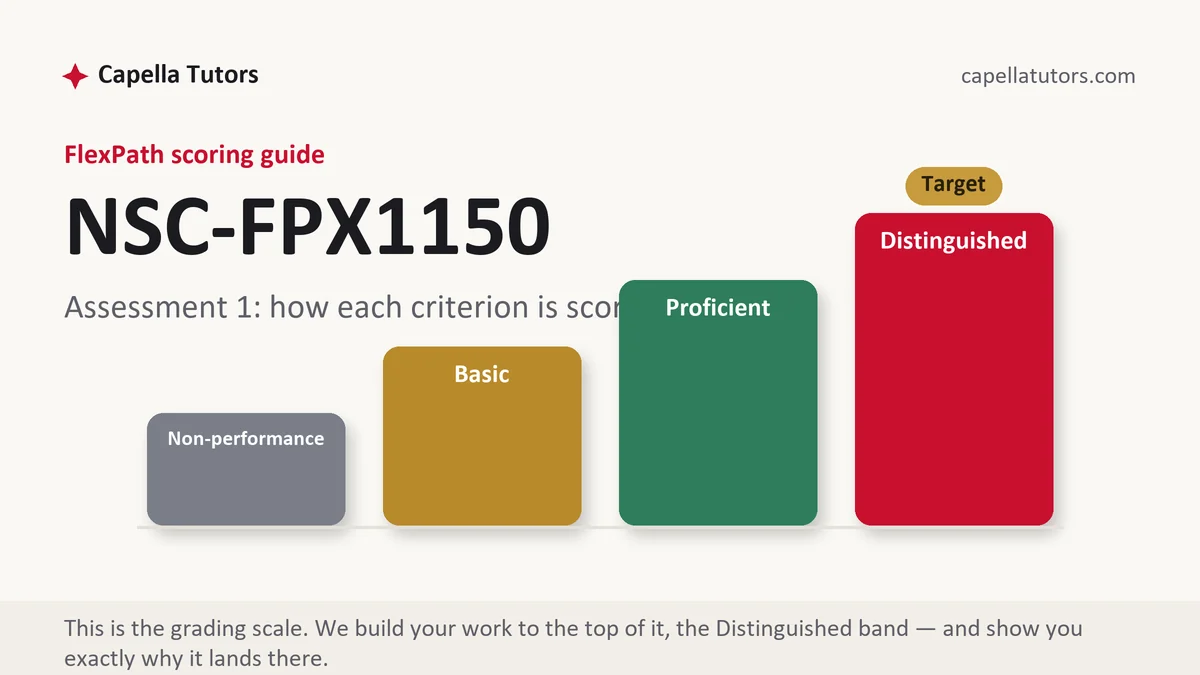
How NSC FPX 1150 Assessment 1 is scored
FlexPath grades criterion by criterion, with no letter and no average. Every row settles on one of four levels, and that level text is the brief you write to:
| Level | What it means on an innovation analysis |
|---|---|
| Distinguished | The underlying science named and dated, the engineering decision that turned it into a device identified, and the constraint that still limits it stated with a figure. The additional move is written into the criterion. |
| Proficient | The technology explained accurately with its scientific basis identified. Complete, and one step below the wording above it. |
| Basic | A summary of what the innovation does, with the science gestured at rather than traced. The default landing place for a first attempt. |
| Non-performance | A required element missing, most often the evidence behind the claim. An empty row cannot be partially credited. |
A summary and an analysis can be the same length and use the same sources. The difference is whether the paper answers the question of how anybody knows, and that question is what almost every criterion in this course is asking in its own vocabulary.
The NSC FPX 1150 Assessment 1 method, step by step
-
Test the topic against the rows before you commit to it
Copy each criterion into a blank document and check your candidate technology against the list. If a row asks you to evaluate the evidence supporting a device and your device has three press releases behind it, change the device now rather than in the last two hours before submission.
-
Build the chain in four links
Every innovation worth writing about sits on a finding somebody made without knowing what it would become. Write the underlying principle, the experiment that established it, the engineering decision that turned it into a product, and the constraint that still limits it. Four links is usually the whole distance between description and analysis.
-
Use the method words the way scientists use them
A hypothesis can fail. A theory has survived a great deal of testing and organizes many observations. A controlled comparison holds everything constant except one factor. Replication turns a result into a finding. Peer review filters rather than guarantees. Precision with these words reads as familiarity with the process, and it is worth more here than enthusiasm.
-
Quantify the benefit against a named baseline
Faster and cleaner are comparisons, and a comparison with nothing behind it is an adjective. State the improvement in units, name what it is being measured against, and give the window. Then do the same for the cost, because every innovation shifts one somewhere and the criterion is looking for both halves.
-
Keep the vendor out of the evidence chain
A manufacturer is a party to the question and cannot settle it. Company data is citable as a claim about what the company says, never as the finding itself. Trace anything that matters to the study or the agency report underneath, and attach a date, because a five-year-old figure in a moving field is a factual error rather than an old source.
-
Self-score against the guide, then submit early
Mark each criterion D, P, B or N yourself, reread every row you did not put at the top, and repair it before anybody else reads the file. Attempts go into a queue with up to two business days of review attached, so a submission early in the week leaves you room to act on what comes back.
A structure that maps to the criteria
These lengths are our tutors' planning targets for an innovation analysis, not Capella rules; wherever your scoring guide asks for more, give it more.
| Section | What it must do | Guide |
|---|---|---|
| The claim | The innovation stated as a specific claim about what it does and for whom, with its version and date fixed. | ~140 words |
| The science underneath | The principle it depends on and the experiment or observation that established that principle, named and dated. | ~250 words |
| The evidence | What has been measured, by whom, under what conditions, and how often, with replication kept apart from single results. | ~300 words |
| Benefit, quantified | The improvement in units against a stated baseline, with the source and the period the figure covers. | ~220 words |
| Cost and constraint | The money, energy, materials or exposure the innovation creates or moves elsewhere, and who carries it. | ~230 words |
| Sources and format | Peer-reviewed science, agency technical reporting and standards bodies, in current APA both ways. | as needed |
Annotated sample excerpt
A model excerpt written by our team to show how a chain from science to device reads at the top of the column. Read it for the moves, then build the same chain around the technology your prompt named.
Salt water does not separate itself, and the reason is osmotic pressure: dissolved ions pull fresh water toward them across a permeable barrier, and seawater at ordinary salinity exerts something close to 27 bar of it.1 Reverse osmosis is the engineering answer to that number, pushing the water the other way at a pressure above the osmotic figure, so the practical design question was never the membrane alone but the pump, which is why the technology stayed in the laboratory until high-pressure equipment and thin-film composite membranes arrived together.2 The constraint has moved rather than disappeared: modern seawater plants use roughly 3 to 4 kilowatt hours per cubic meter of drinking water produced, against a thermodynamic floor near 1 kilowatt hour, so the remaining gap is pumping and recovery losses, and the concentrate left behind is twice the salinity of the sea it came from and has to go somewhere.3
- 1States the principle and attaches a number to it in the same sentence, so the engineering that follows has something to be measured against.
- 2Names the engineering decision and the reason the idea waited, which is the link most drafts skip between a principle and a product.
- 3Gives the current figure, the theoretical floor and the by-product in one sentence. A constraint expressed as a gap between two numbers is what the top column means by evaluating an innovation.
The full premium sample for your exact assessment, written fresh to your scoring guide and issue, is free to request. Study it, revise it into your own voice, and submit work you understand.
The five mistakes that cost Distinguished
- The device described and the principle assumed. A paper that explains what a machine does without the science it exploits leaves the central row unanswered.
- A vendor cited for the vendor's own claim. The company is a party to the question, and its number is evidence about the company rather than about the technology.
- Benefit stated with no baseline. An improvement has to be an improvement over something, and the something has to appear in the sentence.
- The failed attempts left out. Most innovations arrive after several that did not work, and the failures are where the interesting constraint usually lives.
- Theory used as a synonym for guess. In science the word means close to the opposite, and using it loosely tells the evaluator you have not read a method section.
Pre-submission checklist
- Every criterion has its own labeled section and its own evidence
- The chain runs principle, experiment, engineering decision, remaining constraint
- Each measured claim carries who measured it, under what conditions, and how often
- Benefit and cost are both expressed in units against named baselines
- No press release, keynote or product page is carrying a finding
- Dates attached to every figure, APA matched both ways, self-scored before submitting
Innovation analysis due this week?
Send the prompt, the criteria and the technology you were assigned or are choosing between. Eight people handle the file, including a research analyst who traces the device back to the literature it rests on and a reviewer who grades the draft against your own rows. It returns within 24 to 48 hours and goes back through review at no cost for as long as the guide is unmet.