This manual is for NSC FPX 1150 Assessment 2, start to submission. A middle assessment in this course usually puts a public claim in front of you and asks whether the evidence behind it holds. The assessment usually wants the method that produced the number rather than the number, so the graded work is separating what has been demonstrated from what has been announced. Delegating is an option: a premium original sample testing your claim against independent measurement lands inside 24 to 48 hours, with revision included until the guide is met. Capella's catalog lists the course as NSC-FPX1150, and some courserooms print NSC1150; both point to this same Assessment 2.
One honesty note before the manual: Capella revises courses and scoring guides over time, so always write to the exact scoring guide attached to your assessment in the courseroom. The course identity above is verified on capella.edu; the method and structure below are our tutors' approach to it, not Capella's official rubric text.
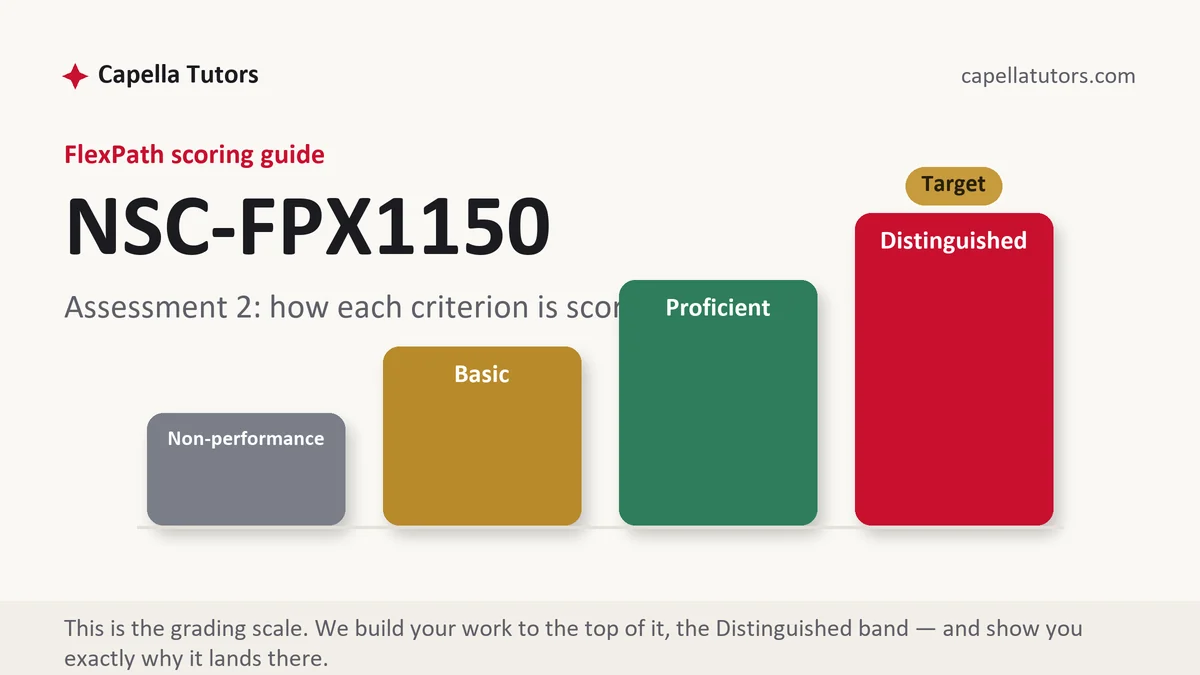
How NSC FPX 1150 Assessment 2 is scored
Each criterion is scored on its own, at one of four levels, and the level wording is what you are writing to:
| Level | What it means on a claim appraisal |
|---|---|
| Distinguished | The claim narrowed until it can be checked, the conditions of the test stated, and the difference between what was measured and what was advertised made explicit. |
| Proficient | The claim examined against real sources and judged fairly. Sound, and one level short of the top. |
| Basic | The claim restated with sources attached that share its subject without testing it. A common shape for a first submission. |
| Non-performance | A required element absent, usually the method behind the figure. Nothing to grade means no credit for the row. |
An appraisal is not a verdict written in advance. Some claims survive checking, and a paper that finds a claim well supported and says exactly which evidence supports it scores as high as one that finds the opposite. What the row measures is whether the checking happened on the page.
The NSC FPX 1150 Assessment 2 method, step by step
-
Narrow the claim until it can be tested
A claim about a whole category cannot be checked. Fix the version, the conditions and the comparison, so that the sentence you are examining could turn out to be false. That narrowing is usually the first criterion, and papers that skip it spend the rest of their length on generalities.
-
Ask what result would have forced the author to write something else
A scientific report states a method, gives the conditions, reports the inconvenient results with the rest, and stops where the data stops. A persuasive document states a conclusion and recruits evidence toward it, and the tell is the absence of limits. Two further checks help: who paid for it, and whether the figures trace to something you can open.
-
Find the test conditions and put them in the sentence
Almost every performance number is conditional. Temperature, rate, depth of use, duration, sample size: any of these can move a result more than the difference under discussion. Report the conditions beside the figure, because a number quoted without them is not comparable to the number it is being set against.
-
Separate replicated results from single ones
One measurement is a claim, and independent measurements that agree are the beginning of a finding. Say which of the two you have. Where only the manufacturer has published, say that, and treat the absence of independent testing as a result in itself rather than as a gap to be filled with optimism.
-
Do the arithmetic on the page
Convert units, work an annual figure from a daily one, express a change as a percentage of a stated base. The errors that cost marks here are mundane: a watt confused with a watt hour, a monthly figure set against an annual one, a percentage with no starting value. A reader who can follow the calculation will trust the conclusion.
-
State the verdict with the confidence the evidence carries
Write what the evidence supports, what it does not reach, and what measurement would close the distance. Then self-score every criterion against the guide and repair anything below the top column. Submit with room for a two-business-day review rather than against the last hour of the session.
A structure that maps to the criteria
Planning targets our tutors use on an appraisal of this kind, not Capella requirements; your own scoring guide decides where the length goes.
| Section | What it must do | Guide |
|---|---|---|
| The claim, narrowed | The public statement restated as one testable sentence, with version, conditions and comparison fixed. | ~140 words |
| Where the claim comes from | Who is making it, in what document, and what interest they hold in the answer. | ~180 words |
| What has in fact been measured | The independent testing, its method, its conditions and its sample, reported before its result. | ~330 words |
| The gap | The distance between the tested condition and the advertised one, expressed in units where possible. | ~250 words |
| Verdict and what would settle it | What the evidence supports, what it does not, and the measurement that would close the remainder. | ~200 words |
| Sources and format | Peer-reviewed testing, standards bodies and agency reporting, with vendor material labeled as such, current APA. | as needed |
Annotated sample excerpt
A model excerpt from our team, showing how an appraisal paragraph handles a number it did not produce. Learn the moves, then run them on the claim your own criteria named.
The advertised comparison is a cycle count, and a cycle count means nothing until three conditions travel with it: the temperature, the charge and discharge rate, and the capacity level at which the cell is declared finished.1 Published testing on lithium iron phosphate cells generally supports a longer cycle life than nickel manganese cobalt cells of comparable size, and it also shows the advantage narrowing at higher rates and shrinking again at low temperature, where the iron phosphate chemistry loses usable capacity faster than the comparison.2 So the datasheet figure and the laboratory figure are not in conflict; one was produced at a mild rate at 25 degrees Celsius with an 80 percent end-of-life definition, and the other at conditions closer to a vehicle in February, which means the honest version of the claim is that the advantage is real, conditional, and largest in exactly the application the advertisement did not name.3
- 1Refuses the number until its conditions arrive, and names the three that matter. This is the sentence that turns a restatement into an appraisal.
- 2Concedes what the independent testing supports before qualifying it, which is what fairness looks like in a criterion that measures evaluation.
- 3Explains the discrepancy by test conditions rather than by accusing anybody of dishonesty, then states the verdict with its boundary attached. Resolving a conflict by method is the top-column move.
The full premium sample for your exact assessment, written fresh to your scoring guide and issue, is free to request. Study it, revise it into your own voice, and submit work you understand.
The five mistakes that cost Distinguished
- A performance figure quoted without conditions. Rate, temperature and endpoint decide the number, and a figure stripped of them is not comparable to anything.
- Two sources that cite each other treated as two sources. A number appearing in three articles with one origin has been repeated, not verified.
- An appraisal that was a verdict before the reading started. If no evidence in the paper could have changed the conclusion, the evaluation row has nothing in it.
- Units mixed without conversion. A monthly figure set against an annual one, or power against energy, produces an answer wrong by an order of magnitude.
- Absence of independent testing described as inconclusive. That absence is itself a finding about the claim, and reporting it plainly is worth more than hedging.
Pre-submission checklist
- The claim appears as one sentence that could be false
- Every figure carries its test conditions and its source
- Independent testing is kept visibly apart from vendor material
- Each conversion or percentage shows its base and its arithmetic
- The verdict states what the evidence reaches and what it does not
- APA matched in both directions, self-scored at the top column before submitting
A claim to check and no time to check it?
Send the criteria and the claim, product or announcement you were handed. Our analyst finds the independent testing, the draft reports conditions before results, and a reviewer scores the file against your own guide row by row. Delivered in 24 to 48 hours with free revision until it clears.