This manual is for NSC FPX 1150 Assessment 3, start to submission. A closing assessment in this course usually turns from what a technology does to what it costs and who carries the cost. The assessment usually asks for consequences with names, timescales and figures attached rather than a paragraph of caution. Your scoring guide decides whether that arrives as a recommendation, a briefing or an evaluation. If you would rather not build it, a premium original sample quantifying both sides of your case comes back inside 24 to 48 hours and is revised free until it scores. Capella's catalog lists the course as NSC-FPX1150, and some courserooms print NSC1150; both point to this same Assessment 3.
One honesty note before the manual: Capella revises courses and scoring guides over time, so always write to the exact scoring guide attached to your assessment in the courseroom. The course identity above is verified on capella.edu; the method and structure below are our tutors' approach to it, not Capella's official rubric text.
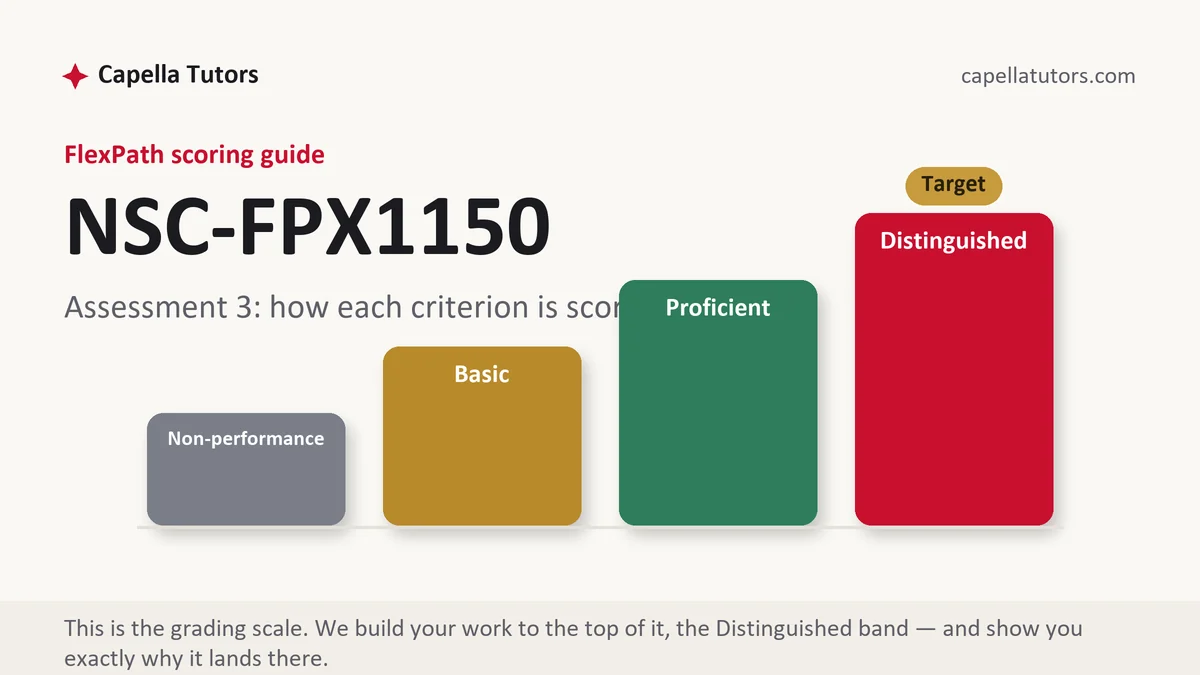
How NSC FPX 1150 Assessment 3 is scored
Every criterion is placed on one of four levels independently of the others, and the level descriptions are your instructions:
| Level | What it means on a consequence and risk deliverable |
|---|---|
| Distinguished | The risk quantified, the person who bears it named, the timescale given, and the measurement that would show whether the worry was justified identified. The extra move sits in the criterion wording. |
| Proficient | Consequences identified accurately and weighed against the benefit. Solid, and one level below the top. |
| Basic | A paragraph of general caution with no specifics inside it. The commonest way a strong technical paper loses its final row. |
| Non-performance | A required element absent, most often the cost side of the comparison. A row with no content takes the floor. |
A risk section is gradeable only where it is specific. A technology raises concerns is a sentence an evaluator cannot score. The same idea with a quantity, a population and an interval attached becomes the strongest paragraph in the paper, and it usually takes fewer words than the vague version.
The NSC FPX 1150 Assessment 3 method, step by step
-
Turn the criteria into headings, then decide the scale of the case
A whole category forces you into generalities, and a case with a boundary lets you use numbers. Pick the smallest version of the subject that still answers every row, because scale is the decision that separates a strong submission here from a competent one.
-
Name the exposure and the unit it is measured in
Risk arguments fail when the quantity is left implicit. State what is being measured, in what unit, over what period, and what level counts as ordinary in the population concerned. Once the unit is fixed, every later comparison in the paper has something to attach to.
-
Find the action level and say who set it
Most exposures have a threshold published by an agency, and the threshold is a policy judgment rather than a biological boundary. Quote it, cite the body that set it, and say what the body recommends above and below it. A recommendation that ignores the published level is arguing with an authority it did not acknowledge.
-
Cost both sides in the same currency
Put the intervention's price, its running cost and its lifespan on the page, then put the avoided exposure beside it. A comparison in mixed units is not a comparison. Where a figure cannot be quantified, attribute it to somebody specific instead, because an unowned cost tends to disappear from the analysis.
-
Say what would show whether the worry was justified
Name the measurement, the interval and the person who would take it. This is the sentence that converts caution into a testable claim, and it is frequently what the top column is describing when it asks you to evaluate consequences.
-
Reconcile the numbers, then self-score
Confirm that every figure in the prose matches the source it came from, that units are consistent throughout, and that each citation appears in both directions. Then grade yourself criterion by criterion and rework anything under the top level, leaving time for the two-business-day review window.
A structure that maps to the criteria
The targets below are our tutors' planning figures for a deliverable of this shape, not Capella rules; the scoring guide in your courseroom governs.
| Section | What it must do | Guide |
|---|---|---|
| The situation and its scale | The specific case, bounded, with the population and the period the analysis covers. | ~140 words |
| The exposure, measured | What is being measured, in what unit, at what level, and what is ordinary for that population. | ~250 words |
| What the studies show | The studies behind the risk, with design and population stated before the finding. | ~280 words |
| The intervention | How it works, what it costs to install and to run, and how long it lasts. | ~230 words |
| Recommendation and verification | The action advised, who carries the cost, and the measurement that would confirm it worked. | ~220 words |
| Sources and format | Peer-reviewed epidemiology, agency guidance and standards documents, dated, in current APA. | as needed |
Annotated sample excerpt
An original excerpt from our team showing what a quantified risk paragraph looks like. Use it as a pattern and rebuild it around whatever exposure or consequence your prompt assigned.
Radon is measured in picocuries per liter of indoor air, and the Environmental Protection Agency sets its action level at 4 picocuries per liter, a figure chosen as an achievable target rather than as a point where harm begins.1 The evidence behind it is not animal work alone: pooled analyses of residential case-control studies across North America and Europe found lung cancer risk rising with long-term indoor concentration, with no threshold visible below the action level, which is why a reading of 3 is lower risk rather than no risk.2 A sub-slab depressurization system answers the physics rather than the chemistry, cutting a slot through the slab and running a fan that holds the soil gas below the floor at slightly lower pressure than the room, and at an installed cost commonly in the low thousands with a fan drawing perhaps 60 to 90 watts continuously, the recurring cost is electricity, the recurring obligation is a retest, and the honest recommendation names both.3
- 1Fixes the unit and the published threshold in the first sentence, and says what kind of number the threshold is. Treating an action level as policy rather than biology is a distinction the top column rewards.
- 2Reports the design and the geography of the evidence before the finding, then draws the consequence for a reading under the threshold. This is the sentence that keeps the recommendation honest.
- 3Explains the mechanism of the intervention, then prices it in installation, running power and an ongoing obligation. Costing an intervention in the units it actually consumes is what separates a recommendation from a suggestion.
The full premium sample for your exact assessment, written fresh to your scoring guide and issue, is free to request. Study it, revise it into your own voice, and submit work you understand.
The five mistakes that cost Distinguished
- Concern expressed with no quantity in it. A sentence saying a technology raises risks gives an evaluator nothing to place on the scale.
- An action level treated as a biological boundary. Published thresholds are policy judgments about achievability, and describing them otherwise misstates the evidence.
- The intervention priced at purchase only. Running cost, lifespan and the retest obligation are usually the larger part of the commitment.
- A cost with nobody attached to it. Risk that belongs to no named party quietly leaves the analysis, and the criterion asking who bears it goes unanswered.
- No verification step. A recommendation with no measurement behind it cannot be checked, which is the difference between advice and an argument.
Pre-submission checklist
- The case is bounded, with its population and period stated
- The exposure has a unit, a level and a published reference point
- Study design and population precede every reported finding
- The intervention carries installation cost, running cost and lifespan
- The recommendation names who pays and what measurement would confirm it
- Units consistent throughout, APA matched both ways, self-scored before submitting
Risk and consequence section holding up the paper?
Send the criteria and the technology, exposure or decision you were given. We locate the agency guidance and the peer-reviewed evidence, quantify both sides in matching units, and write the verification step most drafts leave out. Turnaround is 24 to 48 hours, with rework included for as long as a criterion is still short.