Send the prompt and the scoring guide for anything this course asks you to produce, and a premium original sample returns inside 24 to 48 hours, argued in doctoral register, mapped criterion by criterion, revised free until the guide is satisfied. Your transcript will read NHS FPX 8002, Collaboration, Communication, and Case Analysis for Doctoral Students, worth 2 program points in Capella's FlexPath Doctor of Nursing Practice, a degree the catalog sets at a minimum of 26 program points across thirteen two-point courses with a minimum of 1,000 supervised practicum hours attached. It is one of only two codes in that list that does not begin with NURS, which is a fair hint about how this course wants a clinical problem read. In Capella's catalog the course code is written NHS-FPX8002.
What NHS FPX 8002 actually grades
This is the course that decides whether you can build an argument, and the criteria are written about method rather than opinion. The graded act is conversion: a practice situation arrives as a story, with personalities and half-remembered timelines, and you turn it into an object that can be analyzed. That means a problem stated so somebody could measure it, actors described by what they are authorized to do rather than by how helpful they were, evidence attached to every contested claim, options weighed in the open, and one recommendation you would sign. A reader should be able to disagree with you by attacking your evidence. If the only way to disagree is to read the situation differently, the analysis has not happened yet.
The collaboration criteria are the second strand, and more technical than the word suggests. Doctoral scoring does not reward the observation that teams should communicate better. It rewards a diagnosis of where a specific team's information failed and which mechanism would have caught it: a structured handoff with read-back, a shared mental model set in a briefing, an escalation path with a named threshold. Conflict gets the same treatment, a structural feature of overlapping scopes and unequal authority rather than a personality clash. When a respiratory therapist, a hospitalist, and a charge nurse each hold part of a decision and none holds all of it, that is a design problem, and the paper naming it as one is out of the Basic column already.
The third strand is audience. In current courserooms the assessments are "Demonstrating Effective Leadership", "Personal Leadership Portrait Part 1" and "Personal Leadership Portrait Part 2", and your scoring guide decides the exact format of each. Register is graded here for the first time. Claims get scaled to the evidence behind them, your clinical experience appears as context rather than proof, and you state the limits of what you can establish before an evaluator finds them.
How we help in this course
Work in 8002 goes through our doctoral bench, and the sequence is deliberate. Before any prose is drafted we build two artifacts you will keep using for the rest of the degree: a stakeholder table recording what each party is permitted to decide, and an options grid pricing each course of action against feasibility and risk. Those two structures are what most submitted case analyses lack, and they are also what makes the writing fast, because once the comparison exists on a grid the paragraphs nearly write themselves.
The studio terms apply without adjustment for doctoral level. One premium original sample per deliverable, inside 24 to 48 hours of your materials landing, drafted straight at the Distinguished descriptors rather than at the instructions, routed through the eight-person pipeline and both quality passes, then revised at no charge until the guide is met. One pass is spent on attribution alone, checking every framework is cited to the body that published it. Faculty feedback re-enters the same cycle free, which matters in a first doctoral course where one comment about register can touch four criteria.
The assessments, one by one
Assessment 1: Demonstrating Effective Leadership
A practice situation analyzed as a leadership problem. Read the full Assessment 1 manual.
Assessment 2: Personal Leadership Portrait Part 1
The first half of your leadership portrait, grounded in self-assessment. Read the full Assessment 2 manual.
Assessment 3: Personal Leadership Portrait Part 2
The completed and revised leadership portrait. Read the full Assessment 3 manual.
How to actually write NHS FPX 8002: where to begin
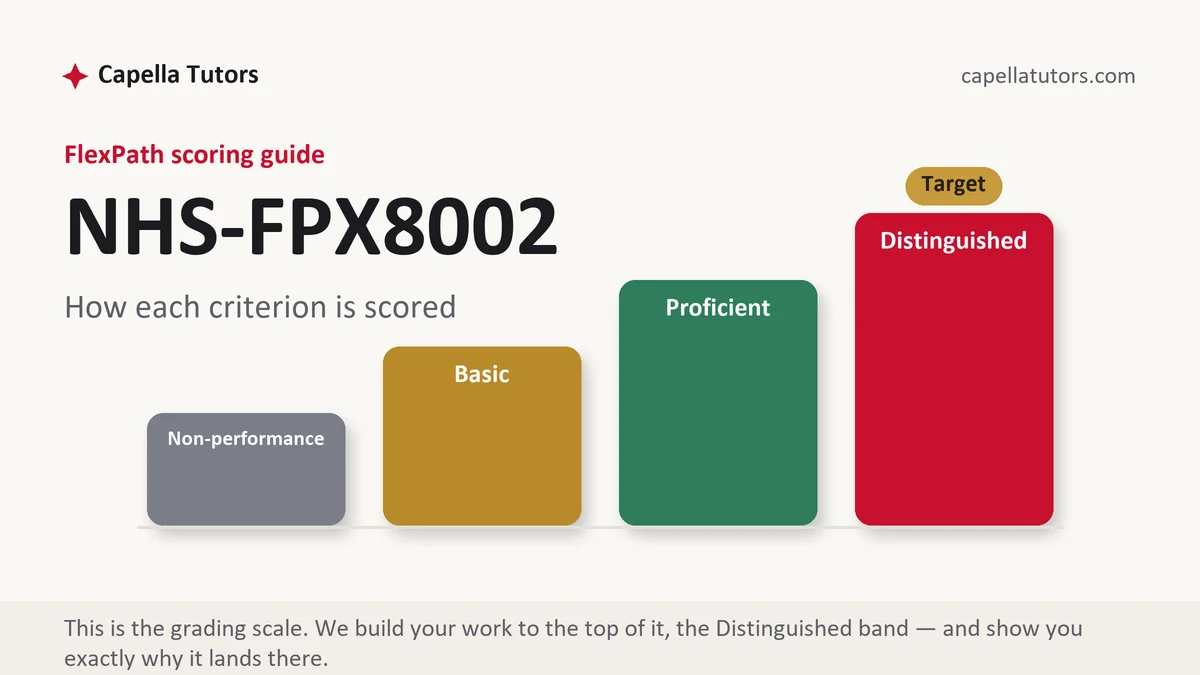
Open the scoring guide before you open the case. Copy each criterion into a blank document as a heading, paste the Distinguished wording under it, then decide which paragraph pays for that criterion. FlexPath scores every criterion at one of four levels, Non-performance, Basic, Proficient or Distinguished, and here the gap between Basic and Distinguished is the gap between retelling and analyzing. Basic work narrates what happened and attaches a conclusion. Distinguished work states a position in the first paragraph and spends the document earning it. Anything you cannot file under a criterion heading costs you words you needed elsewhere.
Next, quantify the problem in one sentence, with a denominator and a window, before you write anything else. Not that handoffs on the unit are unreliable, but that in an audit of 60 transfers from the emergency department over eight weeks, 22 arrived without a documented medication reconciliation and 9 of those involved anticoagulants. Those figures can be estimates as long as you label them as estimates and say where they came from, whether a report your unit already runs or a chart review you performed. A stated basis for a rough number reads as rigor, while a precise number with no origin reads as decoration. Once the problem has a size, every later section has something to be proportionate to.
Then build the comparison in the open. Give two or three genuine options, and for each say what it costs, who has to agree, how long approval takes, and what could go wrong. Carry a rejected option to the end with the reason for rejecting it, because a reader cannot see analysis happen when only the winner is on the page. Close by naming the person with authority to say yes, the message they need to say it, and the measure that reports back in ninety days.
| Section | What goes in it | What Distinguished looks like |
|---|---|---|
| Problem statement | The case reduced to one problem, with a count, a denominator, a time window, and the source of the count. | A problem framed so a reader could contest it on evidence rather than on taste, with a competing reading acknowledged. |
| Actors and authority | Everyone affected, everyone who decides, and what each discipline's scope actually permits. | Decision rights mapped rather than job titles listed, with the gaps and overlaps between scopes named. |
| Evidence and framework | The literature bearing on the problem plus the collaboration or communication framework governing your reading of it. | One framework applied to the facts throughout, its elements visibly doing work, cited to the body that published it. |
| Options and tradeoffs | Two or three real courses of action with cost, feasibility, approval path, and risk for each. | A rejected option carried to the end with its reasons, so the comparison is visible instead of asserted. |
| Recommendation and communication | The chosen action, the decision-maker, the message per audience, the channel, the timing, the escalation route. | A different message for the executive and the bedside audience, each opening with the ask, with a second route if the first is refused. |
| Evaluation and references | What gets measured, when it gets reviewed, who owns it, and current APA in both directions. | A measure the organization already collects, a named review date, and a reference list that matches the text exactly. |
Developing the synthesis
The evidence base for teamwork is weaker than its confidence suggests, and saying so is one of the fastest ways to show doctoral judgment here. Much of the literature is single-site before-and-after work with no comparison group, measured by self-reported climate surveys given to people who knew a program had just started. That does not make it useless, it makes it evidence of a particular strength, and your job is to name which. The top column sorts sources into two piles: normative sources say what teams are supposed to do, empirical sources say what happened when teams did it. Competency statements and professional standards belong in the first pile, and quoting them as though they demonstrate an effect is a category error faculty catch immediately.
Then take one dispute and settle it rather than surveying five. Structured handoff tools reduce omissions in observed studies, yet adherence decays once the observers leave, and the honest synthesis says both and argues for a design that survives the decay. Psychological safety is a second worthwhile fight, well supported as a predictor of speaking up and also invoked as though a leader could install it by announcing it. Cite Edmondson's own work for the construct rather than a secondary summary, and note what the original measured. Then say what your evidence cannot establish and why the recommendation stands. A limitation you volunteer is a criterion earned. The same limitation found by your evaluator is a criterion lost.
Citations that survive faculty review
Three kinds of source do three different jobs in a doctoral case analysis. Peer-reviewed interprofessional and health services research, pulled through the Capella library, CINAHL and PubMed, supports any claim that a communication change moves an outcome, and five years is the working window unless you are citing a framework's origin. Normative and regulatory material establishes obligation rather than effect: the interprofessional competency statements, AHRQ team training materials, Joint Commission requirements where handoff or escalation is at issue, and nursing scope and standards documents whenever you claim who was permitted to act. Institutional material, your own policies and audit reports, supplies local fact, and you name it in text even when it cannot be linked. Cite the competency document itself rather than a review that quotes it, then run current APA in both directions.
The mistakes that land Basic instead of Distinguished
- Telling the case in chronological order. A timeline is data, not analysis, and organizing by date answers the criteria by accident.
- Listing professions instead of examining authority. Who was in the room says nothing about who could have stopped it.
- One recommendation with no rejected alternative. Without a comparison, nothing shows judgment was exercised.
- A framework cited through a textbook. Secondhand attribution is visible in the reference list.
- A communication plan compressed into a closing paragraph. If the deliverable asks you to communicate a recommendation, the communication is the deliverable.
NHS FPX 8002 questions students actually ask
How is a doctoral case analysis different from the case studies I wrote in my master's?
A master's case study is usually asked to apply one framework correctly to a situation someone else has already summarized for you. A doctoral case analysis is asked to define the problem itself, and that is the whole difference. You decide what the case is about, you defend that choice against a competing reading of the same facts, you say who holds the authority to act, and you carry a rejected option through the paper so a reader can see the comparison happen. The second difference is accountability for uncertainty. At the master's level an unmentioned gap in the evidence is often overlooked, while at doctoral level naming what you cannot establish is itself a graded behavior, because a practice leader who overstates certainty is dangerous rather than merely wrong.
Which collaboration framework should I use?
Choose by the failure you are analyzing rather than by which name you recognize. If information dies in transit between clinicians, a structured handoff and closed-loop confirmation is the framework that has something to say about your case. If the problem is that people saw the risk and did not raise it, the psychological safety and speak-up literature is the relevant body. If the argument is about who was permitted to decide, scope of practice documents and the interprofessional competency statements do the work. One framework applied all the way through a case earns more than three named in an introduction and then abandoned, and your scoring guide will usually tell you whether it wants a specific model or leaves the choice to you.
Can I reuse writing from my master's program?
Treat your own earlier papers as sources rather than as raw material. Reusing substantial passages from work you already submitted for credit without citing it is self-plagiarism, and current APA guidance is explicit that your prior work needs a citation like anyone else's. The safer move in this course is to reuse the topic and abandon the prose, because a master's paragraph almost never survives doctoral criteria anyway. Its claims are pitched at the wrong strength, its evidence is often older than a five-year window allows, and it rarely states what the evidence fails to establish. Before you reuse anything, check your own program's academic integrity policy, since institutional rules on prior submitted work vary and your faculty apply theirs, not ours.
First doctoral deliverable due?
Send the case, the prompt, and the criteria. We will map the decision rights and build the options grid before a sentence gets written. First premium sample free.