This manual is for NHS FPX 8002 Assessment 3, start to submission. Personal Leadership Portrait Part 2 completes the portrait you began in Assessment 2. It usually asks you to revise Part 1 using faculty feedback and to finish the remaining sections, such as ethical leadership, diversity and inclusion in health care leadership and your role as a scholar-practitioner, so the final document presents a coherent picture of the leader you are and intend to become. The grade turns on integration and growth. The finished portrait should read as one argument about you, not as two assignments joined, and it should show how feedback changed it. Below is the method our tutors use, a structure that maps to the criteria, and an annotated sample excerpt. Prefer to hand it off? A premium original sample for this exact assessment comes back in 24 to 48 hours, revised free until it meets the guide. Capella's catalog lists the course as NHS-FPX8002, and some courserooms print NHS8002; both point to this same Assessment 3. In current courserooms this assessment typically appears as "Personal Leadership Portrait Part 2".
One honesty note before the manual: Capella revises courses and scoring guides over time, so always write to the exact scoring guide attached to your assessment in the courseroom. The course identity above is verified on capella.edu; the method and structure below are our tutors' approach to it, not Capella's official rubric text.
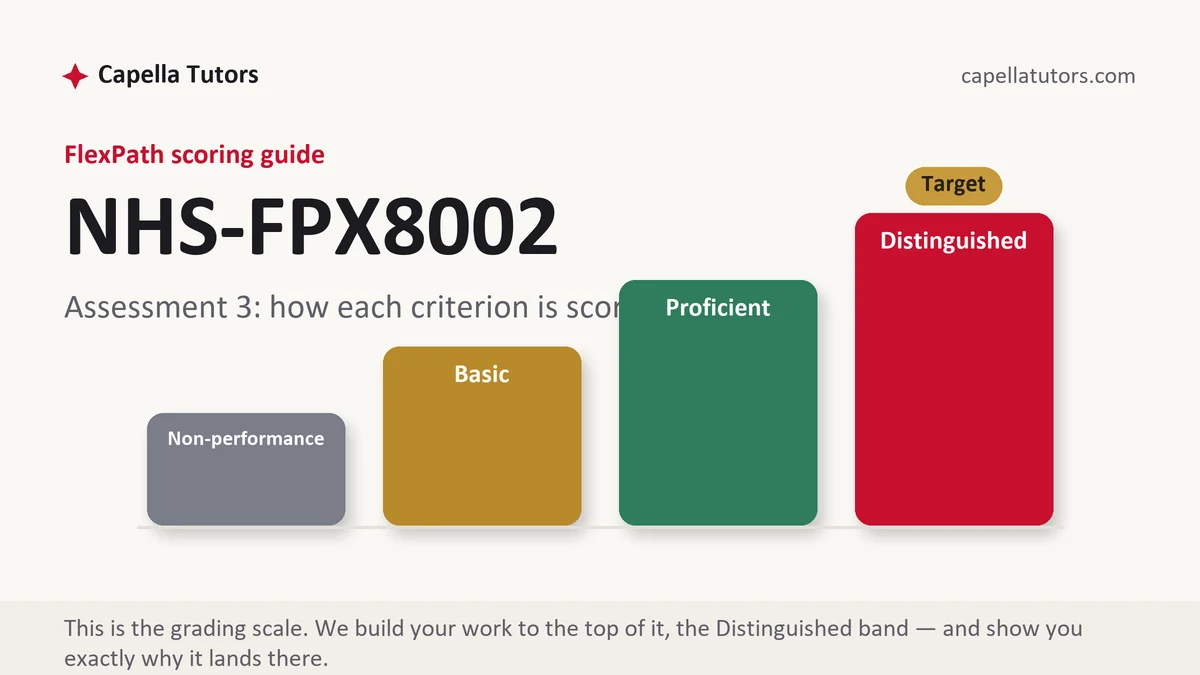
How NHS FPX 8002 Assessment 3 is scored
FlexPath does not use letter grades. Each criterion in the scoring guide lands on one of four levels, and the level descriptions are the real writing brief:
| Level | What it means on the completed leadership portrait |
|---|---|
| Distinguished | Part 1 is revised in response to feedback, the remaining sections are evidenced with theory and practice examples, the scholar-practitioner role is defined with a concrete plan, and the whole portrait reads as one integrated account with clear development goals. |
| Proficient | All sections are present and accurate, but revisions to Part 1 are minimal and the sections connect loosely. |
| Basic | New sections are added without revising Part 1, and examples are general. |
| Non-performance | Required sections are missing or Part 1 feedback is ignored. |
Read your Part 1 feedback first and make those changes before writing anything new. Evaluators often check whether the feedback was addressed.
The NHS FPX 8002 Assessment 3 method, step by step
-
Revise Part 1 from feedback
Address every comment, and strengthen evidence where faculty asked for it.
-
Write ethical leadership
Your ethical commitments as a leader, a framework or code you rely on, and an example of an ethical decision.
-
Write diversity and inclusion
How you build inclusive teams and equitable care, with evidence and an example.
-
Define your scholar-practitioner role
How you will use evidence and contribute to it in practice, for example through a DNP project or quality work.
-
Set development goals
Two or three goals drawn from your growth areas, each with actions and a time frame.
-
Integrate the portrait
Revise transitions and the introduction and conclusion so the document reads as one account.
A structure that maps to the criteria
Word counts are planning targets our tutors use, not Capella rules; follow the sections and length your scoring guide assigns to the completed portrait.
| Section | What it must do | Guide |
|---|---|---|
| Introduction (revised) | Who you are as a leader and what the portrait shows. | ~125 words |
| Part 1 sections (revised) | Leadership approach, change management, EI and collaboration, updated from feedback. | ~500 words |
| Ethical leadership | Commitments, framework and an example. | ~200 words |
| Diversity and inclusion | Inclusive leadership with evidence and an example. | ~200 words |
| Scholar-practitioner role | How you use and contribute to evidence. | ~175 words |
| Development goals, conclusion and references | Goals with actions, then current APA. | ~175 words |
Annotated sample excerpt
An original model excerpt from our team, written to show the register that reaches the top of the guide. Learn the moves, then write your own version.
As a scholar-practitioner, my role is to move evidence into my organization and to produce evidence from it, not only to consume what others publish.1 In practice that means my DNP project on discharge teaching will be designed so its data can be shared with other units, and it means I will bring one current study to each monthly practice council meeting rather than relying on what the group already believes.2 My Part 1 feedback noted that my examples leaned on clinical expertise rather than inquiry, so this section is where I commit to the habit that closes that gap.3
- 1Defines the role precisely as two-way work with evidence.
- 2Turns the definition into concrete practices tied to the DNP project.
- 3Shows the feedback from Part 1 shaping the final portrait.
The full premium sample for your exact assessment, written fresh to your scoring guide and topic, is free to request. Study it, revise it into your own voice, and submit work you understand.
The five mistakes that cost Distinguished
- Ignoring Part 1 feedback. Address it before adding new sections.
- Two documents stapled together. Integrate the portrait into one account.
- Ethics in the abstract. Give an example of an ethical decision.
- Diversity without action. Say what you do to build inclusive teams.
- Goals without actions. Each goal needs steps and a time frame.
Pre-submission checklist
- Part 1 revised from feedback
- Ethical leadership with framework and example
- Diversity and inclusion with evidence and example
- Scholar-practitioner role defined with concrete practices
- Development goals with actions and time frames
- Integrated document with current APA references
Want help completing the portrait?
Send the scoring guide, your Part 1 and its feedback. Our team returns a premium original completed portrait in 24 to 48 hours, revised free until it meets the guide.