This manual is for NHS FPX 8002 Assessment 1, start to submission. The opening deliverable in this course usually asks you to take a practice situation and convert it into something analyzable: one problem stated with a count behind it, the people involved described by what they are authorized to decide rather than by job title, and a defensible reading of the case argued against a competing reading of the same facts. Below is the method our doctoral bench uses, a structure that maps to the criteria, and an annotated sample excerpt. Would you rather we ran it? A premium original sample for this exact assessment comes back inside 24 to 48 hours, with revisions free until the guide is met. Capella's catalog lists the course as NHS-FPX8002, and some courserooms print NHS8002; both point to this same Assessment 1. In current courserooms this assessment typically appears as "Demonstrating Effective Leadership".
One honesty note before the manual: Capella revises courses and scoring guides over time, so always write to the exact scoring guide attached to your assessment in the courseroom. The course identity above is verified on capella.edu; the method and structure below are our tutors' approach to it, not Capella's official rubric text.
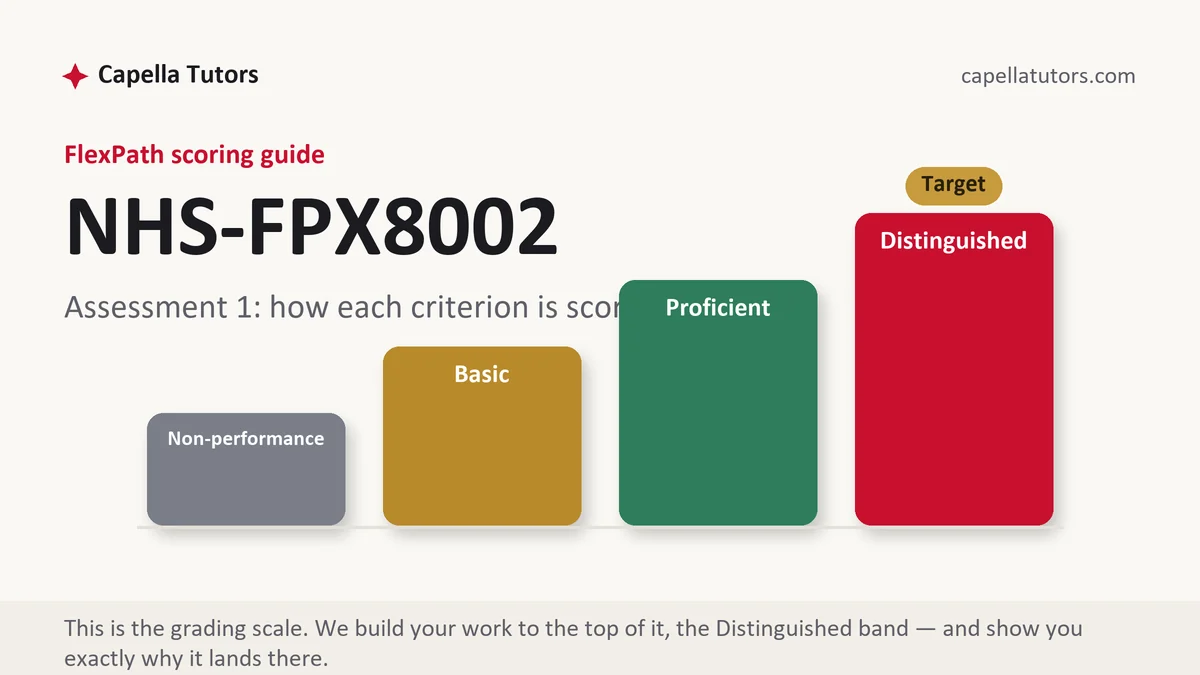
How NHS FPX 8002 Assessment 1 is scored
FlexPath issues no letter grades. Every criterion on your scoring guide lands on one of four levels, and the wording of those levels is the brief you are drafting to:
| Level | What it means on a doctoral case analysis |
|---|---|
| Distinguished | The problem is defined rather than retold, authority is mapped, a rejected option is still visible at the end, and the writing names what the case cannot settle. The additional move is written into the criterion itself; locate it and perform it. |
| Proficient | The case is analyzed accurately and completely and the recommendation is defensible. Sound work, one visible comparison short of the top column. |
| Basic | The situation is narrated in the order it happened with a conclusion attached at the end. This is where most first doctoral submissions land, and the fix is structural rather than verbal. |
| Non-performance | A required element is missing, most often the authority mapping or the alternatives. Absence rather than weakness is what puts a criterion on the floor. |
Read the four levels as behaviors rather than as quality adjectives. Narrating earns Basic, analyzing earns Proficient, and analyzing while showing the reasoning under contest earns the top column.
The NHS FPX 8002 Assessment 1 method, step by step
-
Turn the criteria into the document's skeleton
Open a blank file, paste each criterion in as a heading, and put the Distinguished wording underneath it. Then decide which paragraph pays for which criterion. Anything that cannot be filed under a heading is spending words you needed elsewhere.
-
Reduce the case to one problem with a denominator
Write the problem as a sentence a reader could argue with: a count, what it is counted out of, the window it covers, and where the figure came from. An estimate labeled as an estimate reads as rigor. A confident number with no origin reads as decoration, and evaluators check origins first.
-
Map decision rights before you write a recommendation
Build a table of everyone the problem touches, with a column for what each party is permitted to decide and a second for what they can only advise on. Overlaps and gaps in that table are usually the finding. A list of professions is not.
-
Choose one framework and make it work the whole way through
Pick the framework that fits the failure rather than the one you recognize, then apply its elements to your facts section by section. One model carried to the end outscores three named in an introduction. Cite it to the body that published it, since secondhand attribution shows up in the reference list.
-
Price two or three options and keep the one you reject
For each option give the cost, the approval path, the time to a decision, and the risk if it fails. Carry the rejected option all the way to the recommendation with the reason it lost. A reader cannot watch judgment happen when only the winner is on the page.
-
Self-score, then reread as the person who must say yes
Mark yourself against each criterion honestly, then reread as the executive who would have to approve it. If that reader cannot find the ask, the cost, and the measure inside a minute, the recommendation criterion is not yet earned. Submit early in the week, because a doctoral evaluation can sit for two business days.
A structure that maps to the criteria
The word targets below are planning figures our tutors use for a doctoral case analysis of ordinary length, not Capella rules; stretch any section your scoring guide weights more heavily.
| Section | What it must do | Guide |
|---|---|---|
| Problem statement | Reduce the case to one problem with a count, a denominator, a window, and a named source for the figure, then say why that framing beats the obvious alternative. | ~200 words |
| Case facts that matter | Only the facts your analysis will use, grouped by relevance rather than by chronology, with the disputed ones flagged as disputed. | ~250 words |
| Actors and authority | Who is affected, who decides, what each discipline's scope permits, and where two scopes overlap without either one owning the call. | ~250 words |
| Evidence and framework | The literature bearing on the problem and one collaboration framework applied to your facts, its elements visibly doing work rather than being defined. | ~300 words |
| Options and recommendation | Two or three real courses of action costed and compared, the rejected one still present, and the chosen action with the person who can authorize it. | ~300 words |
| Evaluation and references | What gets measured, on what denominator, reviewed by whom and when, plus current APA matched in both directions. | ~150 words |
Annotated sample excerpt
An original model excerpt from our doctoral desk, at the register the top column describes. Study material: take the moves, then build your own version on your own case.
Across the four acute campuses in this system, 214 inpatient deaths last fiscal year carried sepsis as a contributing diagnosis, and the mortality review committee closed 186 of them with a finding that care had been appropriate.1 The closure rate, not the deaths, is the problem this analysis defines, because a review process that almost never finds anything reviewable produces no learning while consuming roughly 40 physician hours a month.2 A competing reading deserves to be stated first: the care may genuinely have been appropriate, and the committee may be measuring a real absence rather than failing to see a present one, which is why the sections below separate what the reviewers were given from what they concluded.3
- 1Opens on numbers with a denominator, a window, and a named source, so the reader can contest the framing on evidence rather than on taste.
- 2Relocates the problem from the outcome to the process that reviews it. Choosing which problem the case is about is the graded act, and doing it explicitly is a top-column move.
- 3Puts the rival reading of the same facts on the page before defending against it, then tells the reader how the analysis will adjudicate. Proficient work skips this sentence.
The full premium sample for your exact assessment, written fresh to your scoring guide and issue, is free to request. Study it, revise it into your own voice, and submit work you understand.
The five mistakes that cost Distinguished
- Chronology as organization. A timeline is raw material, and a paper sorted by date answers its criteria only by accident.
- A problem with no size. Without a count and a denominator, no later section can be proportionate to anything.
- Job titles instead of authority. Who was present tells the reader nothing about who could have stopped it.
- A single option presented as inevitable. With nothing rejected on the page, the comparison criterion has no evidence to grade.
- Certainty the case does not support. Volunteering the limit of what you can establish earns a criterion; leaving it for the evaluator to find loses one.
Pre-submission checklist
- Each scoring-guide criterion has its own labeled section in the document
- The problem appears as one contestable sentence with a count, a denominator, and a source
- Decision rights are tabled, with overlaps and gaps between scopes named
- One framework is applied throughout and cited to its originating publication
- A rejected option survives to the final page with the reason it was rejected
- Self-scored at the top level on every criterion, with references matched both ways
First doctoral case analysis due?
Send the case file, the prompt, and the criteria. We map the decision rights and build the options grid before a sentence is drafted, then return a premium original sample aimed at the Distinguished column in 24 to 48 hours, revised free until your evaluator agrees.