This manual is for NHS FPX 8002 Assessment 2, start to submission. Personal Leadership Portrait Part 1 is the first half of a two-part portrait of you as a doctoral health care leader. The portrait covers your personal approach to leadership, change management and emotional intelligence, interprofessional communication and collaboration, ethical leadership, diversity and inclusion, and your role as a scholar-practitioner; Part 1 lays the foundation, usually with your personal approach to leadership grounded in self-assessment results and leadership theory, and the sections your scoring guide assigns to this part. The grade turns on evidence about yourself. A portrait that names admirable leadership traits scores lower than one that reports what your assessments showed, where you fall short, and what theory explains it. Below is the method our tutors use, a structure that maps to the criteria, and an annotated sample excerpt. Prefer to hand it off? A premium original sample for this exact assessment comes back in 24 to 48 hours, revised free until it meets the guide. Capella's catalog lists the course as NHS-FPX8002, and some courserooms print NHS8002; both point to this same Assessment 2. In current courserooms this assessment typically appears as "Personal Leadership Portrait Part 1".
One honesty note before the manual: Capella revises courses and scoring guides over time, so always write to the exact scoring guide attached to your assessment in the courseroom. The course identity above is verified on capella.edu; the method and structure below are our tutors' approach to it, not Capella's official rubric text.
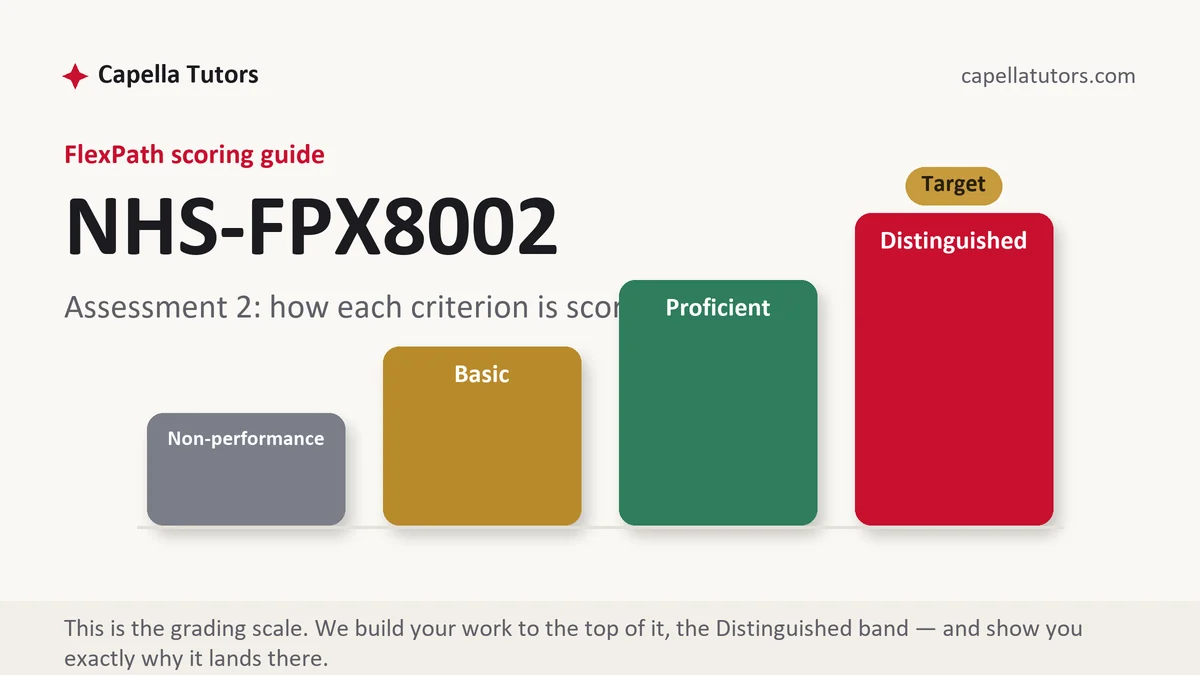
How NHS FPX 8002 Assessment 2 is scored
FlexPath does not use letter grades. Each criterion in the scoring guide lands on one of four levels, and the level descriptions are the real writing brief:
| Level | What it means on a leadership portrait |
|---|---|
| Distinguished | Your leadership approach is described through specific self-assessment results and a named theory, strengths and growth areas are both evidenced, examples from your practice illustrate each claim, and the sections connect to doctoral-level leadership expectations. |
| Proficient | The portrait is accurate and organized, but examples are general and growth areas are understated. |
| Basic | The paper describes leadership styles in general with little about you. |
| Non-performance | Required sections for this part, or the self-assessment evidence, are missing. |
Check which sections your guide assigns to Part 1 and which to Part 2, and write Part 1 so it can be revised and extended rather than replaced.
The NHS FPX 8002 Assessment 2 method, step by step
-
Gather your self-assessment results
Whatever instruments the course provides or names, such as leadership style or emotional intelligence assessments. Record the actual results.
-
Name your leadership approach
Connect your results to a theory such as transformational, servant or authentic leadership, with a source.
-
Illustrate with practice examples
One concrete, de-identified situation for each major claim about how you lead.
-
Address change management and emotional intelligence
How you lead people through change, what your EI results suggest, and where that helps or hinders.
-
Cover interprofessional communication
How you communicate and collaborate across disciplines, with an example and evidence.
-
Name growth areas honestly
The two areas your results and experience point to, which Part 2 can build into a development plan.
A structure that maps to the criteria
Word counts are planning targets our tutors use, not Capella rules; follow the sections and length your scoring guide assigns to Part 1.
| Section | What it must do | Guide |
|---|---|---|
| Introduction | Purpose of the portrait and your current role. | ~125 words |
| Personal approach to leadership | Self-assessment results and the theory that explains them. | ~250 words |
| Change management and emotional intelligence | How you lead change, with evidence and examples. | ~225 words |
| Interprofessional communication and collaboration | How you work across disciplines. | ~200 words |
| Growth areas and conclusion | What to develop, carried into Part 2, then references. | ~150 words |
Annotated sample excerpt
An original model excerpt from our team, written to show the register that reaches the top of the guide. Learn the moves, then write your own version.
My results on the course's leadership assessment placed me highest on individualized consideration and lowest on intellectual stimulation, which fits what my staff tell me: I am good at noticing when a nurse is struggling and less consistent at inviting the team to question how the unit works.1 Transformational leadership theory treats both as essential, and the gap matters in my role because the improvement work I lead depends on frontline nurses proposing changes, not only accepting them.2 When our unit redesigned its handoff process last year, the best ideas came from two night-shift nurses I asked directly, which suggests the skill is there but not yet a habit I practice with the whole team.3
- 1Reports actual assessment results and connects them to feedback.
- 2Uses a named theory to explain why the gap matters in this role.
- 3Grounds the analysis in a real example that points toward development.
The full premium sample for your exact assessment, written fresh to your scoring guide and topic, is free to request. Study it, revise it into your own voice, and submit work you understand.
The five mistakes that cost Distinguished
- Leadership in general. Write about your own results and practice.
- No assessment evidence. Report what your instruments showed.
- Only strengths. Growth areas are part of an honest portrait.
- Examples that identify people. Keep every example de-identified.
- Writing Part 1 as finished. Leave room for Part 2 to extend and revise it.
Pre-submission checklist
- Self-assessment results reported
- Leadership approach tied to a named theory
- Practice examples for each major claim
- Change management, emotional intelligence and collaboration addressed as assigned
- Growth areas named for Part 2
- Current APA references
Want the leadership portrait drafted?
Send the scoring guide and your self-assessment results. Our team returns a premium original Part 1 in 24 to 48 hours, revised free until it meets the guide.