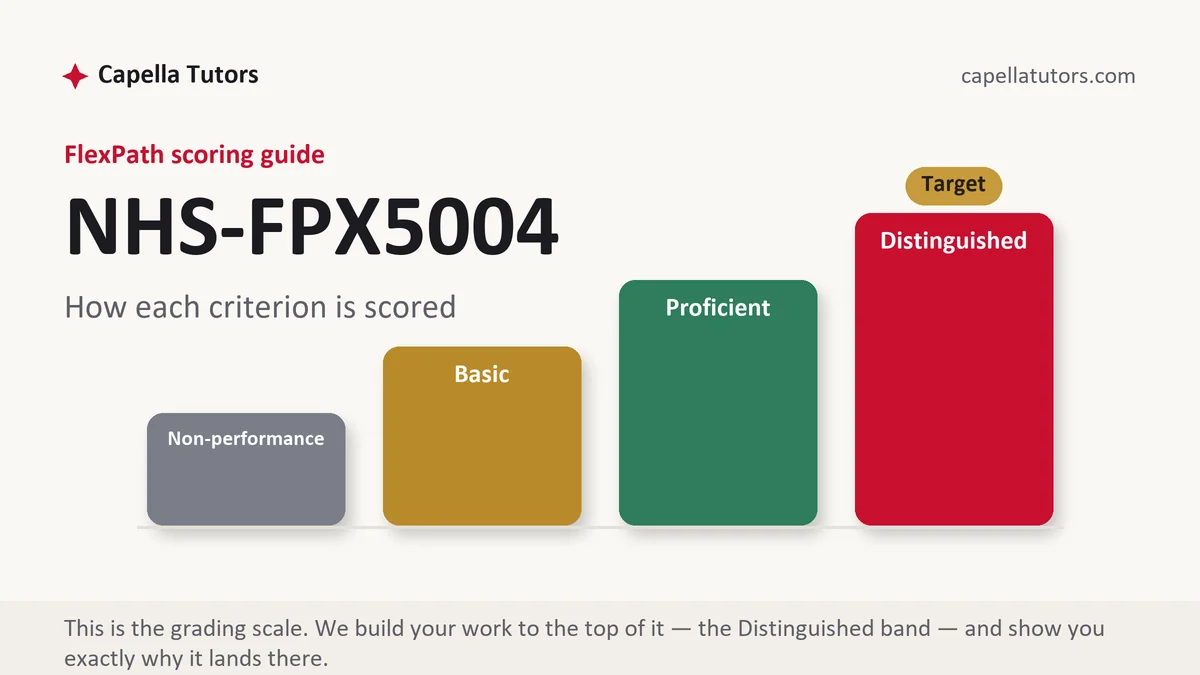
Every deliverable in this course can come back to you as a premium original sample with a walkthrough attached, inside 24 to 48 hours. The course itself: NHS FPX 5004, Communication, Collaboration, and Case Analysis for Master's Students, carrying 2 points of the 27 that make up Capella's FlexPath MSN. It is a core course, shared by every specialization in that program, and it is delivered in FlexPath, so your work is scored per criterion from Non-performance up to Distinguished rather than graded as a letter. In Capella's catalog the course code is written NHS-FPX5004.
What NHS FPX 5004 actually grades
This course grades two things at once and students usually notice only one. The visible layer is case analysis. You are handed a situation, often an interprofessional breakdown somewhere in a care setting, and asked to take it apart in writing. The layer underneath is the writing itself. Master's level scholarly voice, APA 7 mechanics, source integration, and paragraphs that argue rather than report are scored criteria here, not polite notes at the bottom of the feedback. That is why nurses with fifteen years on a unit sometimes land Basic on a first submission. The clinical judgment is there, the register is not.
Distinguished work in 5004 reads like a memo from someone who expects to be quoted: the problem stated in a single sentence, evidence attached to each claim, a communication failure named as a failure instead of described as unfortunate, and recommendations pointed at people who could act on them. Basic work summarizes the case back to the evaluator. That summary reflex is the most common shape of a first attempt in this course, and it is also the easiest thing to fix once you see it.
How we help in this course
Send the case materials and the scoring guide and the draft comes back written in the register the guide is grading for, not a nursing narrative with citations bolted on afterward. Our writers know the move this course rewards: the case read as a system problem, breakdowns traced to who failed to tell whom what, and a recommendation set aimed at a named audience. The APA layer goes to an editor whose entire job is that layer, which is why the mechanics criteria rarely cost our clients a level.
Terms are the same on any deliverable in the course. One premium original draft, inside 24 to 48 hours, built against the Distinguished column of the guide you upload, checked by eight people and two QA passes before it reaches you, then revised at no charge for as long as it takes to clear the criteria.
The assessments, one by one
Assessment 1
A premium original sample for this deliverable comes back inside 24 to 48 hours, written to the scoring guide you upload and revised free until every criterion clears. Read the full Assessment 1 manual.
Assessment 2
Hand it over and a premium original sample arrives inside 24 to 48 hours, aimed at the top column of the scoring guide you upload and revised at no cost until it lands there. Read the full Assessment 2 manual.
Assessment 3
A premium original deck with full speaker notes, written to your scoring guide, comes back in 24 to 48 hours with free revisions until every criterion clears. Read the full Assessment 3 manual.
Assessment 4
You can hand this one off: a premium original sample, written in the reflective register the criteria actually reward, arrives inside 24 to 48 hours with revisions free until the guide is satisfied. Read the full Assessment 4 manual.
How to actually write NHS FPX 5004: where to begin
Open the scoring guide before you read the case a second time. Copy the criteria into a blank document, one per heading, and paste the Distinguished wording underneath each. That document is now your paper, and the assessment instructions are demoted to what they actually are, a description of the scenario and the format. The assessments in this course usually ask for some version of the same act: analyze a situation involving people who had to work together, then produce something a professional audience could use. Your scoring guide decides the rest, including whether the deliverable is a paper, an annotated bibliography, a memo, or slides with speaker notes, so read it before you commit to a shape.
Then run the analysis before you write anything. Case analysis has a sequence, and skipping it is what produces summary. First, separate fact from interpretation: list what the case says happened, with no adjectives attached. Second, state the problem in one sentence, and make it a problem of process rather than personality, since a case about a difficult physician is unwritable while a case about a handoff with no read-back is analyzable. Third, list everyone involved by role, and note what each of them knew and when. Fourth, find the point where information should have moved and did not. That point is your thesis. Everything else in the paper hangs off it.
Register is the third of the grade nobody prepares for. Master's level writing here means claims with sources attached, paragraphs that open with a position instead of a topic, and the first person used sparingly and only where a criterion invites reflection. Contractions go. Hedging goes. So do the two habits clinical writers carry in with them: the passive voice that hides who did what, and the chronological retelling that walks an evaluator through the shift instead of arguing about it. Set the APA scaffolding up before drafting, title page, heading levels that match your criterion outline, and a reference list built as you go rather than reconstructed at midnight.
| Section | What goes in it | What Distinguished looks like |
|---|---|---|
| Introduction and problem statement | What the case is, and the one-sentence problem you intend to analyze. | A problem framed as a process failure, scoped narrowly enough that the paper can actually resolve it. |
| Case facts | Events, roles, and the flow of information, stated without interpretation. | Fact separated from inference so cleanly that the evaluator can see which is which at a glance. |
| Analysis | The case read through a named communication or collaboration framework. | The framework doing work: each element explains something specific that happened, including what it fails to explain. |
| Interprofessional considerations | Who needed to reach whom, and where the structure prevented it. | Roles named with their scope, plus the hierarchy or incentive that made silence the rational choice. |
| Recommendations | What should change, for whom, starting when. | Every recommendation matched to a failure named earlier, with an owner and a way to tell whether it worked. |
| Conclusion and APA mechanics | The synthesis, plus the formatting the criteria score. | No new material in the conclusion, no in-text citation missing from the list, headings mirroring the criteria. |
Developing the synthesis
Synthesis is the criterion most often lost in 5004, because the source material invites listing. You will finish your search with four or five articles on interprofessional communication, and the temptation is a paragraph for each. Put them in conversation instead. Two studies on handoff tools that disagree are worth more than five that agree: one found a structured tool cut omissions on a surgical unit, another found the same tool abandoned within months on a unit with thinner staffing, and the sentence that scores is the one explaining why. Weigh the designs first, then weigh each setting against your case, and let setting break the tie when the designs are comparable.
Then say what the literature cannot settle. Much of the communication research runs in academic medical centers, so if your case sits in a rural clinic or a long-term care facility, naming that limitation and arguing why the mechanism should still transfer is precisely the move the top column describes. One more habit separates levels here: tie every verdict to the criterion it serves. A synthesis paragraph that ends without telling the evaluator what it proved has done half the work.
Citations that survive faculty review
The library, not open search. CINAHL and MEDLINE through Capella return the peer-reviewed interprofessional communication literature the criteria assume, and roughly the last five years is the working window unless you are citing a source for its historical position. Past the journals, this course has a small set of sources that carry institutional weight: the AHRQ TeamSTEPPS materials for team communication structure, Joint Commission patient safety publications for the standards layer, and professional association position statements for questions about role and scope. Cite each of those as the report or web document it is, with the publishing body as author and the year printed on the document.
In text, the citation belongs inside the sentence making the claim, with the author's name doing grammatical work, rather than parked in parentheses after the paragraph has already finished arguing. Give every source an assignment: this one establishes that the failure type is common, this one supplies the framework, this one supports the recommendation. A reference list longer than the argument needs is a signal, and evaluators read it correctly.
The mistakes that land Basic instead of Distinguished
- Retelling the case. A chronological account with citations is still a summary, and it caps every analysis criterion.
- A problem statement about a person. Personalities cannot be fixed by a recommendation, processes can.
- A framework named in the introduction and never used again, sitting in a background section instead of doing analytical work.
- Recommendations with no owner and no measure. Improve communication answers nothing the case actually raised.
- APA treated as final cleanup. Headings that do not match the criteria cost you on mechanics and make the analysis harder to grade.
- The first person everywhere, or nowhere. Reflection criteria invite it, analysis criteria do not.
NHS FPX 5004 questions students actually ask
Can I use a case from my own workplace?
Usually yes, and usually you should, as long as the scoring guide has not handed you a required scenario. A case you lived gives you the information flow in detail, which is the thing invented cases never have. Two rules keep it safe. Strip identifiers, no names, no unit designations, no dates precise enough to point at a patient or a colleague, and say in one sentence that you have done so. Then check that the case contains a decision point, because a situation where nothing turned on communication gives the analysis criteria nothing to grade. If your own case is thin, a published case from the course materials is the safer pick, since at least the facts are fixed and complete.
How strict is the APA grading really?
Strict enough to move a criterion, not strict enough to sink a good analysis by itself. The mechanics criterion usually covers the visible layer: title page, heading levels, in-text citation form, reference list accuracy, and whether the prose reads at master's level. A reference list that matches every in-text citation matters more than a perfect hanging indent, and headings that mirror the scoring guide read as organized before a word is graded. The habit that pays is building the list while drafting, then checking both directions at the end, every citation present in the list, every list entry present in the text. Reconstructing sources from memory the night before is where the avoidable losses happen.
What does master's level writing actually mean here?
It means arguing, sourcing, and owning a position. Concretely: every paragraph opens with a claim rather than a topic, every claim that could be questioned carries a citation, the passive voice appears only when the actor genuinely does not matter, and the paper reaches a conclusion the evidence forced instead of a summary of what was discussed. It also means brevity, since padding is visible at this level in a way it is not in undergraduate work. If you can delete a sentence and lose nothing, an evaluator noticed it before you did. The register is learnable in about a week, which is why the first sample is worth reading as a model rather than as a product.
In NHS FPX 5004 right now?
Upload the case, the assessment instructions, and the scoring guide. The first premium sample is free and lands within 24 to 48 hours.