This manual is for NHS FPX 5004 Assessment 1, start to submission. A premium original sample for this deliverable comes back inside 24 to 48 hours, written to the scoring guide you upload and revised free until every criterion clears. If you would rather build it yourself, the method is below. Assessment 1 of NHS FPX 5004 is the program's first real test of analysis, and it usually asks you to take a coordination failure in a care setting apart in writing, often on a template the courseroom supplies and addressed to a reader who outranks you. The subject is communication. The thing being graded is whether you can hold the record of what happened apart from your reading of it, then argue a cause that a recommendation could actually reach. Capella's catalog lists the course as NHS-FPX5004, and some courserooms print NHS5004; both point to this same Assessment 1.
One honesty note before the manual: Capella revises courses and scoring guides over time, so always write to the exact scoring guide attached to your assessment in the courseroom. The course identity above is verified on capella.edu; the method and structure below are our tutors' approach to it, not Capella's official rubric text.
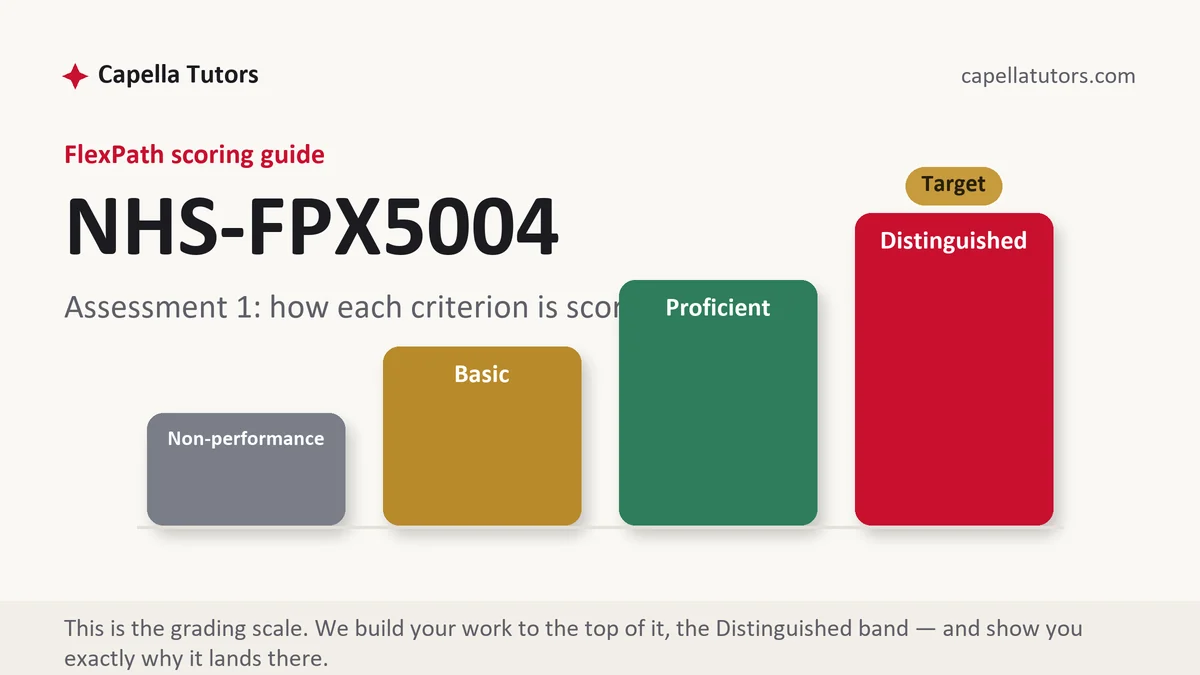
How NHS FPX 5004 Assessment 1 is scored
FlexPath trades the letter grade for a column. Every criterion in your scoring guide is judged on its own terms, and the four level descriptions are the real writing brief:
| Level | What it means on a master's-level case analysis |
|---|---|
| Distinguished | The breakdown is traced to a named point where information should have moved and did not, a communication framework does explanatory work rather than sitting in a background paragraph, and each recommendation carries an owner and a measure. Every criterion also names its own additional requirement, and your scoring guide is the authority on what that is. |
| Proficient | The case is analyzed completely and the recommendations follow from it, but causation stays implied and the framework describes the events instead of explaining them. |
| Basic | The situation retold in sequence with citations attached. Chronology standing in for causation is the most common first submission in this course, and it caps every analysis criterion in the guide. |
| Non-performance | A required element never appears, most often the recommendation set or the framework a criterion asks for by name. Evaluators score the hole rather than the prose around it. |
Read the four levels as a progression in one skill rather than as four separate standards. Proficient work explains what happened; Distinguished work explains why the same conditions would produce it again, which is the sentence a recommendation needs in order to mean anything. That habit is also what 6004 and 6008 will grade you on later, in law and in money instead of in handoffs, so the hours spent learning it here pay three times.
The NHS FPX 5004 Assessment 1 method, step by step
-
Turn the criteria into headings before you reread the case
Copy each criterion from the scoring guide into an empty document as a heading and paste its top-level description underneath. Now reread the case with those headings open. You will notice you are reading for evidence instead of for story, which is the whole difference between an analysis and a summary, and the setup takes about ten minutes.
-
Separate the record from your reading of it
Build two lists. The first holds only what the case states: times, roles, actions, documented attempts, no adjectives and no motives. The second holds what you infer. Most lost analysis criteria come from one fused sentence in which an inference wears the grammar of a fact, and evaluators are trained to find exactly that fusion.
-
State the problem as a property of the process, in one sentence
Finish this sentence before you draft: the failure here is that the process ___. A problem located in a person cannot be reached by a recommendation, so a case about an unresponsive colleague is unwritable while a case about a handoff with one synchronous channel and no fallback is analyzable. Narrow the sentence until a single policy change could plausibly fix it.
-
Build an information timeline, role by role
Lay out who knew what and at what time, one row per role. The distance between the moment information existed and the moment the person who needed it received it is the object of the entire paper. A timeline also protects you from the retelling reflex, because once the sequence lives in a table you stop narrating it in the prose.
-
Put one framework to work, and source the analysis properly
Choose a framework and use it as an instrument: SBAR for handoff content, the AHRQ TeamSTEPPS competencies for team structure and communication, or a sensemaking reading if your case turns on how a signal was interpreted. Then draw evidence from the interprofessional literature in journals such as the Journal of Interprofessional Care, BMJ Quality and Safety, and the Journal of Nursing Management, reached through CINAHL or MEDLINE rather than open search. Carry the design into the sentence: a prospective study on two surgical units and a national cross-sectional survey support different kinds of claim, and a master's evaluator reads for whether you know which one you are holding.
-
Self-score against the guide, then submit early in the week
Grade your own draft criterion by criterion, writing the level beside each one honestly, and rework anything short of the top column before an evaluator sees it. Then submit on a Monday or a Tuesday. Evaluation can take up to two business days, and a Thursday submission often waits out the weekend before the feedback you need arrives.
A structure that maps to the criteria
The word targets below are planning figures from our own drafts of this deliverable, not Capella requirements. Your scoring guide, and the template it hands you, outrank every number in this table.
| Section | What it must do | Guide |
|---|---|---|
| Framing and audience | Name the situation, the reader you are addressing, and the one-sentence problem this document resolves. | ~150 words |
| The case on the record | Events, roles, and the movement of information, stated as fact with interpretation held back. | ~250 words |
| Analysis of the breakdown | The framework applied to these facts, with the causal claim argued and the point of failure named. | ~400 words |
| Roles, hierarchy, and constraint | Who needed to reach whom, and the structure or incentive that made silence the reasonable choice. | ~250 words |
| Recommendations | What changes, who owns it, when it starts, and the metric that will show whether it worked. | ~300 words |
| References and APA layer | Current APA 7, every citation matched both directions, headings mirroring the criteria. | as needed |
Annotated sample excerpt
An original model excerpt from our team, written at the register that scores at the top of the guide. Treat it as study material: take the moves, then write your own case.
The transfer of a 74-year-old patient from the emergency department to the progressive care unit took six hours and twenty minutes against a unit standard of ninety, and the record contains no single decision that caused the delay.1 Bed assignment was released at 11:40, the receiving charge nurse learned of it at 14:05 from a bed-board refresh rather than from a call, and the emergency department nurse documented two attempts to reach a receiving nurse who was at that moment in a code on another unit.2 The problem this analysis addresses is not slowness. It is that the handoff depended on one synchronous phone call with no defined alternative, so a single unavailable clinician stopped the transfer without anyone noticing it had stopped.3
- 1Opens with a measured gap against a stated standard, then removes the thing the evaluator is watching for, a villain. A number in the first sentence signals analysis rather than complaint.
- 2Three facts, each timestamped, none interpreted. Keeping fact and inference in separate sentences is the cleanest way to satisfy an analysis criterion that asks you to distinguish them.
- 3Names the failure as a property of the process, a single-threaded dependency with no fallback, which is the kind of problem a recommendation can reach. This sentence is the paper's thesis, and every section after it exists to defend it.
The full premium sample for your exact assessment, written fresh to your scoring guide and issue, is free to request. Study it, revise it into your own voice, and submit work you understand.
The five mistakes that cost Distinguished
- The chronology. A minute-by-minute retelling with citations attached is still a narrative, and it holds every analysis criterion at Basic no matter how accurate it is.
- The villain. Naming a person as the cause ends the analysis, because personalities are not available for redesign and recommendations aimed at them are unenforceable.
- The decorative framework. A model introduced in a background paragraph and never applied again answers no criterion. If deleting the framework would not change your analysis, it was ornament.
- Recommendations without an owner or a measure. Improve communication between departments names nobody and proves nothing. A criterion asking for recommendations is asking for a role, a start date, and a number.
- Sources that cannot carry the claim. A blog summary, a vendor page, or a review article cited for a finding it merely mentions all read as undergraduate sourcing. Cite the primary study, with its design inside the sentence.
Pre-submission checklist
- Every scoring-guide criterion has its own labeled section, in the order the guide lists them
- Fact and inference live in separate sentences, and the case facts carry no adjectives
- The problem statement describes a process, narrow enough that one policy change could reach it
- One framework applied to the evidence, with at least one thing it fails to explain named
- Every recommendation has an owner, a start point, and a metric someone else could check
- Current APA 7 throughout, citations matched both directions, self-scored before submitting
Want this case analysis done with backup?
Send the case materials and the scoring guide. A team of eight, including a research analyst and two QA reviewers, returns a premium original sample written to the top column in 24 to 48 hours, with free revisions until every criterion clears. This is the first piece of analysis your master's program will read from you, so make it the one that sets the standard.