This manual is for NHS FPX 5004 Assessment 2, start to submission. Hand it over and a premium original sample arrives inside 24 to 48 hours, aimed at the top column of the scoring guide you upload and revised at no cost until it lands there. Building it yourself instead? Start here. Assessment 2 of NHS FPX 5004 usually turns the lens from the case to the leader. The deliverable asks you to analyze a collaboration problem you can speak to firsthand, measure your own leadership against the qualities the evidence associates with effective interprofessional teams, and recommend how a team like this one should be led. Your scoring guide decides the format, frequently a written response addressed to a supervisor or a director. What no version of it allows is a personality inventory with no team in it, or a team analysis with no leader in it. Capella's catalog lists the course as NHS-FPX5004, and some courserooms print NHS5004; both point to this same Assessment 2.
One honesty note before the manual: Capella revises courses and scoring guides over time, so always write to the exact scoring guide attached to your assessment in the courseroom. The course identity above is verified on capella.edu; the method and structure below are our tutors' approach to it, not Capella's official rubric text.
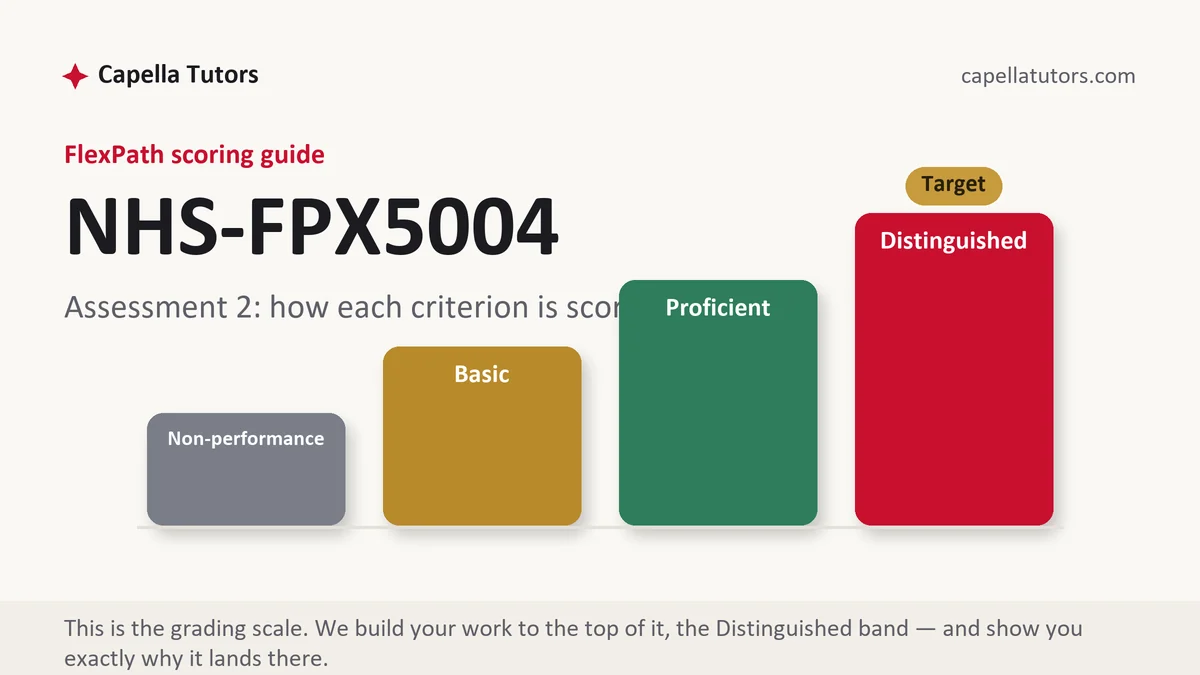
How NHS FPX 5004 Assessment 2 is scored
Nothing here is graded on a curve or a point total. Each criterion in the guide gets its own level, and the wording of those levels tells you what to write:
| Level | What it means on a leadership and collaboration analysis |
|---|---|
| Distinguished | Leadership qualities come from named evidence rather than from a list of virtues, the writer's own practice is assessed against them with specifics and with a shortfall admitted, and the recommendations follow from the diagnosis instead of restating it. Each criterion also carries its own extra demand, and your scoring guide is the authority on what it is. |
| Proficient | The qualities are sourced and the self-assessment is honest, but the join between the diagnosis of the team and the leadership response stays loose. |
| Basic | Adjectives about good leaders, a flattering self-portrait, and advice anybody could have given. This is where submissions land when the writer never anchors the argument in one specific team. |
| Non-performance | A required element is missing, most often the self-assessment or the recommendation set. Absence, not weakness, is what puts a criterion on the floor. |
The pattern that separates the top two levels here is asymmetry. Proficient writers praise a quality they already have; Distinguished writers name the quality that was missing when it mattered, then show what they did about it. That move is uncomfortable and it is also the evidence the criterion asks for, because a self-appraisal with nothing at stake reads as a claim rather than as an appraisal.
The NHS FPX 5004 Assessment 2 method, step by step
-
Pick a team problem with a decision inside it
Choose a conflict you watched from close enough to know what each side actually wanted: a discharge dispute between nursing and therapy, a disagreement about who owns a follow-up call, a handover each discipline considered the other's job. Strip identifiers, say in one sentence that you have done so, and confirm that a decision turned on the disagreement. A conflict where nothing was at stake gives the criteria nothing to grade.
-
Diagnose the conflict before you diagnose yourself
Name what each discipline was optimizing for. Therapy protecting a functional assessment and nursing protecting a bed and a family's travel window are not irrational positions in collision; they are two defensible goals with no shared decision rule between them. Write that sentence first. The leadership analysis then becomes an argument about supplying the missing rule, which is far stronger than an argument about improving communication.
-
Source the leadership qualities instead of listing them
The qualities you measure yourself against should come from evidence a master's evaluator recognizes: the IPEC core competencies for interprofessional collaborative practice, the AONL nurse leader competencies, the ANA Code of Ethics for the obligations that outrank convenience, and the transformational and relational leadership literature carried by the Journal of Nursing Management and the Journal of Advanced Nursing. Name the framework, say which of its domains you are using, and explain why that domain fits this team, because a construct borrowed whole and unexplained reads as decoration.
-
Assess yourself against those qualities with evidence
For each quality, give one concrete instance from your own practice and a verdict on it. What did you do in the room, what did it produce, and what would a colleague say if asked. Include the quality you lack. One weakness with a consequence attached is worth more to this criterion than three strengths with none, and it is the only version of a self-assessment a reader believes.
-
Write recommendations a supervisor could authorize on Monday
Convert the diagnosis into two or three changes with owners: a standing multidisciplinary huddle at a named time, a documented tie-break rule for functional readiness disputes, an escalation path with a person in it rather than a title. Attach a measure to each, and price the cost you are asking somebody to absorb, since a recommendation that pretends to be free is one a director cannot act on.
-
Score the draft criterion by criterion, then submit early
Read the finished draft against the guide with the level descriptions open, and mark every criterion honestly before submitting. Anything below the top column earns one more pass. File it at the start of the week so the two business days an evaluation can take do not turn into five.
A structure that maps to the criteria
The targets below come from our drafts of this deliverable and are planning figures only. If the template in your courseroom sets a different shape, the template wins.
| Section | What it must do | Guide |
|---|---|---|
| Situation and purpose | The team, the conflict, and the question this document answers for the reader receiving it. | ~150 words |
| Diagnosis of the collaboration failure | What each discipline was protecting, and the shared rule or channel that did not exist. | ~300 words |
| Qualities of effective leadership here | The competencies the evidence ties to leading this kind of team, cited and defined. | ~300 words |
| Self-assessment against those qualities | Your own practice measured against each one, with instances, including where you fell short. | ~300 words |
| Recommendations for leading the team | Two or three authorizable changes, each with an owner, a measure, and its cost named. | ~300 words |
| Conclusion and APA layer | The synthesis with nothing new introduced, plus the mechanics the criteria score. | ~150 words |
Annotated sample excerpt
A model excerpt written by our team, showing the register the top of the guide describes. It is study material: learn the moves, then write about your own team.
Nursing and rehabilitation services were not in disagreement about the patient; they were in disagreement about which threshold released her.1 Therapy held that a second stair assessment was required before a home discharge, nursing held that the family's transport window closed at 15:00 and that a home safety visit could carry the residual risk, and both positions were defensible under their own professional standards.2 The failure was structural. No document on this unit states who decides when functional readiness and discharge timing conflict, so the dispute defaulted to whoever escalated hardest, which on that Tuesday was neither of them.3
- 1Refuses the easy frame in the opening clause. Reading a conflict as a disagreement about criteria rather than about competence is what makes the rest of the analysis possible.
- 2Gives each side its strongest version, with the professional standard behind it. An evaluator scoring an interprofessional criterion is reading for evidence that you can state fairly a position you did not hold.
- 3Locates the failure in the absence of a decision rule, then closes on what happened instead, which hands the recommendation section something to build. Note the specificity: this unit, no document, that Tuesday.
The full premium sample for your exact assessment, written fresh to your scoring guide and issue, is free to request. Study it, revise it into your own voice, and submit work you understand.
The five mistakes that cost Distinguished
- The virtue list. Communicative, compassionate, collaborative: qualities nobody would argue with, sourced to nothing and applied to no team. It is the fastest route to Basic in this deliverable.
- The flawless self-portrait. A self-assessment that finds only strengths answers the criterion in form and fails it in substance, because the evaluator is reading for the capacity to appraise, not for confidence.
- The conflict about personalities. A difficult therapist and a territorial charge nurse are not findings. What each discipline was protecting, and the rule that was missing, are findings.
- Recommendations with no cost. Every change spends somebody's time or somebody's authority. Naming the cost is what separates a proposal from a wish, and directors read for it first.
- Frameworks left unexplained. Invoking transformational leadership or a competency set without saying which domain you are using, and why it fits this team, is a citation standing in for an argument.
Pre-submission checklist
- One specific team conflict, de-identified, with a decision that actually turned on it
- The failure stated as a missing rule or channel rather than as a personality
- Leadership qualities drawn from cited competencies or peer-reviewed evidence, not adjectives
- A self-assessment containing at least one honest shortfall and its consequence
- Two or three recommendations, each with an owner, a measure, and a named cost
- Headings mirroring the scoring guide, APA 7 checked both directions, self-scored before submission
Want the leadership analysis handled?
Send the scoring guide, the template if your courseroom supplied one, and a few lines about the team conflict you have in mind. A premium original sample comes back in 24 to 48 hours, built against the top column by an eight-person pipeline with two QA passes, and revised free until the criteria are satisfied.