This manual is for NHS FPX 5004 Assessment 3, start to submission. A premium original deck with full speaker notes, written to your scoring guide, comes back in 24 to 48 hours with free revisions until every criterion clears. If you are building it yourself, work through what follows. Assessment 3 of NHS FPX 5004 usually moves the course from analysis to launch. The deliverable is commonly a presentation with speaker notes, aimed at the people who will do the work rather than at your instructor, opening a project that asks several disciplines to change something they currently do separately. Your scoring guide decides the slide count, whether notes are required, and whether narration has to be recorded. The criteria are written about persuasion under constraint: a case for the project, a plan for collaborating on it, and a way to tell whether it worked. Capella's catalog lists the course as NHS-FPX5004, and some courserooms print NHS5004; both point to this same Assessment 3.
One honesty note before the manual: Capella revises courses and scoring guides over time, so always write to the exact scoring guide attached to your assessment in the courseroom. The course identity above is verified on capella.edu; the method and structure below are our tutors' approach to it, not Capella's official rubric text.
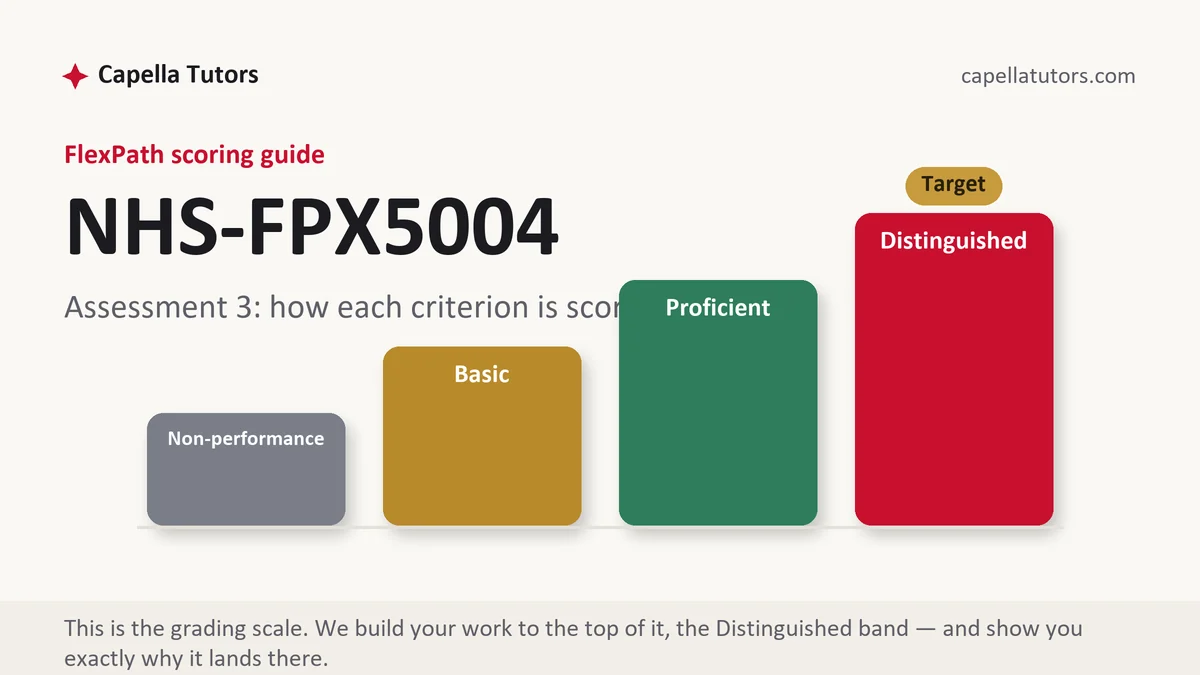
How NHS FPX 5004 Assessment 3 is scored
A FlexPath deck is not scored as a whole. Each criterion in the guide is judged separately and lands on one of four levels, so read the level language as the design brief:
| Level | What it means on a project kickoff presentation |
|---|---|
| Distinguished | Slides carry one idea each while the speaker notes carry the argument, the collaboration plan names roles and a meeting cadence instead of good intentions, and the evaluation plan states the metric with its baseline. Each criterion also names its own additional demand, and your scoring guide decides what that is. |
| Proficient | A complete, well-sourced deck with a real plan, but the notes read as the slide text spoken aloud and the measures stay general. |
| Basic | Paragraphs pasted onto slides, a mission statement in place of a project, and no way to tell success from activity. Density is the usual symptom and the easiest one to fix. |
| Non-performance | A required component is absent, most often the speaker notes or the evaluation section. A deck can look finished and still leave a criterion unanswered. |
Two audiences read this deliverable at once, and the split is what makes it hard. The evaluator needs the depth and the citations; the imagined room needs to follow you at speaking pace. The resolution is a division of labor. The slide states the claim, the note argues it and carries the citation, and nothing load-bearing lives only where the other audience cannot see it.
The NHS FPX 5004 Assessment 3 method, step by step
-
Define the project narrowly enough to launch
A kickoff needs a boundary. Interpreter use during discharge teaching on one unit is launchable; cultural competence across an organization is a sentiment. Write the scope in one sentence containing a population, a setting, and a behavior, then check that a team of six could finish it inside a quarter.
-
Open on evidence rather than on values
The first substantive slide should carry the gap: the share of your patients who speak a language other than English at home, the documented interpreter use rate beside it, and the comprehension or follow-up difference the literature reports when language needs go unmet. Sources a master's evaluator respects here include the national CLAS standards from the Office of Minority Health, Joint Commission expectations for language access, and health services research in journals such as Medical Care and the Journal of General Internal Medicine. A room argues with values and concedes to a rate.
-
Assign the collaboration instead of requesting it
Name every discipline the project needs and what each one owes it: nursing for the teaching encounter, interpreter services for coverage windows, informatics for the field that records language and interpreter identity, a physician sponsor for ordering behavior. Give the group a meeting cadence, a rule for settling disagreements, and one named owner per workstream. Collaboration criteria are scored on specificity, and a slide asking everyone to work together earns nothing.
-
Design the deck for a speaker, not a reader
One claim per slide, six lines at the outside, no paragraph anywhere on the surface. Then write notes that argue: the claim, the evidence with its citation, the objection you expect from that room, and your answer to it. Speaker notes are where the master's register lives in this deliverable, which is why an evaluator reads them first when the slides look thin.
-
Build the evaluation plan into the launch
State the metric, its current value, who pulls it, and how often the group will look at it. Interpreter use per eligible encounter against a documented baseline is a measure; improved cultural awareness is not. Add the condition under which the group would conclude the project has failed, because a kickoff that cannot be falsified reads as advocacy rather than as a plan.
-
Rehearse against the guide, then submit early
Read the deck aloud with a timer and cut anything you find yourself explaining because the slide does not. Then score it criterion by criterion, checking that each criterion owns a slide and that the notes carry what the slides cannot. Submit at the start of the week; evaluation can run two business days, and a deck usually needs one revision cycle.
A structure that maps to the criteria
The slide counts below are planning figures from our own decks for a launch of this kind. If your scoring guide sets a number, or requires recorded narration, the guide decides.
| Section | What it must do | Guide |
|---|---|---|
| Title and purpose | The project, the sponsor, and one sentence saying what will be different in ninety days. | 1 slide |
| The gap, in numbers | Local data against a benchmark or a published finding, with the source visible on the slide. | 2 slides |
| Why it matters here | The standard, requirement, or evidence that makes this the organization's problem rather than a preference. | 2 slides |
| The plan and the roles | Workstreams, named owners, meeting cadence, and the rule for settling disagreements. | 2 to 3 slides |
| Measures and review | Metric, baseline, target, who reports it, and when the group decides it is not working. | 1 to 2 slides |
| Ask, next steps, references | What you need from the room this week, plus a reference slide in current APA 7. | 2 slides |
Annotated sample excerpt
An original model from our team, showing how the surface and the notes divide the work. Study the split, then build your own launch.
Slide reads: 22 percent of our discharges list a preferred language other than English; interpreter use is documented in 9 percent.1 Notes: I want to be careful about what this gap is and is not. It is not evidence that anyone skipped an interpreter, because our documentation field is optional and undercounts by a margin we cannot quantify, and I will say that before anyone else does.2 It is evidence that we cannot answer the question, which matters because the language-access expectations we are surveyed against assume we can, and because patients with unmet language needs are consistently reported to leave with poorer understanding of their discharge instructions.3 So the first workstream fixes the field and the second fixes the encounter.
- 1Two numbers on the surface and nothing else. The slide holds the gap; the argument waits in the notes, where it belongs.
- 2Concedes the limitation of the local data before the room can find it. On a criterion about credible use of evidence, pre-empting the strongest objection is the move that reads as expert.
- 3Separates a compliance reason from a patient reason, keeps both, and lets the two workstreams follow from the two problems. Note that the comprehension claim is attributed to a reported pattern rather than asserted flatly.
The full premium sample for your exact assessment, written fresh to your scoring guide and issue, is free to request. Study it, revise it into your own voice, and submit work you understand.
The five mistakes that cost Distinguished
- The wall of text. A paragraph on a slide fails the communication criterion twice, once for the slide and once for the notes it just made redundant.
- Values in place of a gap. Every audience already agrees that equitable care matters. Only a measured shortfall gives a room something to approve.
- Everyone responsible, nobody accountable. A collaboration plan with no named owners, no cadence, and no tie-break rule is a list of hopes wearing a project's clothing.
- Notes that read the slide aloud. Speaker notes exist to carry the argument, the citation, and the answer to the objection. Repeating the bullet wastes the one place depth is allowed to live.
- No definition of failure. A plan with no metric and no stopping condition cannot be evaluated, and an evaluation criterion will say exactly that.
Pre-submission checklist
- Scope written in one sentence containing a population, a setting, and a behavior
- A measured local gap on a slide, with its source visible and its limitation stated in the notes
- Every discipline named with what it owes the project, plus a cadence and a decision rule
- One claim per slide, no paragraphs, and speaker notes that argue rather than repeat
- A metric with a baseline, an owner, a review interval, and a stated failure condition
- Reference slide in current APA 7, every note citation present in it, self-scored before submitting
Want the deck and the notes built for you?
Send the scoring guide and tell us which initiative you have been asked to launch. A premium original deck with full speaker notes comes back in 24 to 48 hours, written to the top column, checked by two QA reviewers, and revised free until the criteria are met.