Send the prompt and the scoring guide and a premium original sample arrives inside 24 to 48 hours naming each application by the job it does, each standard by the problem it solves, and every cost line by where the figure came from, with revisions free until the criteria clear. The course on your transcript: MHA FPX 5016, Introduction to Health Information Systems, 2 program points in the core of Capella's FlexPath Master of Health Administration, a twelve course degree of at least 24 program points that ends in a capstone project and carries no clinical hour requirement. MHA5016 and MHA FPX 5016 are the same course. In Capella's catalog the course code is written MHA-FPX5016.
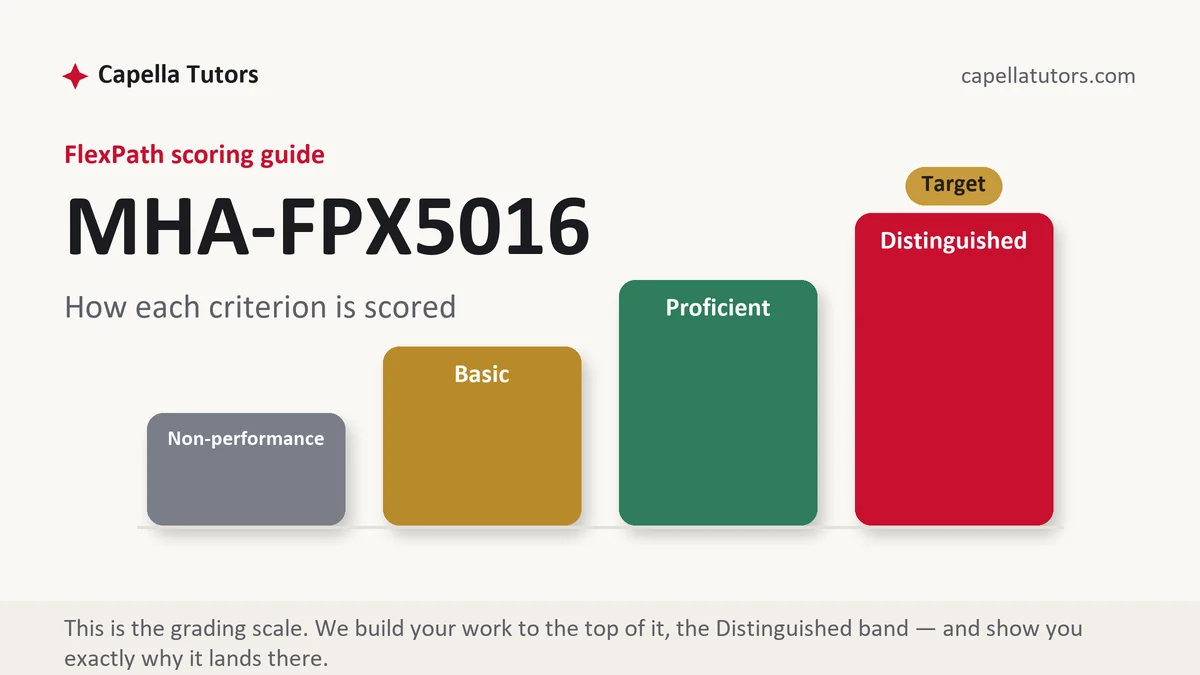
What MHA FPX 5016 actually grades
This course treats information systems as assets an administrator buys, governs and pays for rather than as software clinicians happen to use. The first thing graded is whether you can describe an organization's application inventory precisely: a record system at the center, and around it registration and scheduling, patient accounting and the revenue cycle tools bolted to it, laboratory, radiology with its image archive, pharmacy, the enterprise system that pays the staff and orders the supplies, and a warehouse that every department queries and none of them owns. Writing about the record system as one undifferentiated object is where a first draft usually loses a criterion, because the data your recommendation depends on almost never lives where the paper assumes it does.
The second graded strand splits two problems most students merge. Moving data is a messaging problem: version 2 messages carry transactions between systems inside one building, document standards carry a summary from one organization to another, and a resource based interface over an application programming interface answers a narrow question in real time. Meaning surviving the trip is a terminology problem: diagnosis and procedure code sets and the procedural code set exist to get a claim paid, a clinical terminology exists to say what a clinician meant, a laboratory terminology exists so a potassium result from another hospital is recognizable as one, and a drug terminology exists so two systems agree which medication is which. Two systems can exchange a syntactically perfect message and still disagree about what arrived, and the criteria reward a writer who names the right standard for each job.
The third strand is governance, protection and cost. Who decides what gets built, who owns a data element, who approves a new interface, how the patient index is kept clean, what the organization does during the hours each year when the record system is unavailable, and how the security duties land as administrative work rather than as a technical mystery. Because the course is an introduction, it is not asking for architecture drawings. It is asking whether you can hold a system up against a stated requirement and explain the operational consequence of a poor fit. The compliance side of the same territory belongs to MHA FPX 5014, and the elective that goes further into analysis and design is MHA FPX 5064; here the question is only whether the system as configured produces usable evidence at all.
How we help in this course
Send the guide, the scenario, the vendor names and the workflow that is actually causing pain, and the sample comes back with the inventory written application by application, a requirements matrix whose weights are stated before any score appears, a five year cost of ownership with every input labeled, and an interface list that says which system is the source of truth for each data element. Where the organization has to stay unnamed we build the same analysis on a comparable public system and say so in the text.
The rest is standard across the studio. One premium original deliverable per assessment, written to the Distinguished descriptors in the guide you upload, inside 24 to 48 hours, through an eight person pipeline including a reviewer whose only task is checking that every standard, terminology and code set in the document is named for the job it genuinely does. Revisions are free until the criteria clear, and faculty comments come back into the same cycle at no charge.
The assessments, one by one
Assessment 1: Analysis of Electronic Health Records
Assess an organization's EHR against meaningful use and compliance requirements, identify issues for administration and clinical staff. Read the full Assessment 1 manual.
Assessment 2: Information System Job Description and Summary
A summary of why the organization needs a new health information role and its financial impact, plus a complete job description with duties, skills and qualifications. Read the full Assessment 2 manual.
Assessment 3: Stakeholder Communication in Health Information Systems
Communicate your health information system recommendations to stakeholders, with a timeline, the impact on each group. Read the full Assessment 3 manual.
How to actually write MHA FPX 5016: where to begin
Sort the criteria into two piles before drafting: the ones asking you to describe something accurately and the ones asking you to decide something. Description criteria are lost on vagueness, decision criteria on missing arithmetic, and they fail in different ways. In current courserooms the assessments include "Analysis of Electronic Health Records", "Information System Job Description and Summary" and "Stakeholder Communication in Health Information Systems" among others, and your scoring guide decides the exact format of each.
Then price the thing properly, because the quoted license fee is roughly a fifth of what the organization will spend. Take a departmental system quoted at $340,000 for perpetual licenses with $185,000 of implementation and two interfaces at $22,500 each. Annual maintenance at 18 percent of license is $61,200, so $306,000 across five years, and supporting it internally takes about 1.5 analyst positions at $96,400 fully loaded, which is $144,600 a year or $723,000 over the same period. The five year total is $1,599,000, and the license everyone argued about is 21 percent of it. Those amounts are illustrative, chosen to show which lines actually decide the total. Add the lines students forget and the ratio gets worse: training hours pulled from productive time, the temporary staffing that covers the first two weeks after go live, the interface work triggered when a second system changes version, and the cost of running the outgoing system in parallel while the new one settles.
Then score the requirements in public. Set the weights before the demonstrations and record who set them, because weights chosen afterwards will always match whoever presented best. Say interoperability carries 0.25, clinical workflow fit 0.25, total cost 0.20, vendor viability 0.15, reporting 0.10 and implementation risk 0.05. Rate each vendor from 1 to 5 and one product comes out at 3.55 against another at 3.65, a margin of 0.10 on a five point scale. The Distinguished move is to say plainly that a gap that small is inside the noise of the exercise, then name the two requirements that actually decide the choice and what evidence would settle them, rather than reporting the total as though the arithmetic made the decision for you.
Then argue from data quality, since it is the part of the course with the most direct operational consequence and the least attention in submitted work. An index holding 412,000 patient records with a 6.2 percent duplicate rate contains roughly 25,500 duplicates, and each one splits a problem list, hides an allergy documented on the other record, and turns any quality denominator built on that population into an estimate. An interface running at 99.4 percent success on 8,200 messages a day is dropping about 49 messages daily, which is not a rounding error but a fortnight of missing results if nobody owns the error queue. Close on protection and continuity in administrative language: a documented risk analysis, access granted by role and reviewed when people change jobs, audit log review with a named reviewer and a stated cadence, encryption in transit and at rest, agreements with every vendor that touches the data, and a downtime procedure that has been rehearsed rather than filed.
| Section | What goes in it | What Distinguished looks like |
|---|---|---|
| Organization and application inventory | The systems in use, what each one is the source of truth for, and who administers it. | Applications named by function, with the source of truth for every data element the paper relies on. |
| Requirements | What the organization needs the system to do, stated so it could be tested. | Requirements weighted, weights dated and attributed, each one testable in a demonstration. |
| Standards and exchange | The messaging and document standards, the terminologies, the code sets, the interfaces. | Each standard matched to its job, with versions printed and the semantic gaps named. |
| Data governance and quality | Stewardship, the patient index, duplicate and completeness measures, the error queue. | Quality expressed as measured rates with an owner attached to each remediation. |
| Security and continuity | Risk analysis, access control, logging, agreements, downtime and recovery. | Duties written as administrative controls with reviewers, cadences and a rehearsed downtime plan. |
| Cost, implementation and references | Multi year cost of ownership, staffing, training, the rollout sequence, current APA both ways. | Every cost line sourced or labeled as an assumption, with the internal support cost included. |
Developing the analysis
The health information technology evidence base is thinner than its enthusiasm, and the analysis criterion is where you show you know it. A large share of the benefit literature is single site before and after work written by the team that ran the implementation, which is the weakest design and the most motivated author combination available. Order entry and decision support studies report real reductions in some error types while documenting new failure modes the system introduced, and override rates on interruptive alerts are high enough in published series that any claim beginning with the system will catch it needs evidence rather than assertion.
The useful move is sociotechnical: the same product succeeds in one hospital and fails in another because workflow, training and governance differ, so a vendor reference site establishes that the product can work rather than that it will work for you. Attribute the frameworks you use to the authors who published them, and when you borrow a reported benefit, name the setting it was measured in and say what would have to hold for it to transfer.
Citations that survive faculty review
Four kinds of source do the work, and version numbers matter more here than anywhere else in the MHA. Standards and terminology specifications are cited as the documents they are, with the release or version identifier, because a standard cited without a version reads as unread and the differences between versions are exactly what interface projects fail on. Federal health information technology material, the certification criteria, the program rules governing patient access and information sharing, and the security requirements published for covered organizations, is cited as regulation or agency guidance with its year.
Peer-reviewed informatics, health services and health management journals through the Capella library carry every claim about whether a system changed anything. Vendor documentation and industry press are legitimate for product facts, configuration options and pricing structure, and are labeled as vendor material and never used as evidence of benefit. Where the analysis turns on numbers rather than on features, the statistical reasoning belongs to the analysis course in the same core, MHA FPX 5017, and a figure taken from an internal report should be cited to the organization and year with a line saying it is not retrievable.
The mistakes that land Basic instead of Distinguished
- The record system treated as a single object, so the paper never says which application actually holds the data it depends on.
- A standard named without the job it does, or a billing code set proposed where a clinical terminology is required.
- A cost figure that is the license quote, leaving out maintenance, interfaces, training and the internal staff who run it.
- A go live plan with no downtime procedure and nobody named to read the interface error queue.
- Vendor literature cited as evidence that the system improves care, which an evaluator reads as no evidence at all.
MHA FPX 5016 questions students actually ask
Which standards and terminologies am I expected to name?
Enough of them to show you know what each one is for, which is a shorter list than it looks. Separate the code sets that exist for payment, the diagnosis and procedure classifications and the procedural code set, from the terminologies that exist for clinical meaning, one for clinical concepts, one for laboratory observations, one for medications. Then separate both from the exchange standards: the messaging version that moves transactions between systems in one organization, the document standard that carries a patient summary between organizations, and the resource based interface that answers a specific question over the web. Name the version. The single sentence that earns the criterion is the one explaining that a message can arrive perfectly formatted and still be useless, because the receiving system has no mapping for the codes inside it.
How do I evaluate a system when I cannot get a vendor quote?
Build the evaluation around requirements rather than prices, then source what pricing you can and label the rest. The federal certification listings tell you which products are certified and for which capabilities, which is public and citable. State and municipal procurement portals publish awarded contracts with real figures attached, and other public bodies publish requests for proposals that show what a comparable organization asked for. Trade and professional publications give order of magnitude ranges. Build your cost model from those, print a range rather than a false point estimate, mark every input as sourced or assumed, and put the internal staffing cost in even when nobody quoted it, since it is often the largest line. A transparent model built from public inputs scores above a confident one nobody can check.
What belongs in the security section if I am not technical?
Administrative controls, which is what an administrator is accountable for anyway. A documented risk analysis that names the systems in scope and when it was last refreshed. Access granted by role rather than by request, with a review triggered when someone transfers or leaves. Audit log review with a named reviewer, a cadence and a record that it happened. Encryption in transit and at rest, stated as a requirement in your contracts. Written agreements with every vendor and contractor whose staff can see patient data. Training with a completion percentage whose denominator is the workforce in scope. A downtime and recovery procedure that has been rehearsed on a date you can name. Written that way the section is a management plan an evaluator can grade, rather than a paraphrase of somebody else's technical checklist.
System evaluation due this week?
Send the guide, the vendors and the workflow. First premium sample free, with the requirements matrix and the cost model built.