This manual is for MHA FPX 5016 Assessment 1, start to submission. Analysis of Electronic Health Records asks you to assess the EHR at an organization described in the courseroom, often a Vila Health facility: its current state of compliance with meaningful use and related requirements, the problems it causes for administration and for clinical staff, the upgrades or improvements you recommend, and how the organization can keep compliant over time. The grade turns on evidence from the scenario. Issues that come from the interviews and documents in the simulation score far above general EHR problems. Below is the method our tutors use, a structure that maps to the criteria, and an annotated sample excerpt. Prefer to hand it off? A premium original sample for this exact assessment comes back in 24 to 48 hours, revised free until it meets the guide. Capella's catalog lists the course as MHA-FPX5016, and some courserooms print MHA5016; both point to this same Assessment 1. In current courserooms this assessment typically appears as "Analysis of Electronic Health Records".
One honesty note before the manual: Capella revises courses and scoring guides over time, so always write to the exact scoring guide attached to your assessment in the courseroom. The course identity above is verified on capella.edu; the method and structure below are our tutors' approach to it, not Capella's official rubric text.
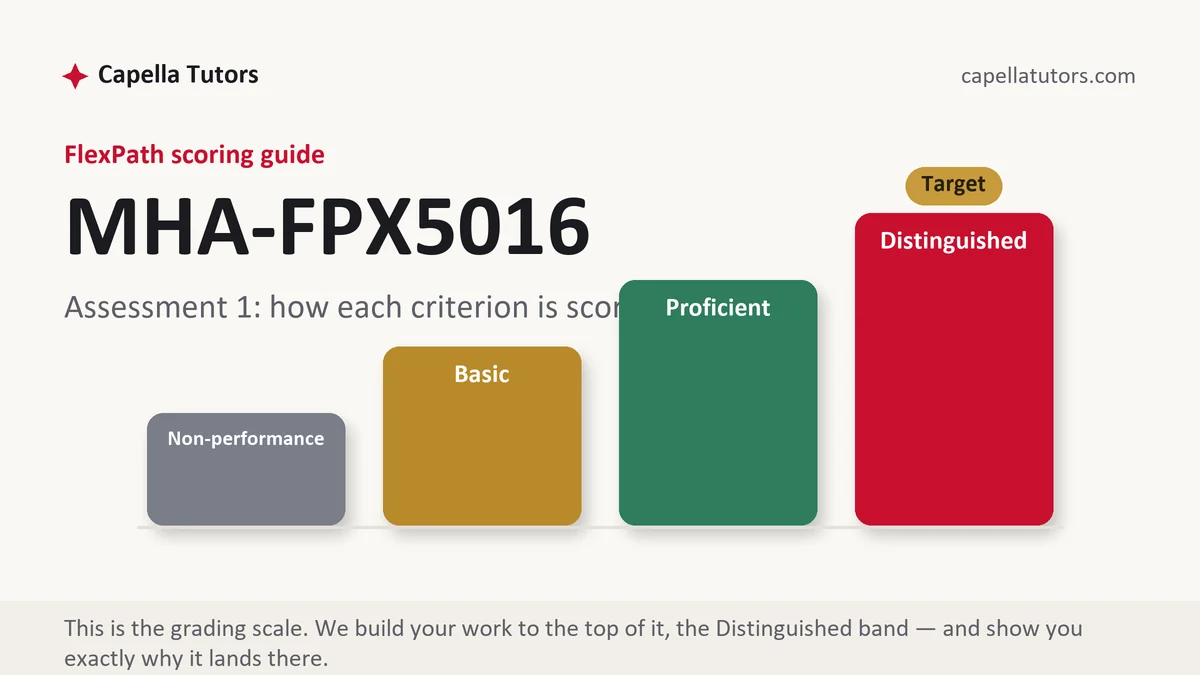
How MHA FPX 5016 Assessment 1 is scored
FlexPath does not use letter grades. Each criterion in the scoring guide lands on one of four levels, and the level descriptions are the real writing brief:
| Level | What it means on an EHR analysis |
|---|---|
| Distinguished | Compliance status is assessed against specific requirements, issues are drawn from the scenario for both administrative and clinical users, recommendations answer those issues, and compliance approaches are practical and supported. |
| Proficient | The analysis is accurate, but issues are general and recommendations are broad. |
| Basic | The paper describes EHRs and meaningful use in general. |
| Non-performance | The compliance assessment, the issues or the recommendations are missing. |
Work from the simulation or scenario materials. Quote or paraphrase what staff said about the system.
The MHA FPX 5016 Assessment 1 method, step by step
-
Explain the requirements
Meaningful use, now the Promoting Interoperability program, and related privacy and security rules, briefly.
-
Assess current compliance
Where the organization meets or falls short, with evidence from the scenario.
-
Identify administrative issues
Reporting, billing, cost or interoperability problems.
-
Identify clinical issues
Usability, documentation burden, alerts, workflow fit.
-
Recommend upgrades
Changes that answer the issues, with evidence.
-
Plan for ongoing compliance
Training, audits, governance and vendor management.
A structure that maps to the criteria
Word counts are planning targets our tutors use, not Capella rules; follow the length and format your scoring guide states.
| Section | What it must do | Guide |
|---|---|---|
| Introduction | The organization and the purpose of the analysis. | ~75 words |
| Current state of compliance | Requirements and where the organization stands. | ~125 words |
| EHR issues: administration | Problems for administrative users. | ~100 words |
| EHR issues: clinical staff | Problems for clinical users. | ~100 words |
| Upgrades and improvements | Recommendations tied to issues. | ~125 words |
| Approaches for compliance and references | How to stay compliant, then current APA. | ~100 words |
Annotated sample excerpt
An original model excerpt from our team, written to show the register that reaches the top of the guide. Learn the moves, then write your own version.
Nurses interviewed in the scenario describe documenting the same assessment in two places because the EHR's flowsheet does not feed the care plan, which adds time at the end of every shift and creates chances for the two records to disagree.1 Physicians report a different problem: medication alerts fire so often that most are overridden without being read, a pattern known as alert fatigue that undermines the safety purpose of the alerts.2 Both issues point to configuration rather than replacement, so the first recommendation is a documentation and alert review led by clinical users before any upgrade is purchased.3
- 1Draws a specific clinical issue from the scenario and states its consequence.
- 2Adds a second issue and names the recognized concept behind it.
- 3Turns the issues into a proportionate recommendation.
The full premium sample for your exact assessment, written fresh to your scoring guide and topic, is free to request. Study it, revise it into your own voice, and submit work you understand.
The five mistakes that cost Distinguished
- General EHR problems. Use the scenario's evidence.
- Compliance named but not assessed. Say where the organization meets or misses the requirements.
- Ignoring one user group. Cover administration and clinical staff.
- Recommendations that do not answer the issues. Tie each to a problem.
- No plan for staying compliant. Address ongoing compliance.
Pre-submission checklist
- Requirements explained
- Compliance assessed with scenario evidence
- Administrative issues
- Clinical issues
- Recommendations tied to issues
- Ongoing compliance approaches and current APA
Want the EHR analysis written?
Send the scoring guide and the scenario notes. Our team returns a premium original analysis in 24 to 48 hours, revised free until it meets the guide.