This manual is for MHA FPX 5016 Assessment 2, start to submission. This assessment asks you to create a job description for a health information management or information systems role the organization needs, such as a health information manager, together with a summary for leadership explaining why the role is needed, what problems it will solve, and its financial impact. The grade turns on fit. A job description copied from a template scores lower than one whose duties answer the specific information problems you identified for this organization. Below is the method our tutors use, a structure that maps to the criteria, and an annotated sample excerpt. Prefer to hand it off? A premium original sample for this exact assessment comes back in 24 to 48 hours, revised free until it meets the guide. Capella's catalog lists the course as MHA-FPX5016, and some courserooms print MHA5016; both point to this same Assessment 2. In current courserooms this assessment typically appears as "Information System Job Description and Summary".
One honesty note before the manual: Capella revises courses and scoring guides over time, so always write to the exact scoring guide attached to your assessment in the courseroom. The course identity above is verified on capella.edu; the method and structure below are our tutors' approach to it, not Capella's official rubric text.
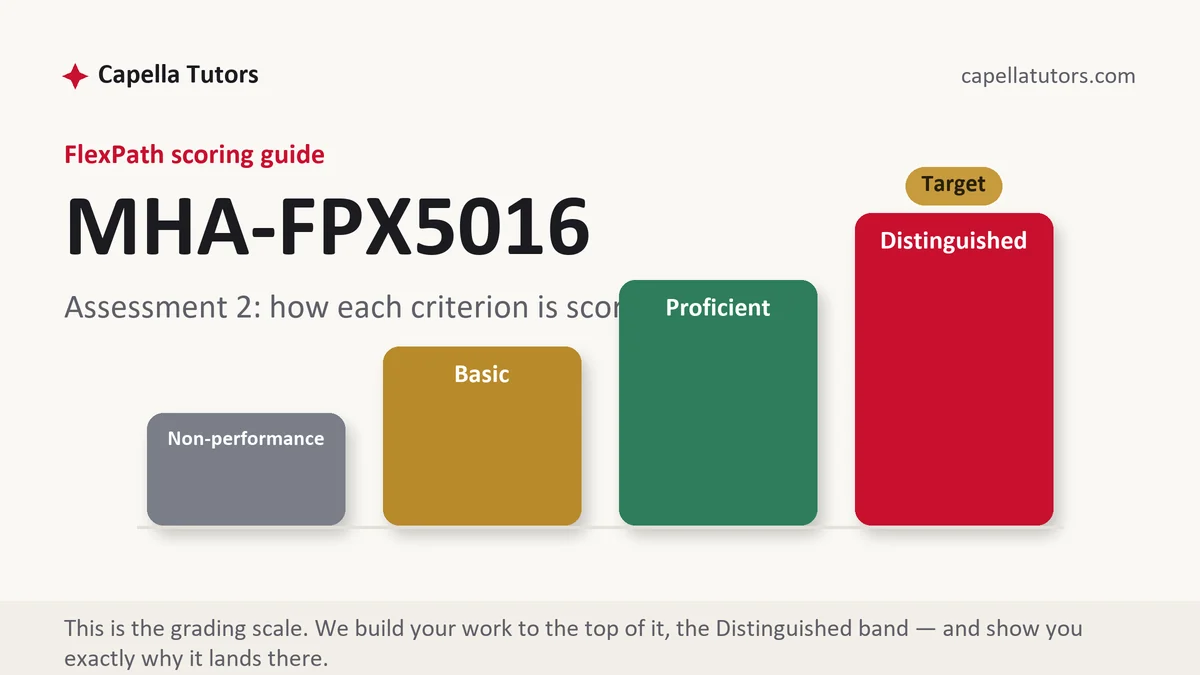
How MHA FPX 5016 Assessment 2 is scored
FlexPath does not use letter grades. Each criterion in the scoring guide lands on one of four levels, and the level descriptions are the real writing brief:
| Level | What it means on a job description and summary |
|---|---|
| Distinguished | The summary links the role to the organization's documented information needs, the financial impact is estimated, and the job description has specific duties, skills, education and experience that match those needs and current professional standards. |
| Proficient | Both parts are complete, but duties are generic or the financial impact is vague. |
| Basic | The job description is templated with little connection to the organization. |
| Non-performance | The summary, the financial impact or a part of the job description is missing. |
Build on the issues you identified in Assessment 1. Each major duty in the job description should answer one of them.
The MHA FPX 5016 Assessment 2 method, step by step
-
Summarize the need
The information management problems the organization faces, from Assessment 1 and the scenario.
-
Estimate the financial impact
Salary and benefits against expected savings or revenue protection, such as fewer denied claims or avoided penalties.
-
Write the role summary
Title, reporting line and purpose in two or three sentences.
-
List duties and responsibilities
Specific duties tied to the organization's needs.
-
Set skills, education and experience
Credentials such as RHIA where appropriate, and the skills the duties require.
-
Check against standards
Compare with professional descriptions from AHIMA or similar bodies.
A structure that maps to the criteria
Word counts are planning targets our tutors use, not Capella rules; follow the length and format your scoring guide states.
| Section | What it must do | Guide |
|---|---|---|
| Summary: organization's need | Why the role is needed now. | ~200 words |
| Summary: financial impact | Costs and expected benefits. | ~150 words |
| Job title and purpose | Reporting line and purpose. | ~75 words |
| Duties and responsibilities | Specific duties tied to needs. | ~200 words |
| Skills, education and experience | Requirements for the role. | ~125 words |
| References | Current APA. | as needed |
Annotated sample excerpt
An original model excerpt from our team, written to show the register that reaches the top of the guide. Learn the moves, then write your own version.
Leads the facility's EHR documentation integrity program, including quarterly audits of record completeness and timeliness, because the audit found that one in five discharge summaries was signed more than seven days late.1 Coordinates release of information and privacy compliance with the compliance officer, ensuring requests are fulfilled within the timelines required by the HIPAA Privacy Rule and that disclosures are logged.2 Serves as the liaison between clinical departments and the EHR vendor for documentation-related configuration requests, prioritizing those that affect coding accuracy and reimbursement.3
- 1Ties a duty to a documented problem.
- 2Names a compliance duty with its regulatory basis.
- 3Defines a liaison duty and its priorities, which shows the role fits the organization.
The full premium sample for your exact assessment, written fresh to your scoring guide and topic, is free to request. Study it, revise it into your own voice, and submit work you understand.
The five mistakes that cost Distinguished
- A template job description. Tie duties to this organization's needs.
- No financial impact. Estimate costs and benefits.
- Vague duties. Make each duty specific and measurable.
- Credentials that do not fit. Match qualifications to the duties.
- Missing summary. Leadership needs the case before the description.
Pre-submission checklist
- Need linked to documented problems
- Financial impact estimated
- Role title and purpose
- Specific duties tied to needs
- Skills, education and experience
- Current APA references
Want the job description and summary written?
Send the scoring guide and your Assessment 1 findings. Our team returns a premium original job description and summary in 24 to 48 hours, revised free until it meets the guide.