This manual is for MHA FPX 5016 Assessment 3, start to submission. Stakeholder Communication in Health Information Systems asks you to communicate your recommendations for the organization's information system to the people affected: who the relevant stakeholders are, what you recommend and on what timeline, how the change will affect each group, best practices for overcoming barriers to adoption, and a value statement that explains why the change is worth making. The grade turns on audience. A communication that tells each stakeholder group what changes for them, and when, scores above a general description of the recommendation. Below is the method our tutors use, a structure that maps to the criteria, and an annotated sample excerpt. Prefer to hand it off? A premium original sample for this exact assessment comes back in 24 to 48 hours, revised free until it meets the guide. Capella's catalog lists the course as MHA-FPX5016, and some courserooms print MHA5016; both point to this same Assessment 3. In current courserooms this assessment typically appears as "Stakeholder Communication in Health Information Systems".
One honesty note before the manual: Capella revises courses and scoring guides over time, so always write to the exact scoring guide attached to your assessment in the courseroom. The course identity above is verified on capella.edu; the method and structure below are our tutors' approach to it, not Capella's official rubric text.
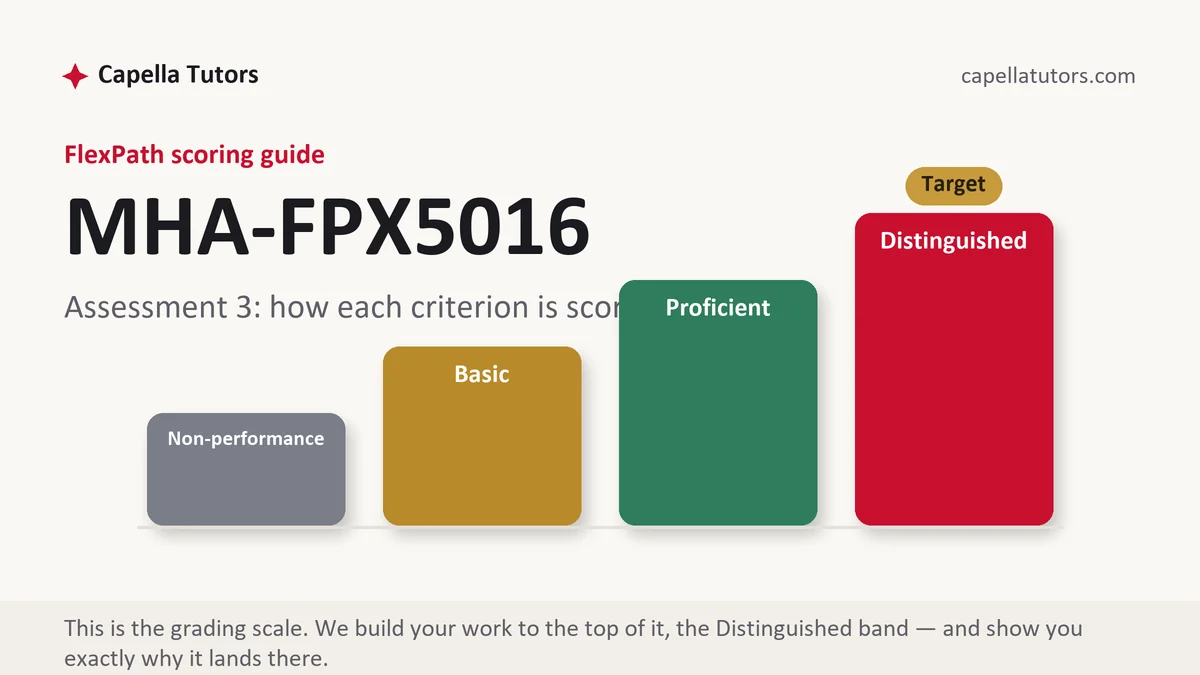
How MHA FPX 5016 Assessment 3 is scored
FlexPath does not use letter grades. Each criterion in the scoring guide lands on one of four levels, and the level descriptions are the real writing brief:
| Level | What it means on a stakeholder communication |
|---|---|
| Distinguished | Stakeholders are identified with their interests, recommendations and timeline are clear, the impact on each group is specific, barriers are anticipated with evidence-based strategies, and the value statement is compelling and supported. |
| Proficient | All parts are present, but the impact on stakeholders and the barriers are general. |
| Basic | The communication restates the recommendation with little attention to audiences. |
| Non-performance | The stakeholders, the timeline or the value statement is missing. |
Keep the recommendations from your earlier 5016 work. This assessment is about carrying them to the people who will live with them.
The MHA FPX 5016 Assessment 3 method, step by step
-
Identify stakeholders
Executives, physicians, nurses, IT, health information staff, and patients where relevant.
-
State the recommendations and timeline
What will change and when, in phases.
-
Describe the impact on each group
Training time, workflow changes, benefits they will see.
-
Anticipate barriers
Resistance, time pressure, technical problems, each with a strategy such as super users or phased rollout.
-
Write the value statement
Why the change matters for quality, safety, efficiency and compliance.
-
Choose the format
Follow the courseroom format, whether memo, presentation or report, with evidence cited.
A structure that maps to the criteria
Word counts are planning targets our tutors use, not Capella rules; follow the length and format your scoring guide states.
| Section | What it must do | Guide |
|---|---|---|
| Introduction | Purpose and the recommendation in brief. | ~75 words |
| Relevant stakeholders | Groups and their interests. | ~100 words |
| Recommendations and timeline | What changes and when. | ~125 words |
| Impact on stakeholders | What each group will experience. | ~125 words |
| Best practices to overcome barriers | Barriers and strategies. | ~125 words |
| Value statement and references | Why it is worth it, then current APA. | ~75 words |
Annotated sample excerpt
An original model excerpt from our team, written to show the register that reaches the top of the guide. Learn the moves, then write your own version.
For nurses, the new EHR training system means four hours of protected training time before go-live and a super user on every shift for the first two weeks, so questions are answered at the bedside rather than through a help desk ticket.1 For physicians, the main change is a redesigned medication ordering screen that reduces the number of alerts they see, which addresses the alert fatigue they reported in the interviews.2 For the health information team, the change shifts work from correcting incomplete records to auditing them, which is the improvement in documentation quality the project is meant to deliver.3
- 1Tells one group exactly what changes and what support it gets.
- 2Connects a second group's change to the concern they raised.
- 3Shows the benefit for a third group and links it to the project goal.
The full premium sample for your exact assessment, written fresh to your scoring guide and topic, is free to request. Study it, revise it into your own voice, and submit work you understand.
The five mistakes that cost Distinguished
- One message for everyone. Address each stakeholder group.
- No timeline. Say when changes happen.
- Barriers ignored. Anticipate resistance with strategies.
- A value statement without evidence. Support the benefits.
- New recommendations. Carry forward your earlier work.
Pre-submission checklist
- Stakeholders identified with interests
- Recommendations and timeline
- Impact on each group
- Barriers and evidence-based strategies
- Value statement
- Current APA references
Want the stakeholder communication written?
Send the scoring guide and your recommendations. Our team returns a premium original communication in 24 to 48 hours, revised free until it meets the guide.