MBA Capstone Experience runs as MBA FPX 5910 at Capella, 2.5 pts / 5 qcr, available in FlexPath in the MBA path. In Capella's catalog the course code is written MBA-FPX5910.
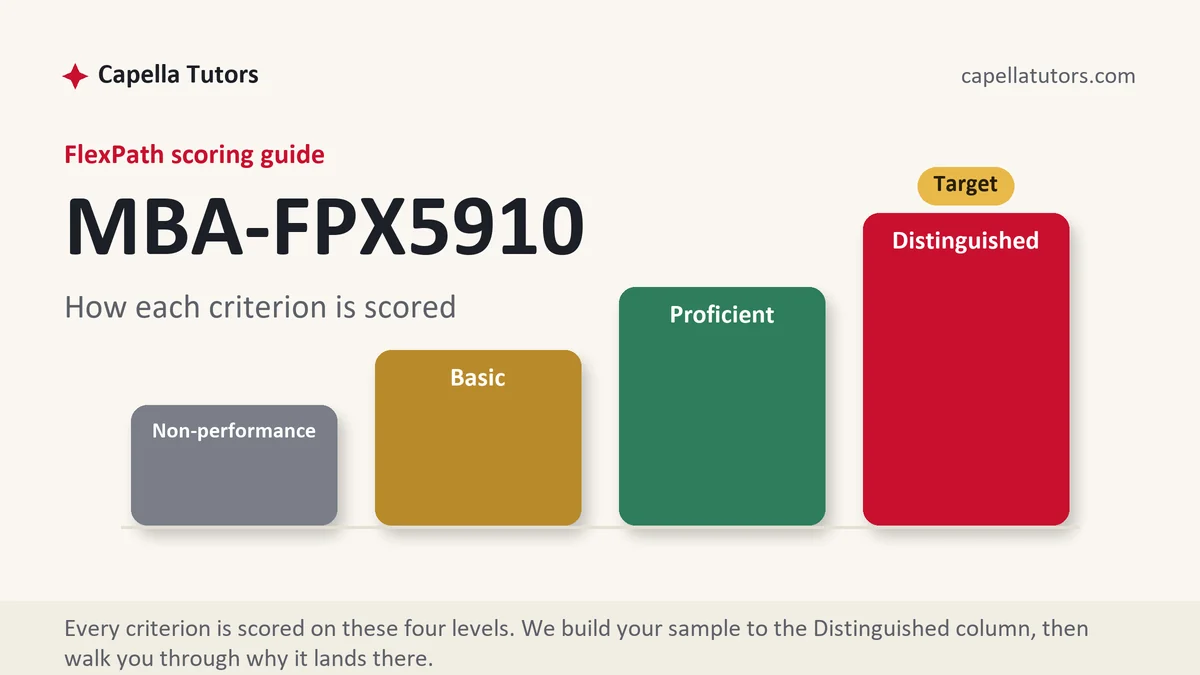
What MBA FPX 5910 actually grades
The integrated finale: one sustained business project that must braid strategy, finance, marketing, analytics, and operations into a single coherent recommendation. Its criteria audit the integration itself, does the marketing plan obey the finance, does the strategy survive the numbers, and the length makes drift the main enemy. Strong capstones are architected before they are written.
How we help in this course
Capstone orders start with structure: a chaptered plan your manager scopes with real dates, then sections drafted so each discipline's thread stays consistent with the rest. The two QA passes check integration explicitly, because that is what the capstone scoring guide is really reading for.
The service terms are the same ones the whole site runs on: 24 to 48 hour delivery per deliverable, Distinguished or A targets matched to your format, two independent QA passes before anything reaches you, and free revisions until the target is met.
Assessment manuals for this course
Every assessment in MBA FPX 5910 has its own manual now: the walkthrough, the structure that maps to the criteria, an annotated sample excerpt, and the done-for-you door. Open Assessment 1, Assessment 2, Assessment 3, or start from the list in the sidebar.
In MBA FPX 5910 right now?
Send the assessment number and the scoring guide from your courseroom. First premium sample free, back in 24 to 48 hours.
An integration audit disguised as a paper
The capstone's scoring guides read for coherence across disciplines: does the marketing plan obey the finance, does the strategy survive the numbers, does the operations design deliver what the recommendation promises. At 2.5 points and 5 quarter credits it is the heaviest single deliverable in the MBA, and its length makes drift the principal enemy. Strong capstones are architected before they are written, which is why every 5910 engagement here opens with structure: a chaptered plan scoped with real dates by your tutorship manager before a paragraph gets drafted.
How staged delivery keeps the threads consistent
Sections draft in sequence, each returning within 24 to 48 hours, and the two QA passes check integration explicitly because integration is what the scoring guide is actually reading for. When a later chapter's numbers force an earlier chapter's revision, the affected stage redrafts free, since a capstone that contradicts itself cannot reach the Distinguished descriptions no matter how strong its parts are.
How does the capstone fit the Expedite Plan's arithmetic?
The master's plan runs two billing sessions, and a staged capstone is what keeps the final session predictable: dated chapters instead of one looming document, closing on schedule alongside your last core courses.
What starts a 5910 engagement?
The capstone's scoring guide plus whatever exists so far, even nothing. The chaptered plan comes back mapped before any commitment, and the first section can be the free sample. Architecture first, prose second; that order is the whole product.
The assessments, one by one
Assessment 1: Capstone Project Summary
The capstone proposal and architecture. Read the full Assessment 1 manual.
Assessment 2: Capstone Proposal
Define the business issue at your chosen company, analyze it, and propose the strategy and action plan the capstone will develop. Read the full Assessment 2 manual.
Assessment 3: Capstone Project Annotated Outline
Outline the full capstone report, with an executive summary, company background, competition, product lines. Read the full Assessment 3 manual.
How to actually write MBA FPX 5910: where to begin
The capstone is one sustained business analysis built across the term, so it starts differently from a single paper: read the scoring guide for every assessment in the course before writing anything, because the later criteria dictate what the earlier chapters must set up. Copy the criteria into a chapter map, one heading per criterion, and treat that map as the architecture of the whole document. Capstones fail by drift, a marketing chapter written in week three that contradicts a finance chapter written in week seven, and the map is what prevents it.
Choose the company early and choose for data access. A public firm gives you a 10-K, investor presentations, and analyst coverage to build on; your own employer works where the course allows it and the numbers are genuinely available. You will live with this choice through every assessment, so an interesting company with thin data is the wrong trade.
Then set up the one artifact that keeps a term-length document coherent: a single assumptions sheet. Every number the capstone uses, growth rates, market sizes, margins, capacity figures, lives there with its source, and every chapter draws from it. When a later chapter forces a number to change, the sheet tells you which earlier sections to sweep. Write the chapters in dependency order, situation before strategy, strategy before the functional plans, finance validating all of it, and hold the integrated recommendation for last.
| Section | What goes in it | What Distinguished looks like |
|---|---|---|
| Company and strategic situation | The firm, its market, and the problem or opportunity, framed with data. | A problem stated with numbers and stakes, specific enough that the rest of the document is obviously necessary. |
| Strategic analysis | The frameworks the guide expects, run on this firm, converging on an option. | Frameworks that produce the decision rather than decorate it, with the rejected options named and priced. |
| Financial case | Projections and valuation of the recommendation, assumptions sourced. | Numbers consistent with every other chapter, sensitivity shown on the inputs that matter. |
| Marketing and operations plans | How the strategy reaches customers and how the operation delivers it. | Each plan obeys the finance: demand assumptions match the projections, capacity matches the demand. |
| Integrated recommendation and implementation | The single recommendation, sequenced with milestones and risks. | One coherent call that every preceding chapter visibly supports, with the first ninety days specified. |
Developing the analysis
The capstone grades a skill none of the core courses could grade alone: integration. Summarizing what each discipline says about the company is Basic; making the disciplines answer to each other is Distinguished. The test is cross-functional consistency. If the marketing chapter projects 20 percent volume growth, the operations chapter must show where the capacity comes from and the financial case must fund the expansion and still clear the hurdle rate; if any link breaks, the recommendation breaks with it. So run the audit deliberately before submission: trace every headline number through all the chapters that touch it, and where two chapters disagree, resolve the disagreement in both rather than softening the language in one. The strongest capstone move is to surface a tension and adjudicate it, the growth the marketing analysis supports exceeds what current capacity delivers, so the recommendation phases the rollout and the finance chapter prices both phases. That is integration performed on the page, which is what the final criteria are written to reward.
Citations that survive faculty review
A capstone reference list is larger than a course paper's and does more kinds of work, so assign every source a job. Company facts cite the 10-K, annual report, and investor materials; market and industry claims cite current industry reports and trade coverage; framework and method choices cite peer-reviewed strategy, marketing, finance, and operations scholarship, mostly inside five years. Work author-date citations into the argument sentences, a market-size claim carries its source in the same sentence that uses it, because a capstone full of uncited numbers reads as opinion. The Capella library's ABI/INFORM and Business Source databases cover the scholarship, SEC filings are free for any public firm, and the same matching rules apply as everywhere in the program: every citation in the reference list, nothing in the reference list uncited, current APA held steady across a document long enough that drift is the default.
The mistakes that land Basic instead of Distinguished
- Chapters written in isolation. A capstone that contradicts itself cannot reach the top column no matter how strong the parts are.
- Framework decoration. A SWOT that sits in the document without producing a decision is summary wearing a template.
- Writing before architecting. Prose started before the chapter map exists is prose that gets rewritten.
- Recycling core-course papers unmodified. Earlier work can inform chapters, but the capstone criteria ask for one integrated argument, not a binder of old ones.
- A thin integration chapter. Saving the actual synthesis for a short conclusion leaves the most heavily weighted criteria barely answered.
MBA FPX 5910 questions students actually ask
Should I pick a public company or my own employer?
Pick for data. A public company gives you a 10-K, investor presentations, and industry coverage, which makes every chapter's evidence problem easy. Your employer works where the course permits it and you can genuinely access the numbers, anonymized to a professional standard. What fails is the middle case: a private firm you find interesting but cannot document.
How do I keep the chapters consistent when they are written weeks apart?
One assumptions sheet, maintained from day one. Every number the document uses lives in it with a source, every chapter draws from it, and when a number changes, the sheet tells you exactly which sections to sweep. Ten minutes of maintenance per assessment replaces the rewrite that otherwise arrives at the end of the term.
How long does the capstone end up?
Scoring guides define coverage, not page counts, and length follows the criteria: it is typically the largest single document in the MBA because it must carry a full strategic situation, the functional plans, and the financial case at defensible depth. Write each section until its criterion is answered at the Distinguished description, then stop; padding a capstone makes the drift problem worse, not better.