Assessment 2 of MBA-FPX5910 is the body of the capstone: the analysis chapters written discipline by discipline, strategy, marketing, operations, and finance, each reaching a decision and each answering to the others. Summarizing what every field says about your company is the Basic version. The graded version makes them agree, so the growth the marketing chapter claims is the volume the operations chapter staffs for and the spend the finance chapter carries. Here is the method our tutors use, a structure keyed to the criteria, an annotated excerpt, and the assumptions-sheet discipline that keeps chapters written weeks apart from contradicting each other. Rather have it drafted? A premium original set of chapters returns in 24 to 48 hours, revised at no cost until your criteria are met.
One honesty note before the manual: Capella revises courses and scoring guides over time, so always write to the exact scoring guide attached to your assessment in the courseroom. The course identity above is verified on capella.edu; the method and structure below are our tutors' approach to it, not Capella's official rubric text.
How Assessment 2 is scored
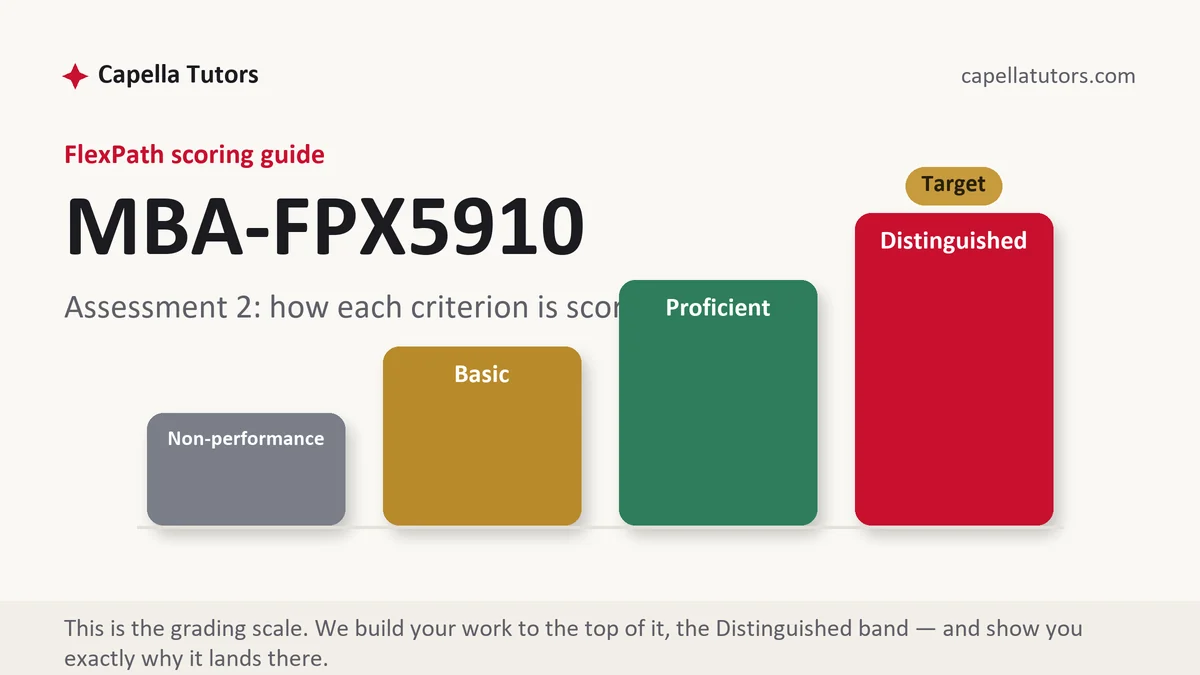
Each criterion lands on one of four levels, and across the analysis chapters the levels separate on whether the disciplines are talking to each other:
| Level | What it means on the integrated analysis chapters |
|---|---|
| Distinguished | Every chapter reaches a decision, and the decisions agree: the demand marketing claims is the demand operations sizes and the demand finance funds, with any contradiction surfaced and settled in both places. The top cell of each criterion adds its own requirement on top of that; read it before you draft. |
| Proficient | Competent functional chapters, analytically correct and internally consistent, joined by transitions rather than by shared numbers. |
| Basic | Each discipline summarized in turn, frameworks reproduced, nothing made to answer anything else. This is what a binder of old course papers reads like. |
| Non-performance | A required chapter or analysis is absent, most often the operations sizing that should sit behind a growth claim. The criterion cannot be scored on what is not written. |
Your scoring guide decides the exact deliverable, but the sequence in 5910 is unforgiving in one direction: the final recommendation can only be as coherent as these chapters, and it cannot repair them. The assumptions sheet you opened with the proposal is the working tool here. Every chapter pulls its figures from the sheet, and when a chapter forces a figure to change, the sheet lists the sections that get swept before you move on. Integration is not a writing style. It is bookkeeping done weekly.
The method, step by step
-
Draft in dependency order
Situation, then strategy, then marketing, then operations, then finance. The order matters because each chapter consumes the one before it: strategy picks the option, marketing sizes the demand that option creates, operations sizes the capacity that demand requires, finance funds and tests the whole arrangement. Written out of order, chapters get rebuilt, and rebuilding is where capstone weeks disappear.
-
Make every framework end in a decision
A SWOT, a five forces run, a segmentation exercise: each earns its pages only if a choice comes out the other side. Close every framework with the sentence it produced, and name the option you rejected along with what rejecting it costs. Analysis that sits in the document without changing anything is the most common form of capstone padding, and evaluators recognize it instantly.
-
Write the marketing chapter as a demand number
The chapter's real output is a quantity: accounts, units, or revenue, by period, built from stated conversion logic rather than from ambition. Show the arithmetic, segment size to reachable share to expected close rate to volume. That figure then leaves the chapter and becomes an obligation on the two chapters after it, which is precisely why it has to be defensible where it stands.
-
Size operations to that exact number
Take the demand figure marketing produced and compute what serving it requires: headcount, capacity, throughput, facilities, lead time, in the same units and the same periods. If current capacity falls short, say so with the gap computed. A shortfall found and handled openly is worth far more to the closing criteria than a plan that quietly assumes capacity is free and infinite.
-
Fund both in the finance chapter, then test it
Every hire, machine, and campaign the previous two chapters committed to becomes a line in the projections, and the projections then face the hurdle rate, the payback, or whatever test your guide names. Run sensitivity on the two inputs the answer is most exposed to. A financial case that only clears at the optimistic value is a case the criteria are designed to find.
-
Sweep the sheet and reconcile before submitting
Take each figure on the assumptions sheet and search the whole document for it. Where two chapters disagree, fix both rather than softening the language in one. Where a chapter used a number the sheet does not carry, add it or delete it. Then self-score each criterion against its top cell and leave enough of the session for a revision cycle.
A structure that maps to the criteria
The numbers below are drafting aids from our files and carry no official weight; what your criteria require is what decides how long each chapter runs.
| Section | What it must do | Guide |
|---|---|---|
| Situation carried forward | The firm and the quantified problem from the proposal, restated in one tight pass so the chapters have a shared starting point. | ~180 words |
| Strategy chapter | The frameworks your guide expects, run on this firm, ending in the chosen option with the rejected ones priced. | ~280 words |
| Marketing chapter | Segment, positioning, and channel decisions resolving into a demand figure by period, conversion arithmetic shown. | ~300 words |
| Operations chapter | Capacity, headcount, and lead time computed against that exact demand figure, with any gap named and closed. | ~300 words |
| Finance chapter | Projections carrying every commitment the chapters above made, tested against the hurdle and stressed on the inputs that move the answer. | ~300 words |
| Cross-chapter reconciliation | The shared figures listed with the chapters using them, and any tension surfaced and settled rather than smoothed away. | ~160 words |
| References | Company facts to filings and investor materials, market claims to industry reports, methods to peer-reviewed scholarship, APA matched both ways. | as needed |
Annotated sample excerpt
An original passage from our files, chosen because it moves a single number through three chapters in one paragraph. That movement is what the integration criteria are reading for.
Ardenline Software's marketing chapter projects 240 new mid-market accounts in year two at an 18,000 dollar average contract value, 4.32 million dollars of new annual recurring revenue, built from a reachable segment of 3,100 firms and an 8 percent close rate on qualified pipeline.1 The operations chapter has to place those accounts: at 31 implementations per consultant per year, 240 accounts need eight consultants against the five Ardenline employs, so the plan hires three at a fully loaded 128,000 dollars each, and the finance chapter carries that 384,000 dollars as operating expense from the first quarter rather than as a footnote.2 Gross churn of 14 percent against the existing 9.6 million dollar base retires 1.34 million in the same year, so net growth is 2.98 million rather than 4.32, and the valuation runs on the net figure because that is what the assumptions sheet holds and what every chapter therefore uses.3
- 1Marketing ends in a quantity with its conversion logic exposed, so the next two chapters have something they can compute against rather than a mood to interpret.
- 2Operations sizes headcount from that exact figure, finds a gap, and the cost of closing it lands in the projections. This is the link most capstones leave broken.
- 3Churn corrects the headline number and the correction propagates to the valuation. Naming the sheet as the source is what stops the gross figure reappearing three chapters later.
The full premium sample for your exact assessment, written fresh to your scoring guide and issue, is free to request. Study it, revise it into your own voice, and submit work you understand.
The five mistakes that cost Distinguished
- Four essays in one folder. Chapters that never cite each other's numbers are course papers stapled together, and the integration criteria read them exactly that way.
- Growth nobody can deliver. A marketing projection with no matching capacity in the operations chapter is the single most caught inconsistency in this course.
- Capacity nobody paid for. Hires and equipment sized in operations but missing from the projections break the finance chapter quietly, which makes the break harder to repair later.
- Frameworks as decoration. Analysis reproduced without a decision at the end fills pages and answers no criterion at all.
- Figures that drift by week. A margin quoted at 22 percent in marketing and 19 in finance tells the evaluator no assumptions sheet is being kept.
Pre-submission checklist
- Chapters drafted in dependency order, each consuming the one before it
- Every framework closed with the decision it produced and the option it rejected
- A demand figure produced in the marketing chapter with its conversion arithmetic shown
- Operations capacity computed against that exact figure, in matching units and periods
- Every commitment from marketing and operations carried as a line in the projections, with sensitivity run
- The assumptions sheet swept, contradictions fixed in both places, criteria self-scored
Want the chapters built to agree?
Send the scoring guide, your approved proposal, and whatever data you have gathered on the firm. Our eight-person pipeline, research analyst and two QA reviewers included, returns premium original analysis chapters with one demand figure running cleanly through marketing, operations, and finance, in 24 to 48 hours and revised free until the guide is met. The closing recommendation inherits whatever coherence these chapters have; give it something worth inheriting.