This manual is for MBA FPX 5910 Assessment 1, start to submission. Assessment 1 of MBA FPX 5910 is the capstone's architecture: the firm chosen, the business problem quantified, the chapters mapped in dependency order, and the evidence plan named before any analysis gets written. Everything you submit for the rest of the course stands on what this document commits you to, so it is graded on feasibility and precision rather than on enthusiasm. Below is the method our tutors run for it, a criterion-mapped structure, an annotated excerpt, and the two habits that stop later chapters contradicting each other: one assumptions sheet, and one written declaration of the numbers your chapters must share. Want it handled instead? A premium original proposal built to your own scoring guide lands in 24 to 48 hours, with free revisions until it clears. Capella's catalog lists the course as MBA-FPX5910, and some courserooms print MBA5910; both point to this same Assessment 1.
One honesty note before the manual: Capella revises courses and scoring guides over time, so always write to the exact scoring guide attached to your assessment in the courseroom. The course identity above is verified on capella.edu; the method and structure below are our tutors' approach to it, not Capella's official rubric text.
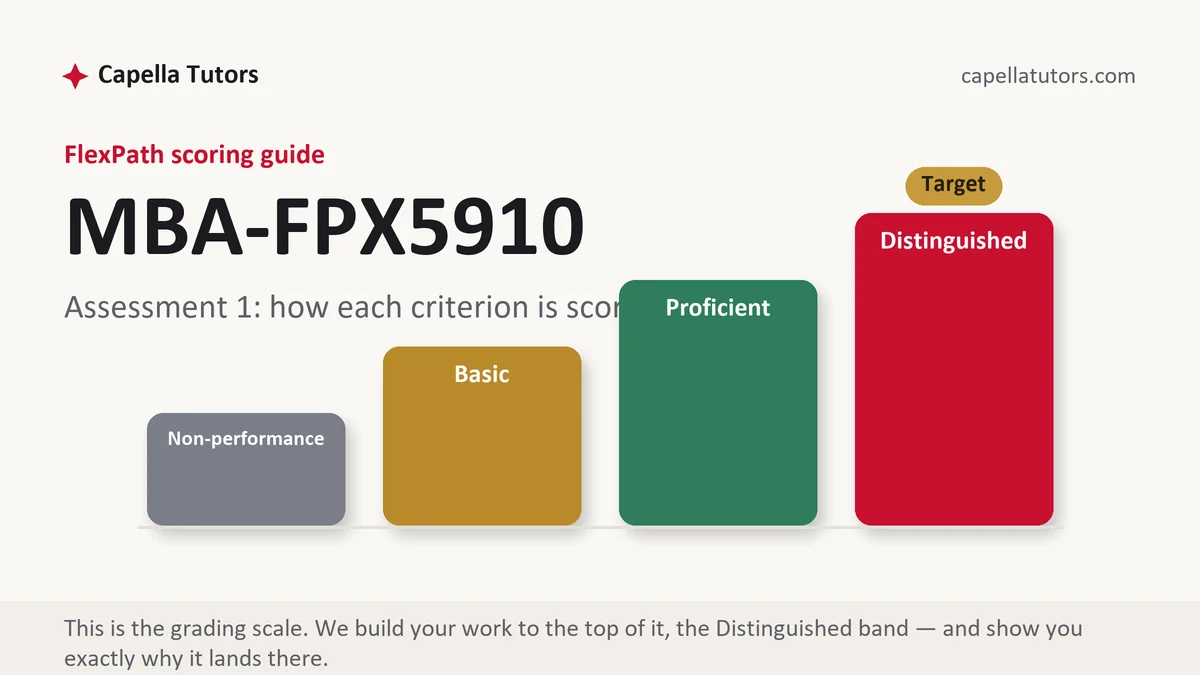
How MBA FPX 5910 Assessment 1 is scored
FlexPath places every criterion at one of four levels, and on a capstone proposal the levels separate on whether the project could actually be executed:
| Level | What it means on a capstone proposal |
|---|---|
| Distinguished | The firm comes with named, already located sources, the problem carries computed figures and a consequence, the chapter map covers every downstream criterion in dependency order, and the numbers the chapters will share are declared before drafting begins. Each criterion's top cell asks for one thing more than the level beneath it; find that thing. |
| Proficient | A feasible project with a sound plan, whose evidence sources stay generic and whose chapters are listed rather than sequenced. |
| Basic | A company and a topic, described with interest, carrying no figures and no dependency order. Most first proposals sit exactly here. |
| Non-performance | A required element of the proposal is missing outright, most often the evidence plan or the problem statement itself. Missing scores below weak. |
This is also where the capstone's real risk gets managed. Your scoring guide decides the deliverable, but the pattern in 5910 is that the analysis chapters follow this document and the integrated recommendation follows those, so a vague scope written now becomes a rewrite in week seven. Two commitments prevent that: a single assumptions sheet holding every number the capstone will use, and an explicit statement of which figures the marketing, operations, and finance chapters have to agree on. Declare them here and integration becomes a habit; leave them implicit and it becomes an emergency.
The MBA FPX 5910 Assessment 1 method, step by step
-
Read every assessment's guide before writing the proposal
The later criteria dictate what this one has to set up, so pull all of the course's scoring guides first and list what the final recommendation will eventually have to prove. Everything on that list needs a chapter, a data source, and a place in your schedule now. Proposals written against the opening guide alone commit students to projects the closing guide cannot grade.
-
Choose the company for documentation, not for interest
You live with this firm for a whole term, so pick one whose numbers you can obtain: a public company with a 10-K, investor presentations, and analyst coverage, or an employer whose figures you can genuinely access and anonymize to a professional standard. Then say in the proposal which documents you have already opened. Naming them converts a claim of feasibility into evidence of it.
-
State the problem as figures with a consequence
A capstone problem is not a topic. Write it as two or three computed facts, a margin that has moved, a share that has shifted, a cost that has grown, then the consequence of leaving it alone. Interesting is not a criterion; consequential is. This is also the sentence every later chapter must stay aimed at, which is why it earns real time up front.
-
Map the chapters in dependency order
Situation before strategy, strategy before the functional plans, finance validating all of them, the integrated recommendation last. Write one heading per criterion across the whole course and note beside each what it needs from the heading above it. That note is the difference between a table of contents and a schedule you can actually keep.
-
Open the assumptions sheet on day one
Build one sheet carrying every number the capstone will use, growth rates, market sizes, margins, capacity, wage costs, each with its source and the date you pulled it. Chapters then draw from the sheet instead of from memory, and when a figure changes in week six the sheet tells you which sections to sweep. Ten minutes of upkeep per assessment replaces the reconciliation crisis that otherwise arrives at the end.
-
Declare the integration links before any chapter exists
Write down which figures more than one chapter will touch: the demand the marketing plan will claim and the operations plan will have to serve, the capacity and hiring that demand implies, the capital the finance chapter must fund and test. A growth claim with no matching capacity and no funding line is the failure the closing criteria are built to catch. Naming the links now makes that consistency deliberate rather than lucky.
A structure that maps to the criteria
Word targets below are planning figures from our tutoring files, not Capella requirements; the guide in your courseroom sets coverage, and a section grows for as long as its criterion needs it to.
| Section | What it must do | Guide |
|---|---|---|
| Company and access to evidence | The firm, why it satisfies the course's requirements, and the specific filings, reports, and internal data already located. | ~200 words |
| The business problem, quantified | Two or three computed facts plus the cost of inaction, written as the question this capstone answers. | ~250 words |
| Scope and chapter questions | What sits inside the project and what does not, with the single question each chapter is responsible for settling. | ~280 words |
| Chapter map and dependency order | Every heading the course's criteria require, sequenced by what each one consumes from the one before it. | ~250 words |
| Evidence and source plan | Which claims rest on filings, which on industry reports, which on peer-reviewed method sources, and where each was found. | ~220 words |
| Assumptions sheet and shared numbers | The figures the document will hold in common, listed now, each with the chapters that must agree on it. | ~200 words |
| References | Filings and industry sources cited where their numbers appear, method sources mostly inside five years, APA matched both ways. | as needed |
Annotated sample excerpt
A short original passage from our files, written to show what a proposal sounds like when it is already carrying numbers. Study the moves, then make them with your own firm.
Brannigan Freight Lines moves 41 million dollars of regional freight on 118 tractors, and the family that built it intends to sell inside three years, which fixes both the horizon and the audience for this project.1 Two figures set the problem: operating margin has slipped from 11.4 to 8.2 percent across four years while the three largest customers now supply 47 percent of revenue, and acquirers in this segment discount concentration and thin margin separately, so leaving both in place costs the family roughly a full turn of EBITDA at exit.2 The capstone therefore answers one question, what combination of customer diversification and cost restructuring moves Brannigan toward the multiple its scale should command, and every chapter draws its revenue base, cost per mile, and concentration figures from a single assumptions sheet so that the accounts the marketing chapter targets, the tractors and drivers the operations chapter must add to carry them, and the valuation the finance chapter builds remain one argument rather than three.3
- 1The firm arrives with documentable scale and a real decision attached. An owner's stated intent gives the whole project its audience, which is what makes the later chapters answerable.
- 2The problem is two computed movements plus a priced consequence. Describing the company as facing competitive pressure is the Basic version of this sentence.
- 3The shared numbers are declared at proposal stage, with the marketing, operations, and finance chapters explicitly bound to the same sheet. This is the sentence that makes cross-functional consistency achievable eight weeks later.
The full premium sample for your exact assessment, written fresh to your scoring guide and issue, is free to request. Study it, revise it into your own voice, and submit work you understand.
The five mistakes that cost Distinguished
- A topic where a problem belongs. Studying a company is not a project; a proposal with no quantified problem gives the later chapters nothing to aim at.
- A firm you cannot document. The middle case, private and interesting and opaque, sinks more capstones than any analytical error does.
- A chapter list instead of a chapter map. Headings with no dependency order let you write a finance chapter before the strategy it is supposed to test exists.
- Sources named as categories. Promising scholarly research proves nothing; name the databases, the filings, and the industry reports you have already opened.
- Shared numbers left implicit. Chapters never told which figures they hold in common will disagree, and the closing criteria are written to find that disagreement.
Pre-submission checklist
- All of the course's scoring guides read, with the closing criteria listed as requirements on this plan
- The firm named alongside the specific documents already located
- A problem statement built from computed figures and the cost of inaction
- A chapter map covering every criterion, sequenced by what each chapter consumes
- An assumptions sheet started, each entry carrying its source and the date pulled
- The shared numbers declared, with the chapters bound to each one named
Want the architecture set before you commit a term to it?
Send the capstone's scoring guides and your company shortlist. Our eight-person pipeline, research analyst and two QA reviewers included, returns a premium original proposal with the problem quantified, the chapters sequenced by dependency, and the assumptions sheet started, in 24 to 48 hours and revised free until it meets the guide. Every later assessment costs less to write when this one is right.