How to write MBA-FPX5910 Assessment 3

The short answer

Assessment 3 of MBA-FPX5910 is the recommendation the whole term was building toward: one decision, argued to an executive audience, that every preceding chapter visibly supports. It is not a conclusion. It carries the financial case, the sequenced implementation, the risks with prices attached, and an honest statement of what would make the call wrong. It is graded criterion by criterion against a FlexPath scoring guide, and the heaviest criteria read for integration rather than for polish. Below is the method our tutors run, a criterion-mapped structure, an annotated excerpt showing a tension adjudicated rather than smoothed, and the sweep that catches contradictions before an evaluator does. Prefer it handled? A premium original closing recommendation arrives inside 24 to 48 hours, and it keeps getting revised free until the guide is met.

One honesty note before the manual: Capella revises courses and scoring guides over time, so always write to the exact scoring guide attached to your assessment in the courseroom. The course identity above is verified on capella.edu; the method and structure below are our tutors' approach to it, not Capella's official rubric text.
How Assessment 3 is scored

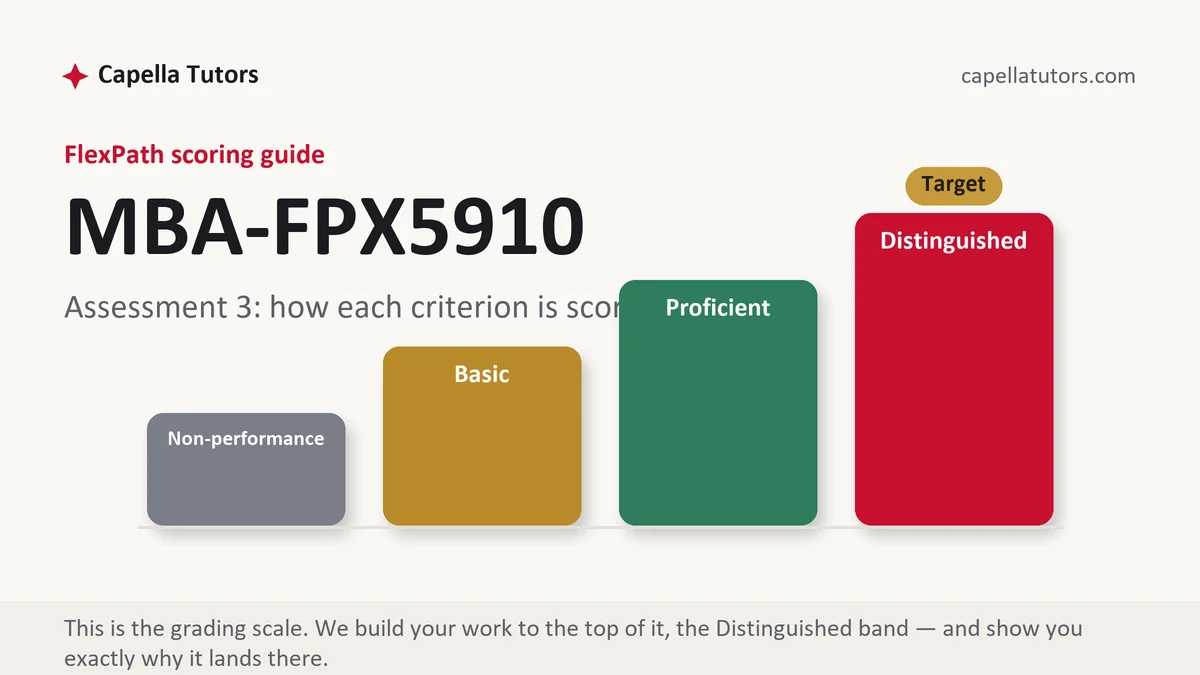
Each criterion resolves to one of four levels, and on the closing recommendation the levels separate on whether the document behaves as a single argument:

LevelWhat it means on the final recommendation
DistinguishedOne recommendation the whole capstone supports, traced figure by figure through the chapters, priced with sensitivity, sequenced with owners and dates, and honest about the conditions that would make it wrong. Every criterion's top cell asks for one further move; read it before you write the section.
ProficientA well-argued call, financially supported, whose implementation stays at the level of intent and whose risks are listed without prices attached.
BasicA conclusion that restates the chapters and endorses the obvious. Agreeable, readable, and unfundable.
Non-performanceA required element left out, usually implementation or the risk treatment. A criterion cannot be scored on what is not on the page.

Your scoring guide decides the deliverable, but the arithmetic of the course is fixed: this paper can only spend what the earlier chapters banked. Run the integration audit before you draft rather than after. Take the assumptions sheet, trace each headline figure through every chapter that touches it, and settle the disagreements first, because a recommendation written on top of an unresolved contradiction inherits that contradiction in the most heavily weighted criteria in the whole MBA.

The method, step by step

  1. Reduce the term to one sentence

    Write the recommendation as a single sentence a board could vote on: what the firm should do, at what scale, by when, at what cost. If it takes a paragraph, the analysis has not converged and the writing will not rescue it. Everything after that sentence exists to make the call survivable, and whatever does not serve it belongs in an appendix or nowhere.

  2. Trace every headline figure through the document

    Take the four or five numbers the recommendation rests on, growth rate, margin, capital requirement, capacity, price, and follow each through every chapter that mentions it. Where two chapters disagree, decide which is right and correct both. The audit costs an afternoon and prevents the exact failure the capstone criteria were built to detect.

  3. Adjudicate the tension instead of softening it

    The strongest closing move is to name a genuine conflict between chapters and resolve it with a decision. The demand the marketing analysis supports exceeds what current capacity delivers, so the recommendation phases the rollout and the finance chapter prices both phases. Surfacing and settling a tension demonstrates integration; smoothing the language merely conceals it, and evaluators read for the difference.

  4. Sequence the first ninety days with owners

    An implementation section is dates, names, and order: what happens in month one, who owns it, what must be true before month two begins, which capital releases when. Specify the first ninety days at a level a manager could act on, then hold the remaining horizon at milestones. Intent written in the future tense is what keeps this criterion parked at Proficient.

  5. Price the risks and name the kill conditions

    For each material risk, give the mechanism, the cost if it lands, the mitigation, and the observable that would tell you it is landing. Then go one step further and state the conditions under which the firm should stop: the metric, the threshold, the review date. Executives fund plans that know how they end, and very few capstones offer them one.

  6. Read the whole document as one argument, then score it

    Read the capstone end to end in a single sitting, asking only whether each chapter is doing work the recommendation needs, and cut what is not. Then grade every criterion against its top cell using only what is on the page, repair whatever is honestly short, and submit with enough of the session left for a revision cycle.

A structure that maps to the criteria

The targets here come from our tutoring files and carry no official standing; coverage belongs to the guide in your courseroom, and a section keeps going while its criterion still wants more.

SectionWhat it must doGuide
The recommendation, statedOne decision with scale, timing, and cost, written so an executive reader knows what is being asked of them by the second sentence.~150 words
What each chapter contributesThe evidence braided: the situation that made this necessary, the strategy that selected it, the demand, the capacity, the money, each cited to its own analysis.~320 words
Financial case and sensitivityThe projection behind the call, the test it clears, and what happens to the answer when the two most exposed inputs move.~300 words
Implementation and the first ninety daysMonth-by-month actions with owners, prerequisites, and capital release points, then milestones for the longer horizon.~280 words
Risks, kill conditions, and monitoringEach risk with mechanism, cost, mitigation, and early indicator, plus the thresholds that would end the program.~240 words
Limits of the analysisWhat the available data could not settle and what a fuller study would measure before the second phase commits.~150 words
ReferencesCompany facts to filings and investor materials, market claims to current industry sources, methods to peer-reviewed scholarship, APA held steady across the document.as needed

Annotated sample excerpt

An original passage from our files, selected because it settles a cross-functional conflict on the page instead of writing around it. That is the move the closing criteria pay for.

Sample excerpt: the recommendation, adjudicated Original model · Capella Tutors

Sable Creek Coffee Roasters should phase the wholesale pivot across two years rather than launch it whole, because the marketing chapter's 310 target cafe and grocery accounts imply 84,000 pounds of annual volume while the single 35-kilogram roaster delivers 61,000 pounds under current shift patterns.1 Phase one takes 190 accounts inside existing capacity and funds a second roaster from the 214,000 dollars of gross profit it generates; phase two adds the remaining 120 accounts in month fourteen once that roaster is commissioned, holding the capital request to 168,000 dollars and keeping the projected return at 19 percent against the firm's 12 percent hurdle.2 Taking all 310 accounts at once would require 340,000 dollars of first-year debt and put fill rates at risk with precisely the grocery buyers the marketing analysis identified as the slowest to win and the least forgiving of a short shipment.3

  • 1The conflict between the marketing volume and the operations capacity is stated in one sentence, in matching units, and the recommendation is the resolution of it rather than a compromise around it.
  • 2The finance chapter funds the phasing, phase two pays for itself, and the return is set against a named hurdle. This is what turns an integration argument into a fundable one.
  • 3The rejected alternative is priced and its operational consequence traced back to a marketing finding. Dismissing an option without a number is the Proficient version of this sentence.

The full premium sample for your exact assessment, written fresh to your scoring guide and issue, is free to request. Study it, revise it into your own voice, and submit work you understand.

Get the full sample free

The five mistakes that cost Distinguished

  • A conclusion pretending to be a recommendation. Restating the chapters and endorsing the obvious answers the lightest criterion and none of the heavy ones.
  • Contradictions carried forward. A capital figure that differs between the operations and finance chapters undoes the integration criteria however well the closing pages are written.
  • Implementation in the future tense. Will develop, will monitor, will engage stakeholders; none of it carries an owner or a date, and the criterion notices immediately.
  • Risks without prices. A list of things that could go wrong, unquantified and unmitigated, is a disclaimer rather than an analysis.
  • No limits section. A capstone claiming certainty its data cannot support reads as inexperience; naming what the analysis could not settle is a mark of the top column.

Pre-submission checklist

  • The recommendation written as one sentence carrying scale, timing, and cost
  • Every headline figure traced through all chapters and reconciled in both places
  • At least one cross-functional tension surfaced and settled with a decision
  • Financial case tested with sensitivity on the two inputs that move the answer most
  • First ninety days sequenced with owners and prerequisites, longer horizon held at milestones
  • Risks priced, kill conditions named, every criterion self-scored before submission

Want the closing argument built to hold?

Send the scoring guide and every chapter you have written so far, contradictions included. Our eight-person pipeline, research analyst and two QA reviewers included, returns a premium original recommendation with the figures reconciled across chapters, the tension adjudicated, and the first ninety days sequenced, in 24 to 48 hours and revised free until the guide is met. This is the last document in the MBA; make it the one you would show an employer.

Keep going

Online now