Core Business Strategy runs as MBA FPX 5006 at Capella, 2 pts / 4 qcr, available in FlexPath in the MBA path. In Capella's catalog the course code is written MBA-FPX5006.
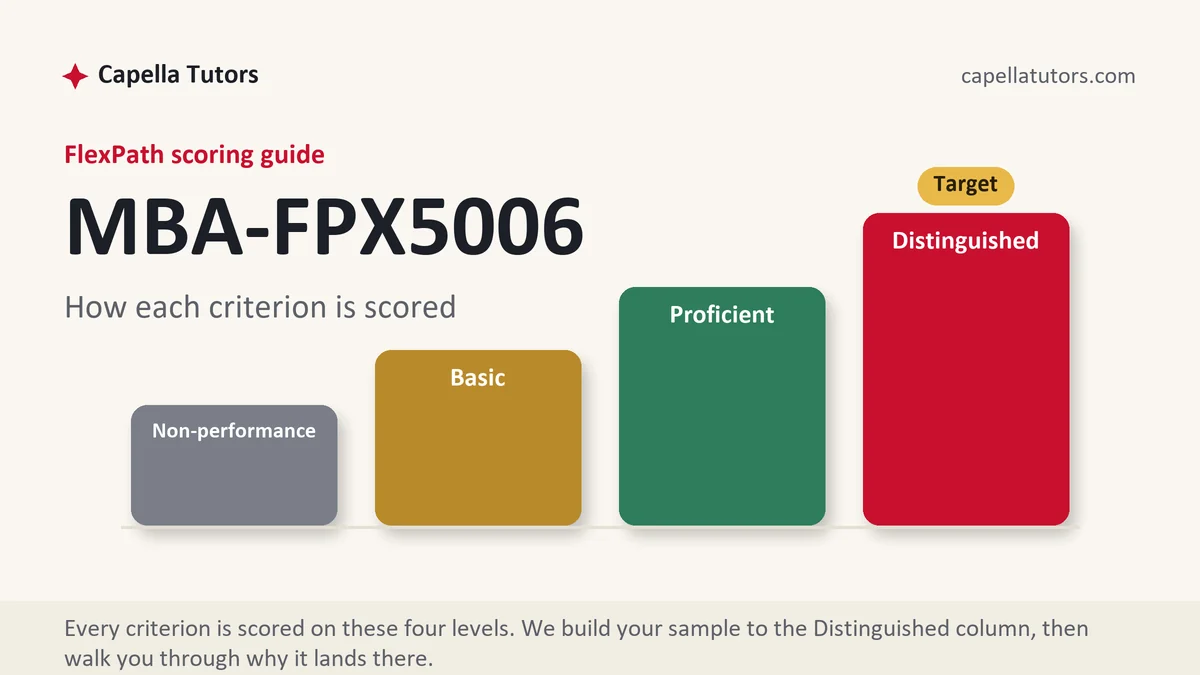
What MBA FPX 5006 actually grades
Strategy assessments hand you an organization and demand a committed recommendation: environmental scans, competitive analysis, and strategic options weighed until one wins. Distinguished work commits, with numbers and named risks, while Basic work surveys frameworks and hedges. The scoring guides here are unusually explicit that analysis must end in a defensible choice.
How we help in this course
Our strategy drafts apply the frameworks to the case rather than explaining them, quantify what the recommendation is worth, and pre-empt the follow-up question a skeptical executive would ask. The walkthrough shows where each criterion got its evidence, which makes your revision pass genuinely fast.
The service terms are the same ones the whole site runs on: 24 to 48 hour delivery per deliverable, Distinguished or A targets matched to your format, two independent QA passes before anything reaches you, and free revisions until the target is met.
Assessment manuals for this course
Every assessment in MBA FPX 5006 has its own manual now: the walkthrough, the structure that maps to the criteria, an annotated sample excerpt, and the done-for-you door. Open Assessment 1, Assessment 2, Assessment 3, or start from the list in the sidebar.
In MBA FPX 5006 right now?
Send the assessment number and the scoring guide from your courseroom. First premium sample free, back in 24 to 48 hours.
Why hedged strategy writing loses to committed strategy writing
The 5006 scoring guides are unusually blunt about it: analysis must end in a defensible choice. Surveying frameworks and presenting balanced options reads as Basic because it stops where the criteria start, while Distinguished work commits to a recommendation, quantifies what it is worth, and names the risks it accepts. Our strategy drafts are built to commit, frameworks applied to the case rather than explained beside it, and the walkthrough pre-answers the follow-up a skeptical executive would ask, because that anticipation is usually the named extra the top column wants.
Turning an evaluation around inside the session
FlexPath's flat-rate economics make evaluation turnaround the real currency of this course: submit, receive the evaluation, submit the next. The desk's role is keeping your side of the loop instant, each assessment drafted to the Distinguished descriptions within 24 to 48 hours, revisions folded in free whenever an evaluator asks for more, so a 2-point strategy course closes in weeks rather than lingering across the session you already paid for.
Do you work from the case materials or general strategy theory?
From the case. The criteria grade application, so the environmental scan, the competitive read, and the recommendation are all built on the scenario your courseroom supplies.
How do I start without over-explaining?
Assessment number plus scoring guide is enough; the scope reply will ask for anything the case genuinely requires. Turnarounds hold at 24 to 48 hours, with free revision until the top column posts.
The assessments, one by one
Assessment 1
The environmental and competitive scan. Read the full Assessment 1 manual.
Assessment 2
Strategic options weighed until one wins, with numbers. Read the full Assessment 2 manual.
Assessment 3
The strategy synthesis that closes the course. Read the full Assessment 3 manual.
How to actually write MBA FPX 5006: where to begin
Begin with the scoring guide, not the case. Download it from the courseroom, copy each criterion into a blank document as a heading, and paste the Distinguished description under each one. Strategy assessments tempt you to start reading about the company; resist that until the outline exists, because the criteria tell you what the reading is for. A typical 5006 assessment asks for an external analysis, an internal analysis, and a strategy recommendation for a chosen or assigned organization, and the criteria map almost one to one onto those stages.
Then build the evidence file. For the external side: an industry profile with market size and growth, the competitive structure, and whatever regulatory or technological pressure is moving the sector. For the internal side: the company's own numbers, revenue by segment, margins across recent periods, and its stated strategy from the annual report. If the company is public, the 10-K is the single best document you will touch, because it hands you segment data, risk factors, and management's own account of the competitive environment in one place.
Write the recommendation before you draft the analysis sections, at least as one committed sentence. It will change as the analysis firms up, but drafting toward a stated destination keeps every section pulling toward the choice, which is the shape the 5006 criteria reward. Analysis that surveys and never lands is the signature Basic performance in this course.
| Section | What goes in it | What Distinguished looks like |
|---|---|---|
| Introduction | The company, the strategic question, and a preview of the recommendation. | The thesis commits in one sentence before any framework appears. |
| External analysis | Industry structure, competitive forces, and environmental pressures, on real data. | Each force rated strong or weak with a figure attached, not just named and defined. |
| Internal analysis | Resources, capabilities, and financial position, framed as strengths and weaknesses. | Every SWOT entry drawn from segment data and margins, not adjectives. |
| Strategic options | Two or three plausible options weighed against the same criteria. | Rejected options get a stated reason with a number in it. |
| Recommendation and risks | The committed choice, its implementation logic, and how success will be measured. | Risks named and accepted openly, not hidden or hedged away. |
Developing the analysis
Run the frameworks instead of touring them. A SWOT that lists a strong brand and growing competition is Basic, a SWOT built from the numbers is Distinguished: revenue in the largest segment down across two annual reports is a weakness, a rival entering the core market at a lower price point is a threat, and each entry earns its cell with a figure. The same discipline applies to the external scan: rate each competitive force and say why, with evidence, rather than defining the force. Then argue from the numbers to the recommendation in a visible chain: the analysis found this, so the options narrow to these, so the recommendation is this, at this cost, with these risks. Every section should open by answering its criterion, because the evaluator scores criteria, not chapters, and a criterion answered in the first sentence never gets missed.
Citations that survive faculty review
Strategy papers live or die on source quality, and the guide's evidence criterion prices it. The mix that holds up: the company's own filings for internal facts, an industry data source in the IBISWorld style for market size and growth, one or two current peer-reviewed strategy articles for the frameworks and for any claim about what strategies produce, all within roughly the last five years except the filings, which should simply be the most recent. Reach them through the Capella library: ABI/INFORM carries the business press and the peer-reviewed journals. Integrate citations into the argument, author and date inside the sentence making the claim, and cite the 10-K like any source, with company, year, and section. A recommendation resting on uncited numbers reads as opinion, and opinion is Basic.
The mistakes that land Basic instead of Distinguished
- Framework tourism. Running PESTLE, five forces, and SWOT at half depth impresses no one; running the two the criteria name at full depth does.
- The hedged recommendation. Saying the company should consider its options is a survey; naming the move, its cost, and its accepted risks is a strategy.
- A SWOT of adjectives. Every entry needs a number or a named fact behind it, or it is decoration.
- Stale company data. Analysis built on a three-year-old article about a company that has since restructured fails the currency check on sight.
- Skipping the risks the Distinguished column asks for. Naming what could go wrong is usually the exact upgrade the top level describes.
MBA FPX 5006 questions students actually ask
Which company should I choose for the analysis?
A public company in an industry you can read about, because evidence is the constraint. Public means a 10-K full of segment data and risk factors; a well-covered industry means market data exists. Avoid private firms and very young companies, however interesting, since you will spend the assessment apologizing for missing numbers. A mid-size public company in one clear industry is easier to analyze well than a sprawling conglomerate.
Do I have to use every framework from the course?
No, use the ones the scoring guide's criteria call for and run them deeply. If a criterion asks for an external environmental analysis, one rigorous pass with real data satisfies it; three shallow frameworks satisfy nothing. Name the framework, apply it to your company's evidence, and let its output feed the recommendation. Depth on few beats coverage of many everywhere in this course.
What if my recommendation turns out to be wrong for the real company?
The guide does not grade clairvoyance, it grades defense. A committed recommendation argued from the evidence you assembled, with costs and risks stated, scores Distinguished even if the real company later does the opposite. The failure mode is not being wrong, it is refusing to land: balanced options presented without a choice is the criterion left unanswered.