This manual is for MBA FPX 5006 Assessment 2, start to submission. Assessment 2 of MBA FPX 5006 is where strategy stops being analysis and becomes a choice. You put two or three real options on the table, judge them against standards you declare in advance, and commit to one with numbers and named risks behind it. Each criterion is scored separately, and this is the assessment where hedging costs the most: a balanced discussion that never lands leaves the heaviest criteria empty. Here is the order our tutors work in, a structure that maps to the criteria, and an annotated excerpt. Prefer it drafted? Send the guide and an original options paper is back within two days, rewritten at no cost for as long as the evaluator keeps asking. Capella's catalog lists the course as MBA-FPX5006, and some courserooms print MBA5006; both point to this same Assessment 2. In current courserooms this assessment typically appears as "Business Strategy".
One honesty note before the manual: Capella revises courses and scoring guides over time, so always write to the exact scoring guide attached to your assessment in the courseroom. The course identity above is verified on capella.edu; the method and structure below are our tutors' approach to it, not Capella's official rubric text.
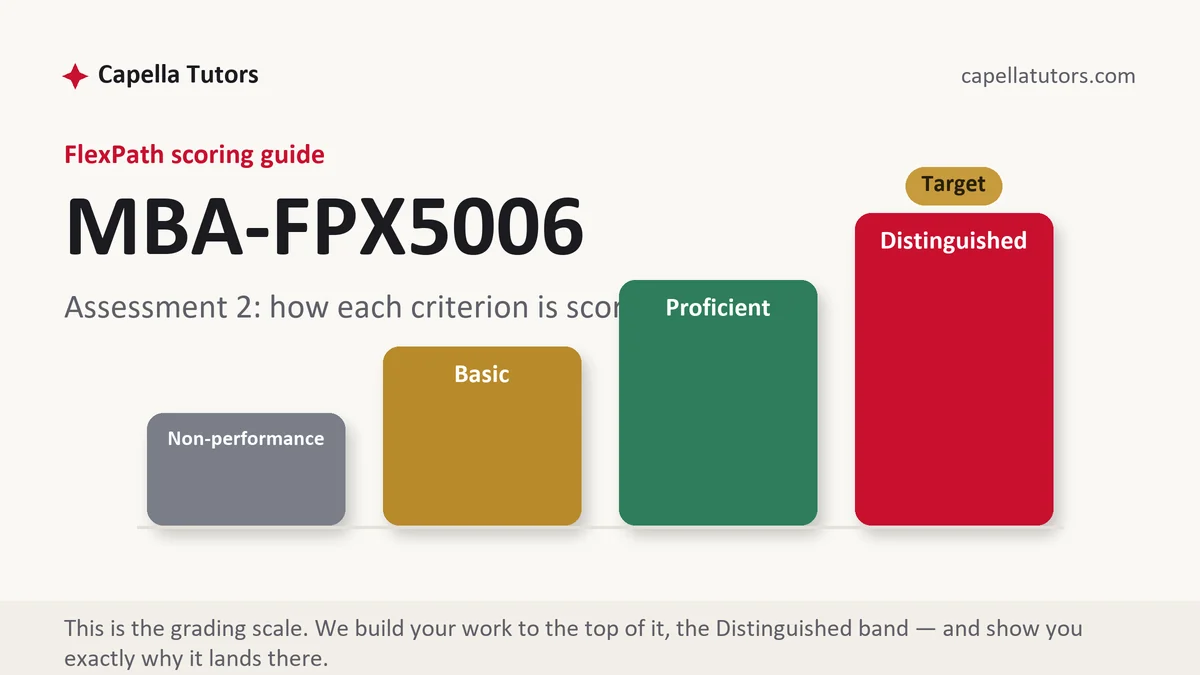
How MBA FPX 5006 Assessment 2 is scored
No points, no letters, four levels per criterion. Read the level text as your instructions, because on a decision paper it is unusually literal:
| Level | What it means on a strategic options paper |
|---|---|
| Distinguished | One option is chosen, priced, and defended, the rejected options are refused for stated reasons with numbers in them, and the risks the choice accepts are named rather than managed away. Your criterion text will add one more requirement; write to it word for word. |
| Proficient | A choice is made and supported. What is normally missing is the money: options compared qualitatively and the recommendation defended in adjectives rather than figures. |
| Basic | Options presented, advantages and disadvantages listed, the decision handed back to the reader. Complete and unanswerable. |
| Non-performance | No alternatives were developed, or no recommendation appears at all. The criterion has nothing to score, so it scores at the floor. |
Evaluators in this course have a reliable tell for Basic work: the phrase should consider. Consideration is what the assessment asked you to do on the reader's behalf, so handing it back leaves the criterion exactly where you found it.
The MBA FPX 5006 Assessment 2 method, step by step
-
Carry the analysis forward as evidence, not as a recap
Whatever you established in the scan gets reused here in compressed form, but only the parts the decision rests on. Two paragraphs of constraining findings beat six pages of re-reported analysis, because the criteria on this assessment are about the decision, not the background.
-
Write options as decisions somebody could sign
Expand into e-commerce is a direction. Launch owned e-commerce fulfilled from the two largest stores by the third quarter, at a stated capital cost, is an option. Each one needs scope, timing, and a price, or the comparison later has nothing to compare.
-
Declare the decision standards before scoring anything
State the three or four standards you are judging against, cost, speed to revenue, fit with existing capability, risk exposure, and say why those. Declaring them first stops the comparison from reverse-engineering the answer you already liked, and evaluators can see the difference immediately.
-
Put a number on every option
Each option gets an estimated cost, an estimated return, and a payback horizon, drawn from the company's own figures where possible and labeled clearly as an assumption where not. An assumption you state and justify is evidence; an assumption you hide is a hole.
-
Reject the losing options in writing
Say which option you are killing and why, with a figure inside the reason. A rejection stated in numbers proves the comparison actually happened, and it is usually the fastest route to satisfying the criterion about evaluating alternatives.
-
Accept the risks out loud, then self-score
List what could go wrong with the option you chose, how likely it is, and what you would do about it, then say plainly which risks you are accepting anyway. Grade each criterion yourself against the guide afterward and rewrite whatever falls short of the top column.
A structure that maps to the criteria
Word targets our tutors plan against on a typical 5006 decision paper. They are budgets, not rules, and the scoring guide settles any conflict.
| Section | What it must do | Guide |
|---|---|---|
| Introduction | The decision facing the organization, the standards you will judge by, and the recommendation stated up front. | ~150 words |
| Evidence carried forward | Only the findings from the earlier analysis that constrain the choice, compressed. | ~200 words |
| Options developed | Two or three options with scope, timing, and cost, described at the same level of detail. | ~350 words |
| Comparison | Each option scored against the declared standards, with figures, and the losers refused for stated reasons. | ~350 words |
| Recommendation and risks | The choice, what it costs, what it returns, and the risks accepted with it. | ~300 words |
| References | Company filings, an industry data source, and recent strategy scholarship, in APA. | as needed |
Annotated sample excerpt
One paragraph from an original comparison section, annotated where a criterion is being answered. Copy the structure of the reasoning, never the sentences.
Option two, wholesaling through national outdoor retailers, scores highest on speed to revenue and lowest on everything else, and the margin arithmetic is why Ridgeway Outfitters should refuse it: wholesale terms in this category run near 50 percent off retail against the 62 percent gross margin the company earns in its own stores, so every dollar moved to wholesale trades about twelve points of margin for volume the brand cannot yet supply.1 Option one, owned e-commerce fulfilled from the Denver and Portland stores, carries an estimated 900,000 dollars in capital and platform cost and reaches contribution breakeven at roughly 4 percent of current retail revenue, a threshold the existing catalog list plausibly covers.2 Option one is the recommendation, and it is recommended in full knowledge that store-based fulfillment degrades in the fourth quarter, when the same staff serve both channels at peak.3
- 1The rejection is made with arithmetic rather than a disadvantage list. Twelve points of margin is a reason a board could check.
- 2Cost and breakeven stated in the company's own terms, then tied to a plausible source of demand. This is the paragraph the recommendation criterion is looking for.
- 3The risk is accepted openly and specifically. Naming the season and the mechanism reads as command; a general note about execution risk does not.
The full premium sample for your exact assessment, written fresh to your scoring guide and issue, is free to request. Study it, revise it into your own voice, and submit work you understand.
The five mistakes that cost Distinguished
- The straw option. Two obviously weak alternatives beside your favorite is not a comparison, and evaluators recognize the shape immediately.
- Standards invented after the fact. If the judgment criteria appear only in the paragraph that crowns the winner, the comparison reads as decoration.
- Costless strategy. A recommendation with no price, no return, and no horizon cannot be defended, only agreed with.
- Risk paragraphs that reassure. Listing risks and then explaining why none of them will happen is hedging in a different costume.
- Assumptions smuggled in. Estimates are necessary and fine; unlabeled estimates read as invented data the moment an evaluator checks the source.
Pre-submission checklist
- Sections named after the criteria, in the guide's own order
- Decision standards stated before any option is scored
- Every option carrying scope, timing, and a cost figure
- At least one option rejected with a number inside the reason
- The recommendation priced, with a return and a horizon
- Accepted risks named, and every estimate labeled as an estimate
Want the options paper drafted?
Send the guide, the organization, and whatever you already submitted for the scan. The desk reuses your own analysis where it helps, builds the options and the arithmetic behind them, runs criteria QA and APA QA, and returns a premium original sample inside 24 to 48 hours, revised free until the top column posts.