This manual is for MBA FPX 5006 Assessment 1, start to submission. Assessment 1 of MBA FPX 5006 is the scan the rest of the course spends: an external read of the industry your organization sits in, an internal read of the organization itself, and enough evidence in both to support a recommendation you have not made yet. FlexPath scores it criterion by criterion, and the difference between columns here is almost always data. Frameworks named and defined sit low, frameworks run on real segment numbers sit high. Below is the working order our tutors use, the section budget that fits it, and an annotated excerpt. Want it drafted instead? Hand over the guide and an original scan built on real filings comes back in a day or two, with revisions carried until the criteria are answered. Capella's catalog lists the course as MBA-FPX5006, and some courserooms print MBA5006; both point to this same Assessment 1. In current courserooms this assessment typically appears as "Strategic Process and Analysis".
One honesty note before the manual: Capella revises courses and scoring guides over time, so always write to the exact scoring guide attached to your assessment in the courseroom. The course identity above is verified on capella.edu; the method and structure below are our tutors' approach to it, not Capella's official rubric text.
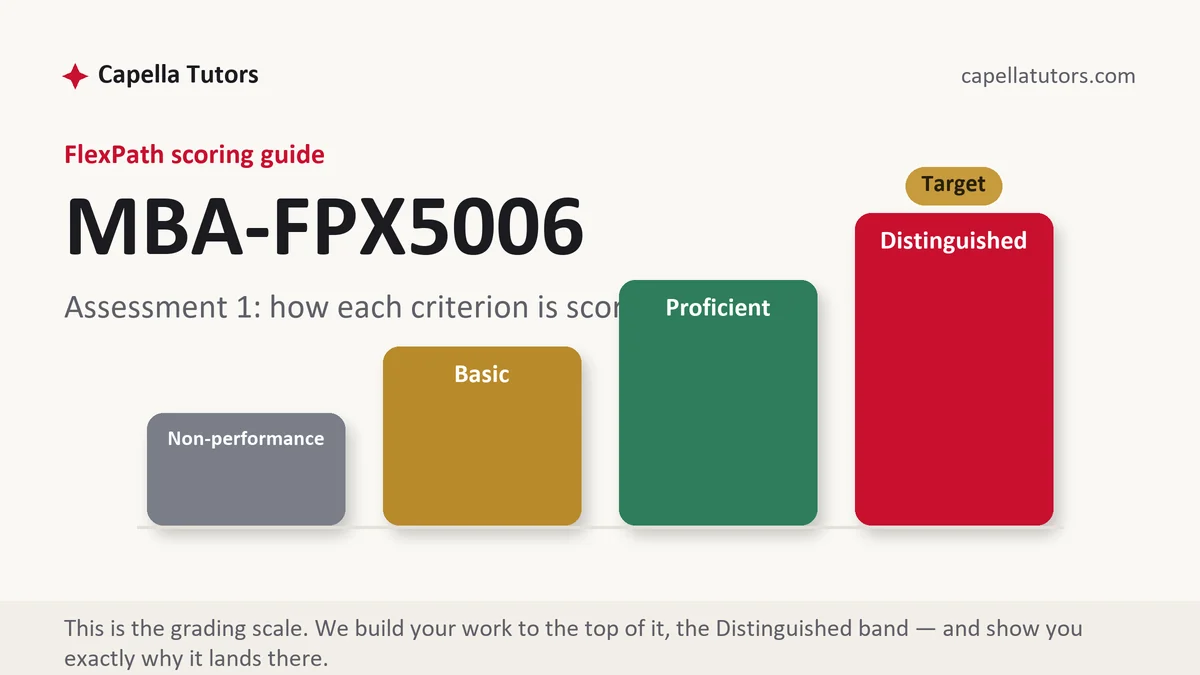
How MBA FPX 5006 Assessment 1 is scored
Strategy assessments are graded the way everything else in FlexPath is graded: four levels, one judgment per criterion, no points anywhere. On a scan the levels look like this:
| Level | What it means on an environmental and competitive scan |
|---|---|
| Distinguished | Every force, trend, and internal strength arrives with a figure attached and a source behind it, and the scan closes by naming which findings will decide the strategy later. The specific upgrade is written into your criterion text; take it literally. |
| Proficient | The analysis is correct and reasonably evidenced. What usually separates it from the top column is unrated forces, identified and described but never judged strong or weak against a number. |
| Basic | Frameworks explained. Five forces defined, a SWOT of adjectives, an industry described in the language of its own marketing. |
| Non-performance | One of the required analyses is absent, most often the internal side, or the organization is never actually named. Absence sets the level, not the writing around it. |
One structural point about this assessment: it is not a report about a company, it is the evidence base for a decision that arrives later in the course. Every paragraph should be gathering something you will spend.
The MBA FPX 5006 Assessment 1 method, step by step
-
Turn the criteria into section headings
Download the guide, paste each criterion into a blank document as a heading, and put the Distinguished sentence underneath. Strategy tempts you to start reading about the company immediately, and the outline is what tells you which reading actually counts toward a level.
-
Choose an organization whose numbers are public
If the guide lets you choose, choose for evidence. A public company files an annual report with segment revenue, margins, risk factors, and management's own account of competition, which is four criteria worth of material in one document. Private firms and young companies cost you the evidence criterion no matter how interesting they are.
-
Build the evidence file before you touch a framework
Collect market size and growth, the named competitors and their shares, the regulatory and technological pressure on the sector, then the company's own segment revenue and margins across at least two reporting periods. Frameworks are containers; filling them is quick once the numbers exist and impossible when they do not.
-
Rate each force instead of defining it
Buyer power is not a paragraph explaining buyer power. It is a judgment: strong, because the three largest regional buyers hold most of the volume and switch on price. Name the force, state the rating, attach the figure, cite the source. That pattern repeated is the external criterion answered.
-
Read the internal side off the financials
Strengths and weaknesses come from the statements, not from adjectives. A segment growing while the flagship shrinks is a strength with a number behind it; a strong brand is a claim with none. Say where each internal finding came from and what period it covers.
-
Point the scan at the decision it feeds, then self-score
Close by naming the two or three findings that will drive the recommendation later. It converts a survey into an argument in progress, and the criteria that ask about strategic significance are answered in that paragraph. Then score yourself criterion by criterion and rewrite anything short of the top.
A structure that maps to the criteria
Below is the section budget our tutors work to on a 5006 scan. It is planning arithmetic; the criteria in your courseroom outrank it everywhere.
| Section | What it must do | Guide |
|---|---|---|
| Introduction | The organization, the industry, and the strategic question the scan is being built to answer. | ~150 words |
| Industry profile | Market size, growth, and structure, sourced to industry data rather than the company's own claims. | ~250 words |
| External analysis | Each competitive force and environmental pressure rated, with the figure that justifies the rating. | ~400 words |
| Internal analysis | Resources, capabilities, and financial position read off segment data and margins. | ~350 words |
| Findings that will decide it | The two or three results the later recommendation will have to answer. | ~150 words |
| References | Filings, industry data, and current peer-reviewed strategy sources in APA. | as needed |
Annotated sample excerpt
An excerpt written by our strategy team, with notes on the three decisions inside it. Use it as a model of register, then run your own evidence.
Threat of new entrants in this region is strong, and it is no longer hypothetical: a hard-discount chain opened four stores inside Fairhaven Markets' trade area in the last eighteen months, each about 18,000 square feet against Fairhaven's 42,000 and carrying roughly 1,400 items against Fairhaven's 28,000.1 The entrant's format reaches profitability at a lower volume per store, so the defense a regional chain usually relies on, scale in assortment, no longer raises the barrier it used to raise.2 Fairhaven's own filings show grocery segment gross margin down 140 basis points across the two most recent fiscal years while unit volume held, which is the signature of a chain defending share on price rather than on format.3
- 1The force is rated in the first four words and evidenced afterward. Rating before explaining is the move that separates analysis from a textbook definition.
- 2The figures are used to make a structural point about barriers rather than left to speak for themselves. Numbers alone are still description.
- 3External and internal evidence meet in one paragraph, and the margin figure gives the recommendation something to push against later in the course.
The full premium sample for your exact assessment, written fresh to your scoring guide and issue, is free to request. Study it, revise it into your own voice, and submit work you understand.
The five mistakes that cost Distinguished
- Framework tourism. PESTLE, five forces, and a SWOT all run at half depth fill the page and answer nothing; two run properly answer the criteria.
- The uncited market. Industry size and growth quoted from memory or lifted from the company's investor deck fails the evidence criterion on sight.
- SWOT by adjective. Strong brand, loyal customers, growing competition. Every cell needs a figure or a named fact behind it or it is decoration.
- Yesterday's company. An analysis built on coverage from three years ago misses the restructuring, the divestiture, or the entrant that changed the question.
- A scan that goes nowhere. Findings never pointed at a decision leave the criteria that ask about strategic significance unanswered.
Pre-submission checklist
- A labeled section standing under every criterion you were given
- Every competitive force rated, not merely named
- At least two reporting periods of the company's own numbers
- Industry size and growth sourced to industry data, cited in the sentence that uses it
- Two or three findings flagged as the ones that will decide the strategy
- Filings, industry data, and current strategy literature in APA both ways
Rather have the scan built for you?
Send the scoring guide and the organization, or ask the desk to pick one with usable filings. A research analyst assembles the evidence file, a strategy writer builds the scan on it, two QA passes check criteria and APA, and the finished scan lands in a day or two, with rewrites included for as long as they are needed.