This manual is for MBA FPX 5006 Assessment 3, start to submission. Assessment 3 closes MBA FPX 5006 with the document the earlier work was building toward: one strategy, argued end to end, with implementation and measurement attached. Synthesis here does not mean summary. It means the analysis is compressed to the few facts that decide the matter, and the rest of the paper is spent defending a course of action. Each criterion is scored on its own, and the closing guide usually asks for implementation detail the earlier assessments never demanded. Below is our tutors' working order, the section budget, and an annotated excerpt. Rather have it built? The closing draft arrives inside two working days, and revisions stay free for as long as the evaluator keeps asking for more. Capella's catalog lists the course as MBA-FPX5006, and some courserooms print MBA5006; both point to this same Assessment 3. In current courserooms this assessment typically appears as "Strategy Implementation".
One honesty note before the manual: Capella revises courses and scoring guides over time, so always write to the exact scoring guide attached to your assessment in the courseroom. The course identity above is verified on capella.edu; the method and structure below are our tutors' approach to it, not Capella's official rubric text.
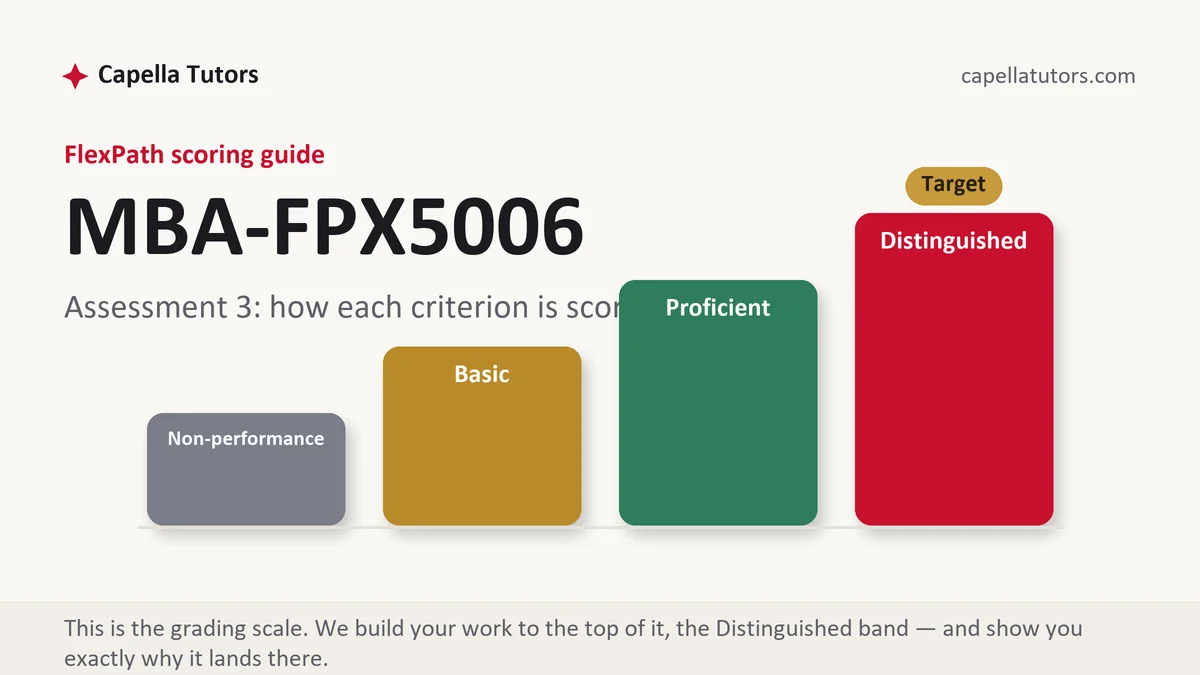
How MBA FPX 5006 Assessment 3 is scored
The four levels again, one judgment per criterion, no aggregate score anywhere. On the closing paper they tend to read like this:
| Level | What it means on a closing strategy synthesis |
|---|---|
| Distinguished | A single strategy stated in one sentence and then defended: evidence compressed, implementation sequenced with dates and owners, success defined by measures that carry numbers and reading dates. Whatever extra your criterion names, give it a labeled paragraph. |
| Proficient | The strategy is clear and supported and implementation is described. The gap is usually specificity, phases without dates and measures without baselines. |
| Basic | The course retold. Analysis repeated at length, the recommendation restated, implementation described as next steps. |
| Non-performance | A required component never appears, most often implementation or evaluation. The criterion scores at the floor for the absence. |
A useful test before you submit: could an operations director act on this document on Monday morning without calling you for clarification? If not, the implementation criterion still has work in it. The same test catches the other common weakness, a measurement section written in verbs rather than numbers, since nobody can act on a promise to monitor performance closely.
The MBA FPX 5006 Assessment 3 method, step by step
-
Harvest the comments from the earlier assessments
Whatever came back short on the scan or the options paper will be graded again here under a different criterion name. Read those comments first and write the fixes into the outline before you write anything new, because a repeated weakness is the most expensive thing on a closing paper.
-
Rebuild the closing guide as the outline
One heading per criterion, Distinguished text pasted beneath, and a note beside each about which evidence you already own. Closing papers are the easiest to overwrite, and the outline is the budget that stops it.
-
Compress the analysis to the facts that decide it
Three or four findings, each with its figure, is enough foundation for a closing strategy. Everything else you gathered stays in the earlier assessments where it was already scored. Repetition costs you the words implementation needs.
-
State the strategy in one sentence and hold it
Write the strategy as a single sentence naming the move, the market, the timeframe, and the money, then make every later section serve that sentence. If a paragraph does not support, sequence, cost, or measure the strategy, it belongs to a different paper.
-
Sequence implementation with dates, owners, and money
Break the strategy into phases carrying start dates, a responsible function, and a budget line each. Sequence matters as much as content: what must be true before phase two can begin is exactly the reasoning the top column is looking for.
-
Define success in measurable terms, then self-score
Name the metrics that will settle whether the strategy worked, their values today, their targets, and when they get read. Then grade the paper criterion by criterion yourself and fix anything you could not honestly call Distinguished.
A structure that maps to the criteria
How our tutors budget a closing 5006 paper. Planning arithmetic, nothing more; where your scoring guide disagrees, the guide is right.
| Section | What it must do | Guide |
|---|---|---|
| Executive summary | The strategy in one sentence, what it costs, and what success will look like. | ~150 words |
| Evidence compressed | The three or four findings the strategy stands on, each with a figure and a source. | ~250 words |
| The strategy | The move itself, the logic behind it, and why the alternatives already lost. | ~300 words |
| Implementation | Phases with dates, owners, budgets, and the dependencies between them. | ~400 words |
| Measurement and risk | Metrics with baselines and reading dates, plus the risks accepted and their triggers. | ~250 words |
| References | The filings, the market data, and the scholarship behind the plan, all in APA. | as needed |
Annotated sample excerpt
An original implementation excerpt with the moves labeled. Read it for the level of detail, then write your organization's version.
Phase one runs January through June and opens four franchised Copperline Kitchens units in the two metropolitan markets where the brand already has delivery-only coverage, because those markets carry order histories the franchise sales team can show prospective operators.1 Franchise development owns recruitment, operations owns the eight-week training build, and the phase carries 640,000 dollars, of which 400,000 is company-funded build-out support amortized against the initial franchise fees.2 Phase two is conditional rather than scheduled: it begins only if the first four units clear 62 percent of the average unit volume the company plan assumes by month five, a threshold chosen because below it the royalty stream does not cover franchise support headcount.3
- 1The phase is bounded by dates and justified by an asset the company already holds. Sequencing reasoning like this is what the implementation criterion pays for.
- 2Owners and money named at the level an operations director could act on, and by function rather than by job titles invented for the paper.
- 3A gate with a number and a reason behind the number. Conditional phasing is the most reliable way to show strategic judgment on a closing paper.
The full premium sample for your exact assessment, written fresh to your scoring guide and issue, is free to request. Study it, revise it into your own voice, and submit work you understand.
The five mistakes that cost Distinguished
- The long recap. Half the paper spent re-running analysis that was already graded leaves implementation and measurement thin, and those are the criteria the closing guide weights.
- Phases without dates. Short term, medium term, and long term are labels; months and quarters are a plan.
- Nobody owns anything. Implementation written in the passive voice never says who does the work, and the criterion asks.
- Metrics without baselines. Increase market share means nothing without today's figure and the date you will read it again.
- Risks without triggers. Naming a risk is half the job; saying what you will do and at what threshold is what completes the criterion.
Pre-submission checklist
- The closing guide's criteria each carrying their own heading
- The strategy stated in a single sentence in the first paragraph
- Analysis compressed to the findings the strategy stands on
- Every phase carrying dates, an owning function, and a budget figure
- Every metric carrying a baseline, a target, and a reading date
- Filings, industry data, and current strategy literature cited both ways in APA
Need the closing strategy written?
Send the closing guide plus your earlier submissions and their evaluations. The desk builds the strategy on evidence you already own, writes the implementation at operating detail, checks it against every criterion twice, and delivers the finished paper in 24 to 48 hours, rewriting at no charge for as long as your evaluator keeps asking.