Attach the tasks and the scoring guide and premium original work comes back within 24 to 48 hours, worked to the Distinguished descriptors in your own guide, with a second mathematician differentiating and integrating everything again from the prompt before it leaves the studio. The listing reads MAT FPX 2200, Calculus, 3 points, FlexPath, one of the Natural Science and Mathematics options a student may pick toward Capella's general education requirement. That requirement runs to at least 22.5 points and insists on a minimum of 2 points from each of its four categories, Communication, Humanities, Natural Science and Mathematics, and Social Science, which makes the mathematics on your transcript a decision you made rather than a course you were handed. In Capella's catalog the course code is written MAT-FPX2200.
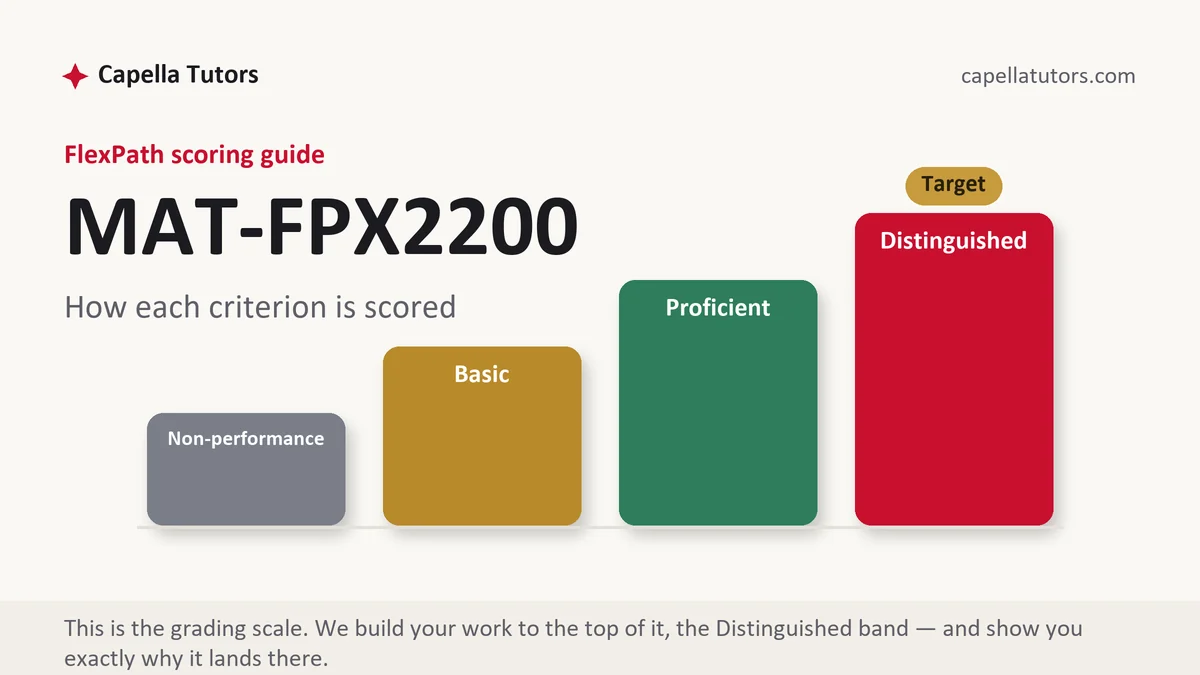
What MAT FPX 2200 actually grades
Calculus rewards two things that look like one skill and are not: reaching the right expression, and saying what it means. A derivative is a rate of change at an instant, an integral is an accumulated total across an interval, and the criteria in this course keep asking you to move between the symbol and the situation. If a function gives distance in miles against time in hours, its derivative is measured in miles per hour and nothing else, and integrating a rate in gallons per minute across thirty minutes returns gallons. The assessments in this course usually pair a computational task with a request to explain the result, so a page of flawless manipulation that never names a unit has answered half of what the row asked for.
Notation is the second thing under grade, and it is where careful students lose points they never see coming. The most common failure is the vanished limit: writing a limit expression on the first line, then dropping the notation on the second while the increment is still sitting in the algebra, which states that a quantity equals something it does not yet equal. The same discipline covers the rest. Say which variable you are differentiating with respect to, since a formula holding two letters is ambiguous without it. Keep the difference between a function and its value at a point, because one is a rule and the other is a number. Attach a constant of integration to every indefinite integral, and keep the differential in place, since it is what tells a reader which variable the accumulation runs over.
The third strand is the middle of the work. Chain rule steps need the inner derivative visible rather than implied, substitutions need the new variable and its differential written out before the integral changes shape, and a related rates problem needs the equation relating the quantities set down before anything is differentiated with respect to time. Optimization has its own checklist that criteria follow closely: the quantity being maximized, the constraint used to reduce it to one variable, the domain that makes physical sense, the critical points, a test that classifies them, and the endpoints examined rather than assumed away.
How we help in this course
Our 2200 solutions are written to be read, not just checked. Each one defines its variables with units before any calculus appears, names the rule behind any line a reader might query, keeps limit notation and differentials where they belong, and finishes with a sentence putting the number back into the situation the problem described. Where a graph is part of the answer, the window and the axis scales are stated so the picture can be reproduced, and where a value is approximate, the approximation is labeled and the exact form is kept alongside it. Send the tasks with the original numbering and the solutions come back matched to it.
Pricing and turnaround work the way they do on every other course here. Delivery lands within 24 to 48 hours, aimed at the Distinguished column, and eight people touch the work: one breaks the guide into required pieces, a subject specialist solves, an independent specialist solves again from the prompt with no sight of the first attempt, the two are reconciled before anything moves on, a reviewer scores the result against your rubric line by line, a formatting pass handles notation and references, and an editor checks that the explanations read as English. Revision stays free until the guide is met, and faculty feedback comes back through the same route at no cost.
The assessments, one by one
Assessment 1
The opening deliverable in Calculus usually pairs a differentiation with a demand that you say what the answer means. Read the full Assessment 1 manual.
Assessment 2
The middle deliverable in Calculus usually asks for the best available choice rather than a rate. Read the full Assessment 2 manual.
Assessment 3
The closing deliverable in Calculus usually moves from rates to totals. Read the full Assessment 3 manual.
How to actually write MAT FPX 2200: where to begin
Print the scoring guide and mark it before you solve anything. Calculus rows are usually written as a computation clause joined to an explanation clause, and students who work only the first clause cap themselves at the middle of the rubric no matter how clean the algebra is. Set out your work in the prompt's own order and numbering, keep one problem per block with the final answer boxed or bolded so it can be found, and leave the scratch work visible where the criterion asks for steps. Neatness is not being graded, but findability effectively is.
Work one applied problem completely and let it set the pattern. A rectangular storage yard is to be fenced on three sides against an existing wall using 240 feet of fencing. Let x be the depth in feet of each side running away from the wall, so the side parallel to the wall is 240 minus 2x, and the enclosed area is A of x equals 240x minus 2x squared, valid for x between 0 and 120. Differentiating gives A prime of x equals 240 minus 4x, which is zero at x equal to 60. The second derivative is negative 4, negative everywhere, so that critical point is a maximum rather than a minimum, and the endpoints both enclose no area at all. The answer sentence names the units and the situation: the yard should run 60 feet deep and 120 feet along the wall, enclosing 7,200 square feet, the largest area 240 feet of fencing can surround in this arrangement. Every graded element of an optimization criterion appears in that paragraph, in order.
Two habits are worth building early. Keep exact values, fractions, radicals, and multiples of pi, all the way to the last line, then convert to a decimal once and say how far you rounded, because decimals introduced early drift and a grader can see them drifting. And sanity-check the answer against the situation before you write it down, since calculus will happily hand you a negative length, a time before the experiment started, or a maximum sitting outside the domain. Discarding such a solution with one sentence explaining why it cannot apply is itself worth marks, and quietly reporting it is the fastest way to lose the row.
| Section | What goes in it | What Distinguished looks like |
|---|---|---|
| The setup | The quantity being modeled, the variable that drives it, and the units of both. | Variables defined in a sentence, with units, before a single derivative appears. |
| The relationship | The equation linking the quantities and the interval on which it makes sense. | A constraint used to reduce the problem to one variable, with the domain stated. |
| The calculus | The differentiation or integration, with the rule behind each step written out. | Chain rule inner derivatives and substitutions shown rather than performed silently. |
| Critical work | Critical points, endpoints, and the test used to classify what you found. | A named test applied, and endpoints actually evaluated instead of assumed. |
| The interpretation | The result restated in the language of the problem, carrying its units. | A sentence saying what the value is a rate of, or a total of, and over what interval. |
| Checks and sources | A second route to the value, plus the text and any software used, in current APA. | An exact result confirmed against a numerical estimate, with the tool and input named. |
Developing the analysis
The explanation criteria in this course ask you to connect two ideas rather than produce another calculation. Average and instantaneous rates are the first pair. A car covering 130 miles in two hours has an average rate of 65 miles per hour, the slope of the straight line joining start to end, while the derivative gives the speedometer reading at a chosen instant. The mean value theorem ties them together and is worth stating properly: if the position function is continuous across the interval and differentiable inside it, there is at least one moment when the instantaneous rate equaled the average, so that driver did hit exactly 65 miles per hour at some point. The second pair is differentiation and accumulation, joined by the fundamental theorem of calculus, which is why integrating a rate of flow across an interval returns a net change rather than a rate. Say which of the two operations your situation calls for and why, because a criterion asking you to explain your approach is asking exactly that.
Citations that survive faculty review
Mathematics assessments still carry references, and evaluators check them. Definitions, theorems, and any result you invoke by name belong to your assigned course materials and should be cited with the section or theorem number, since conventions differ between books in ways that change what an answer looks like: whether log without a subscript means the natural logarithm, how intervals of increase are written, and whether increasing permits a stretch where the derivative is zero. Where you consult a standard text, Stewart's Calculus being the usual one at this level, give the edition. Technology has to be named with the exact input you supplied, whether that is a graphing calculator, Desmos, GeoGebra, or a computer algebra system, and any graph you paste in needs its viewing window recorded so the image can be reproduced. Applied constants and data, densities, costs, flow rates, come from a published source rather than from memory. Sites offering worked solutions to textbook exercises are not references.
The mistakes that land Basic instead of Distinguished
- The constant of integration left off. An indefinite integral without it names one antiderivative and claims it is the only one.
- A limit that disappears before it is taken. Dropping the notation while the increment is still present asserts an equality that does not hold yet.
- The chain rule's inner derivative missing. It is the most common single error in the course and it changes every line that follows.
- A maximum announced with no test. A critical point is a candidate, and the endpoints are candidates too until you check them.
- A number with no units and no sentence. The interpretation clause of the criterion goes unanswered, however good the algebra was.
MAT FPX 2200 questions students actually ask
How much algebra do I really need before this course?
More than most people expect, and it is almost never the calculus that costs the marks. Factoring, working with fractions inside fractions, rules for exponents and radicals, solving an equation for one variable in terms of another, and reading a function's domain off its formula are used in nearly every problem, and a differentiation done perfectly can still fail because a rational expression was simplified wrongly two lines later. Trigonometric values and the behavior of exponential and logarithmic functions arrive as soon as the problems stop being polynomials. If you are returning to mathematics after a gap, spend an evening on algebraic manipulation before the first assessment rather than during it. That evening buys back more points than any amount of extra practice on the rules of differentiation.
The prompt says interpret the derivative in context. What does that sentence look like?
It names what is changing, what it is changing with respect to, how fast, and where. Suppose C(x) gives the cost in dollars of producing x units and you have found that C'(400) equals 12.40. The sentence that scores says that when output is at 400 units, cost is rising at about 12.40 dollars per additional unit, so producing the 401st unit costs roughly 12 dollars 40 cents. Notice the three parts: the units of the derivative are the units of the output divided by the units of the input, the value is attached to one specific input rather than to the function generally, and the meaning is given in the vocabulary of the original situation. Write that sentence for every derivative a criterion asks you to interpret, and the interpretation half of the row is finished.
Do I have to use the limit definition, or can I use the rules?
Use the rules everywhere except where the prompt says otherwise, and read that prompt closely, because the phrase from first principles or by the definition means the difference quotient and nothing else will be accepted. When it is asked for, write the quotient with the increment in place, simplify until the increment cancels from the denominator, and only then evaluate the limit, keeping the limit notation on every line until that final step. Elsewhere the rules are the expected tool and using them is not cutting a corner. What still has to appear is the name of the rule at any step a reader could question, particularly the chain rule, where the derivative of the inside function is the piece most often lost.
Calculus tasks due this week?
Send the problems as they were set, with the criteria. They come back with every rule named, the units carried through, and the result explained in a sentence. Your first premium sample costs nothing.