This manual is for MAT FPX 2200 Assessment 3, start to submission. The closing deliverable in Calculus usually moves from rates to totals. Integrating a rate across an interval returns an accumulated amount, and the units of that amount are the units of the rate multiplied by the units of the input, which is the sentence the explanation clause is asking for. Notation carries real weight here, since a differential dropped or a constant omitted changes what the line claims. What follows next is our tutors' method, a structure drawn straight from the rows, and an annotated excerpt. Rather have the setup written for you? A premium original sample for the integrals you were set ships in 24 to 48 hours, and revision continues free until it clears. Capella's catalog lists the course as MAT-FPX2200, and some courserooms print MAT2200; both point to this same Assessment 3.
One honesty note before the manual: Capella revises courses and scoring guides over time, so always write to the exact scoring guide attached to your assessment in the courseroom. The course identity above is verified on capella.edu; the method and structure below are our tutors' approach to it, not Capella's official rubric text.
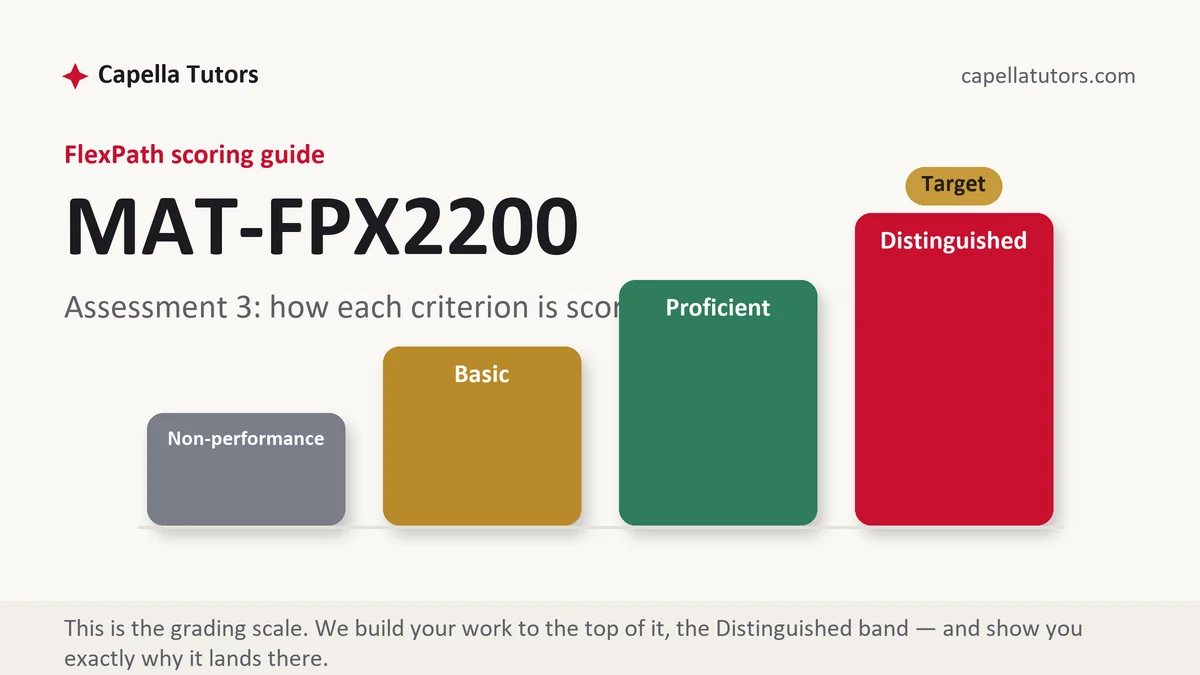
How MAT FPX 2200 Assessment 3 is scored
Marks arrive as level names rather than as figures. Each criterion is placed at one of four, and the wording of each names what has to appear:
| Level | What it means on an accumulation deliverable |
|---|---|
| Distinguished | The rate function is defined with its units, the choice to integrate rather than differentiate is justified from the question asked, the antiderivative is found with the substitution written out, the limits are stated and evaluated in order, and the total is reported in the units accumulation produces. |
| Proficient | The integral is set up and evaluated correctly and the total is right. Correct work that leaves the units unexplained. |
| Basic | A definite integral evaluated with no account of what the answer measures, or an indefinite integral written with no constant and no differential. |
| Non-performance | A required element is missing, usually the limits or the interpretation. An element that never appears is marked at the floor whatever the algebra above it does. |
Say which of the two operations the situation calls for and why, because a row asking you to explain your approach is asking exactly that. A question about how fast something is changing wants a derivative. A question about how much arrived over a span wants an integral, and the fundamental theorem is why that works.
The MAT FPX 2200 Assessment 3 method, step by step
-
Give each criterion a heading and find the explanation clause
Integration rows almost always pair the computation with a demand that you name what the total measures. Put both under the heading so the second one cannot be forgotten in the arithmetic.
-
Define the rate function and its units
One sentence: P of t is output in kilowatts and t is hours after sunrise. The units of the answer follow from these two, so the sentence is doing more work than it looks like.
-
Justify integrating rather than differentiating
Say what the question asks for and which operation answers it. A total accumulated across a span is an integral of a rate, and stating that in words is usually its own row.
-
Find the antiderivative with the substitution shown
Write the new variable and its differential before the integral changes shape, and keep the differential in place throughout. An indefinite integral needs its constant; a definite one needs its limits.
-
Evaluate the limits in order and keep the arithmetic visible
Upper limit minus lower limit, both substituted where a reader can see them. Hold exact values, including multiples of pi, to the last line and then convert once, saying how far you rounded.
-
Report the total in accumulated units, then self-score
Kilowatts across hours give kilowatt-hours, and saying so is the interpretation. Add an average rate if it helps the reader, then mark every row against the guide and submit with two business days in hand.
A structure that maps to the criteria
Read the counts as our tutors' planning targets for accumulation work; your own scoring guide decides which sections carry the weight.
| Section | What it must do | Guide word target |
|---|---|---|
| The situation | What is flowing or accumulating, the rate function, and the units of the rate and the input. | ~150 words |
| Why an integral | The question restated, and the reason accumulation rather than a rate answers it. | ~160 words |
| The antiderivative | The integral set up with its differential, any substitution written out, and the antiderivative found. | ~240 words |
| Evaluating the limits | Both limits stated and substituted in order, with exact values held to the final line. | ~210 words |
| Interpretation | The total in accumulated units, what it means for the decision, and the interval it covers. | ~190 words |
| Checks and sources | An exact result confirmed against a numerical estimate, the tool and its input named, sources in current APA. | as needed |
Annotated sample excerpt
An original excerpt from our team at the level the guide's top column describes. Read it for method and write your own version.
Let t be hours after six in the morning and P(t) = 18 sin(pi t divided by 12) the array's output in kilowatts across the twelve daylight hours, peaking at 18 kilowatts at noon.1 The question asks how much energy the array delivered rather than how fast it was delivering, so the answer is the integral of the rate from t = 0 to t = 12, with the differential dt kept in place because it names the variable the accumulation runs over.2 The antiderivative is negative 216 over pi, times cosine of pi t over 12, and evaluating at 12 and subtracting the value at 0 gives 432 over pi, about 137.5 kilowatt-hours, since kilowatts multiplied by hours accumulate to kilowatt-hours, an average of roughly 11.5 kilowatts across the day.3
- 1The rate function is defined with the units of both its input and its output before any integration, which is where the units of the final answer are decided.
- 2The choice of operation is justified from the wording of the question and the differential is explained rather than carried along silently. Both are gradable moves.
- 3The exact value is kept and then converted once, and the units of the total are derived from the units of the rate. The average rate is added because it is the figure a reader can picture.
The full premium sample for your exact assessment, written fresh to your scoring guide and issue, is free to request. Study it, revise it into your own voice, and submit work you understand.
The five mistakes that cost Distinguished
- The constant of integration left off. Leaving it off names a single antiderivative and implies no others exist.
- Limits never stated. A definite integral is defined by its interval, and an evaluation with no bounds on the page cannot be checked.
- The differential dropped. It tells a reader which variable the accumulation runs over, and a substitution without it is unverifiable.
- A total with no units named. Kilowatts across hours accumulate to kilowatt-hours, and deriving that is the explanation clause of the row.
- Exact values converted too early. Rounding a multiple of pi at the start guarantees the final figure disagrees with any check you run.
Pre-submission checklist
- A labeled section for each criterion, and the explanation clause marked
- The rate function defined with the units of its input and its output
- The choice to integrate justified from the question the prompt asked
- Any substitution written out with its differential before the integral changes shape
- Both limits stated and evaluated in order, exact values held to the last line
- The total reported in accumulated units with its interval, every row self-scored
Integrals and accumulation due?
Send the problems as they were numbered and the criteria. Eight people work the file, ending with an editor who checks the explanations read as English, and one specialist integrates everything again from the prompt alone. Delivery is inside 24 to 48 hours, revised free until the guide is met.