This manual is for MAT FPX 2200 Assessment 1, start to submission. The opening deliverable in Calculus usually pairs a differentiation with a demand that you say what the answer means. A derivative is a rate of change at an instant, and its units are the units of the output divided by the units of the input, so a page of flawless manipulation that never names a unit has answered half of what the row asked. Our tutors' method follows, with a structure built from the rows and an annotated excerpt. Prefer to hand the problems across? A premium original sample on the functions in your prompt arrives in 24 to 48 hours, revised free until the guide is satisfied. Capella's catalog lists the course as MAT-FPX2200, and some courserooms print MAT2200; both point to this same Assessment 1.
One honesty note before the manual: Capella revises courses and scoring guides over time, so always write to the exact scoring guide attached to your assessment in the courseroom. The course identity above is verified on capella.edu; the method and structure below are our tutors' approach to it, not Capella's official rubric text.
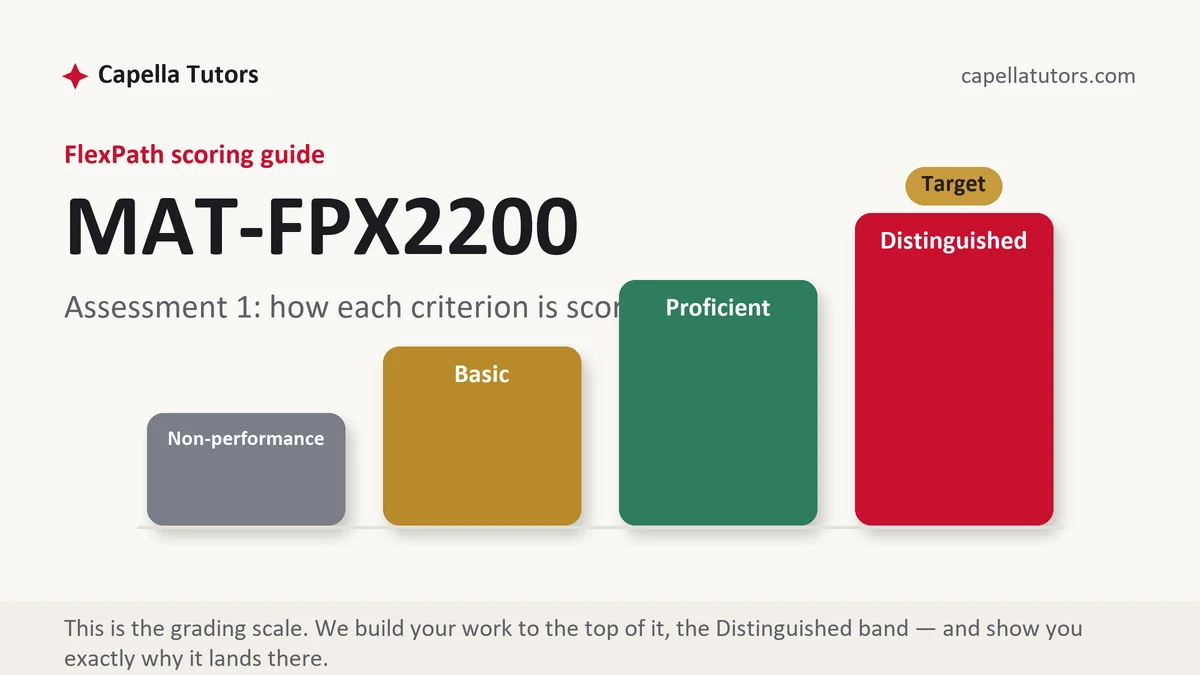
How MAT FPX 2200 Assessment 1 is scored
FlexPath assigns a level to every criterion. There are four of them, and the sentence describing each is what your section is measured against:
| Level | What it means on a derivative and interpretation deliverable |
|---|---|
| Distinguished | The variables arrive defined with units, the rule behind each differentiation step is named, the derivative is evaluated at a stated input rather than described in general, and the interpretation sentence says what is changing, with respect to what, how fast, and where. The additional act is spelled out in the row; locate it and perform it. |
| Proficient | The derivative is correct and evaluated correctly, and the meaning is broadly stated. Accurate work with the units and the location left loose. |
| Basic | A correct derivative with no sentence attached, or an interpretation that describes the function generally instead of at the point asked about. |
| Non-performance | A required element never appears, most often the interpretation or the units. Absence rather than thinness is what drops a row to the floor. |
The interpretation sentence has a fixed shape and it is worth memorizing. Name the quantity changing, the variable it changes with respect to, the rate, and the input where that rate holds. Written that way it also carries the units automatically, which closes two rows with one sentence.
The MAT FPX 2200 Assessment 1 method, step by step
-
Mark the criteria before you differentiate
Calculus rows are usually a computation clause joined to an explanation clause, and working only the first caps you in the middle of the guide however clean the algebra is. Give each row a heading and note which clause is unanswered.
-
Define the variables with their units
One sentence: t is days after the first of April and D is depth in feet. Units decided here are the units of your derivative later, and a rate reported without them cannot satisfy the interpretation clause.
-
Differentiate with the rule named on each line
Say power rule, product rule, or chain rule beside the step that uses it. The chain rule's inner derivative is the piece most often lost, so write it out rather than performing it silently.
-
Evaluate at a specific input
A derivative is a function; the row usually wants a number. Substitute the input the prompt named and report the value with its units, keeping exact forms until the final line.
-
Locate where the rate is zero and say what happens there
Setting the derivative to zero finds the moment the quantity stops rising. Report the input, the value of the original function there, and what that means in the situation rather than only that a critical point exists.
-
Write the interpretation sentence, then self-score
Use the fixed shape: what is changing, with respect to what, how fast, and where. Then mark each row against the guide yourself and submit with two business days in hand for the evaluation.
A structure that maps to the criteria
Take these as planning targets our tutors use on derivative work, not requirements; the rows on your own guide set the weighting.
| Section | What it must do | Guide word target |
|---|---|---|
| The setup | The quantity modeled, the variable driving it, the units of both, and the interval that makes sense. | ~140 words |
| The derivative | Each differentiation step with the rule that produced it named in words. | ~220 words |
| Evaluation | The derivative at the input the prompt named, reported with units and full precision until the end. | ~190 words |
| Where the rate is zero | The critical input, the value of the original function there, and what it means in the situation. | ~220 words |
| Interpretation | The rate sentence in the fixed shape, plus what the model assumes across the interval. | ~190 words |
| Checks and sources | A second route to the value, technology named with its input, references in current APA. | as needed |
Annotated sample excerpt
An original model from our team, at the register the top level of the guide names. Learn what it does and then do it yourself.
Let t be days after the first of April and D(t) the reservoir depth in feet, modeled by D(t) = 42 + 1.8t - 0.06t squared across the thirty days of the melt.1 Differentiating term by term with the power rule gives D prime of t equal to 1.8 - 0.12t, measured in feet per day because the output is feet and the input is days.2 At t = 5 the derivative is 1.2 feet per day, so five days into April the reservoir is rising at about 1.2 feet a day and the sixth day should add roughly that much; the rate reaches zero at t = 15, where the depth peaks at 55.5 feet and the reservoir stops filling.3
- 1Both variables are defined with units and the interval is stated before any calculus appears. The units of the derivative are decided in this sentence.
- 2The rule is named and the units of the derivative are derived from the units of the function rather than announced. Deriving them is what the row credits.
- 3The rate is attached to one specific day, translated into the next day's change, and then the zero is located and read back as the peak. That is the interpretation clause answered in full.
The full premium sample for your exact assessment, written fresh to your scoring guide and issue, is free to request. Study it, revise it into your own voice, and submit work you understand.
The five mistakes that cost Distinguished
- A figure reported with neither units nor an explaining sentence. The interpretation clause of the row goes unanswered however good the differentiation was.
- The chain rule's inner derivative missing. It is the most common single error in this course and it corrupts every line that follows.
- A derivative described in general terms. The row asks what the rate is at a stated input, and a paragraph about the function as a whole does not answer it.
- Decimals substituted for exact values early. Rounding partway through leaves the reported rate disagreeing with the graph beside it, and a grader sees the drift.
- A critical point announced and abandoned. Where the rate is zero the original function has a value, and the situation has a meaning, and both belong in the answer.
Pre-submission checklist
- Each criterion given a labeled section before any differentiation begins
- Both variables defined with units before any differentiation
- Every differentiation step carrying the name of the rule that produced it
- The derivative evaluated at the stated input and reported with units
- The zero of the derivative located and read back into the situation
- One interpretation sentence in the fixed shape, every row self-scored before submitting
Derivatives to interpret this week?
Send the problems exactly as they were set, together with the criteria. A team of eight, including a research analyst and two QA reviewers, returns a premium original sample in 24 to 48 hours with every rule named, the units carried through, and each result explained in a sentence, revised free until the rows clear.