This manual is for MAT FPX 2200 Assessment 2, start to submission. The middle deliverable in Calculus usually asks for the best available choice rather than a rate. Optimization criteria follow a checklist closely: the quantity being optimized, the constraint that reduces it to one variable, the interval that makes physical sense, the critical points, a named test that classifies them, and the endpoints examined rather than assumed away. The method our tutors apply appears below, alongside a structure built from the rows and an annotated excerpt. Want the solving taken over? A premium original sample worked from your own tasks returns within 24 to 48 hours, with free revision until every row clears. Capella's catalog lists the course as MAT-FPX2200, and some courserooms print MAT2200; both point to this same Assessment 2.
One honesty note before the manual: Capella revises courses and scoring guides over time, so always write to the exact scoring guide attached to your assessment in the courseroom. The course identity above is verified on capella.edu; the method and structure below are our tutors' approach to it, not Capella's official rubric text.
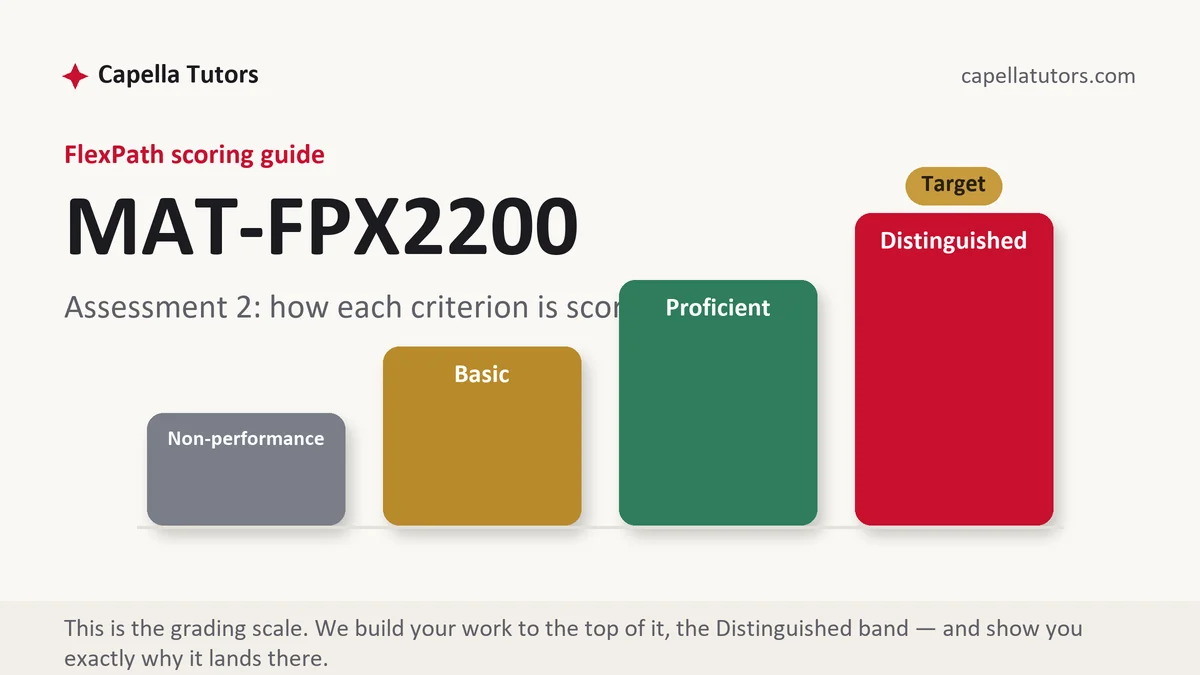
How MAT FPX 2200 Assessment 2 is scored
Nothing is expressed as a percentage in FlexPath. Every row of the guide lands at one of four levels, and the level text is your writing brief:
| Level | What it means on an optimization deliverable |
|---|---|
| Distinguished | The quantity being minimized is written with units, the constraint is used to reduce it to one variable on the page, the critical point is classified by a named test, the behavior at the edges of the interval is addressed, and the answer arrives as dimensions a person could hand to a supplier. |
| Proficient | The function, the critical point, and the classification are all correct. Sound work that skips the edges of the interval. |
| Basic | A critical point announced as the optimum with no test applied, or a formula minimized with the constraint never shown being used. |
| Non-performance | A required element is absent, commonly the classification or the interval. Absence sits at the floor whatever else is right. |
Where the interval is open at both ends there are no endpoints to evaluate, and the row still expects the question answered. Say what happens to the quantity as the variable approaches each edge, since a single critical point on an interval where the quantity grows without bound in both directions is the global optimum, and that argument is a row of its own.
The MAT FPX 2200 Assessment 2 method, step by step
-
Turn each criterion into a heading and read for the checklist
Optimization rows carry more required pieces than any other kind in this course. List them under the heading before you start so none is left out by momentum.
-
Name the quantity being optimized and the constraint
Two sentences with units: material is the surface area in square inches, and the tray must hold a fixed volume in cubic inches. Confusing what is fixed with what is chosen is the standard wrong turn here.
-
Reduce to one variable on the page
Solve the constraint for one dimension and substitute it, showing the substitution rather than presenting the finished single-variable expression. That line is usually where the method row is decided.
-
State the interval the situation permits
A length is positive, and often that is the whole restriction. Where the interval is open, say so explicitly, because it changes what the endpoint requirement means for you.
-
Differentiate, solve, and classify with a named test
Set the derivative to zero and solve exactly. Then apply the second derivative test or the first derivative sign test, name which one, and report what it establishes. A critical point is a candidate until a test speaks.
-
Answer in dimensions, with a check, then self-score
Give the measurements and the resulting quantity with units, and confirm the constraint still holds at those numbers. Then mark every row against the guide and submit with two business days to spare.
A structure that maps to the criteria
The counts are figures we plan around on optimization tasks and carry no official standing; your guide decides where length is earned.
| Section | What it must do | Guide word target |
|---|---|---|
| The problem | What is being chosen, what is being minimized or maximized, and the units of each. | ~140 words |
| Constraint and reduction | The fixed relationship, solved for one dimension, substituted where a reader can see it happen. | ~230 words |
| The interval | The values the situation permits, and whether the interval is open or closed. | ~140 words |
| Critical points and the test | The derivative set to zero, solved exactly, and the named test that classifies the result. | ~240 words |
| The answer and the check | The dimensions with units, the optimized quantity, and the constraint verified at those values. | ~200 words |
| Checks and sources | An independent route to the same value, with any technology named beside its input, in current APA. | as needed |
Annotated sample excerpt
A model passage our writers wrote to the standard the highest level describes. Study its moves, then reproduce them in your words.
The tray has a square base of side x inches and height h inches, it must hold 4,000 cubic inches, and it has no lid, so the constraint is x squared times h equal to 4,000 and the material to minimize is S = x squared + 4xh square inches.1 Solving the constraint for h gives h = 4,000 over x squared, and substituting turns the surface area into a single-variable function S(x) = x squared + 16,000 over x, valid for every x greater than zero.2 Setting S prime of x equal to 2x - 16,000 over x squared to zero gives x cubed equal to 8,000, so x = 20 inches and h = 10 inches; the second derivative, 2 + 32,000 over x cubed, is positive throughout the interval, so this is a minimum, and it is the global one because S grows without bound as x approaches either edge.3
- 1The constraint and the objective are written separately, both with units, and the missing lid is accounted for in the surface area expression rather than assumed.
- 2The substitution is performed on the page and the interval is stated in the same breath. Presenting the reduced function ready made forfeits the method row.
- 3The critical point is classified by a named test, and the open interval is handled by describing the behavior at its edges. Both are separate requirements on most guides.
The full premium sample for your exact assessment, written fresh to your scoring guide and issue, is free to request. Study it, revise it into your own voice, and submit work you understand.
The five mistakes that cost Distinguished
- A maximum or minimum announced with no test. A critical point is a candidate, and the second derivative or a sign chart is what turns it into an answer.
- The constraint never visibly used. A two-variable expression cannot be optimized, and the substitution line is the one the row is looking for.
- Endpoints ignored on an open interval. The requirement becomes a statement about behavior at the edges, and it still has to be made.
- Dimensions returned with no units. Twenty is not an answer; twenty inches on a side with a ten inch height is.
- The constraint left unverified at the answer. Substituting the winning dimensions back to confirm the volume takes one line and is free marks.
Pre-submission checklist
- One section per row, with every required piece of the checklist listed
- The objective and the constraint each written with units
- The constraint solved and substituted visibly, reducing the problem to one variable
- The permitted interval stated, and whether it is open or closed
- The critical point classified by a named test, and the edges of the interval addressed
- Dimensions given with units and the constraint verified at them, every row self-scored
An optimization problem to hand off?
Send the tasks with their original numbering and the criteria. Eight people handle the file, including an independent specialist who solves everything again from the prompt with no sight of the first attempt. Delivery is 24 to 48 hours, aimed at the top column, revised at no charge until the guide is satisfied.