Hand over the problem set and the scoring guide, and premium original work comes back within 24 to 48 hours, solved line by line against the Distinguished wording in your guide, with a second mathematician reproducing every step before it ships. The catalog entry reads MAT FPX 2051, Discrete Mathematics, 3 points, taught in FlexPath and sitting among the Natural Science and Mathematics choices in Capella's general education requirement. Nobody is placed into it. That requirement asks for at least 22.5 points spread over Communication, Humanities, Natural Science and Mathematics, and Social Science, no fewer than 2 points from each, and this course is one of several ways to cover part of it. In Capella's catalog the course code is written MAT-FPX2051.
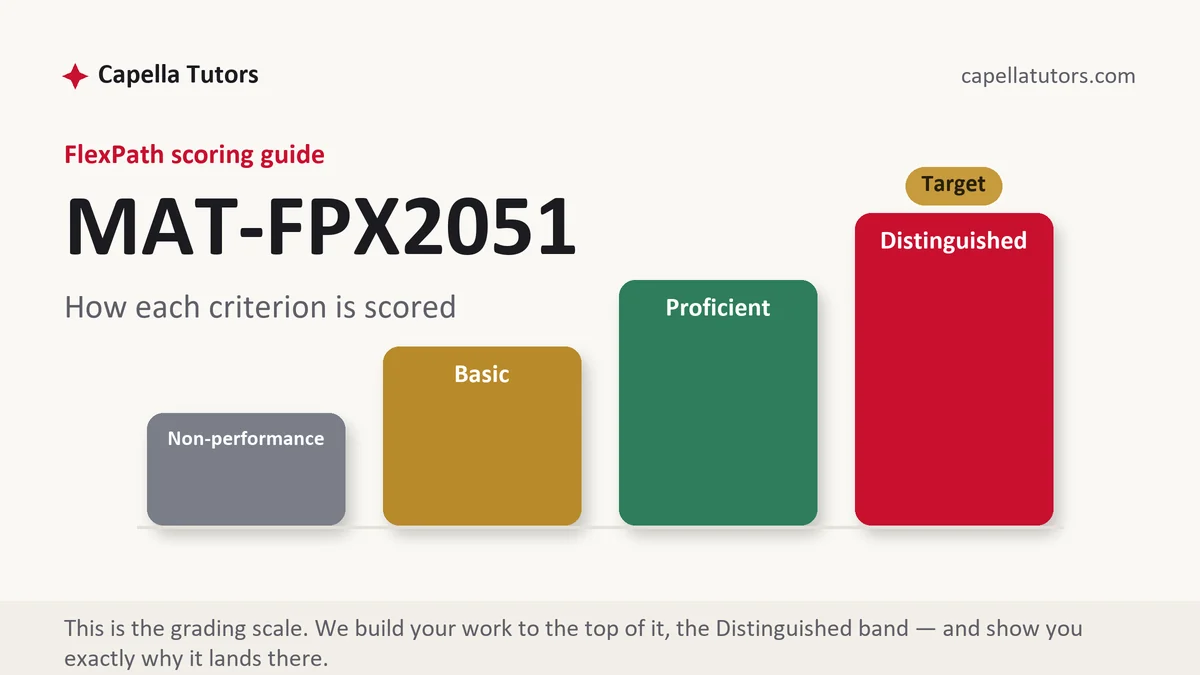
What MAT FPX 2051 actually grades
Discrete Mathematics grades the argument, not the answer at the bottom of it. In courses built on continuous functions you can often check a result by substituting a value back in. Here the claims are about whole structures, statements, sets, relations, arrangements, and graphs, and the only way to verify one is to read the reasoning. That makes the written derivation the artifact under grade. The assessments in this course usually pair problems with a request to explain your approach, and the criteria pair a verb like determine or compute with a verb like justify or demonstrate. Everything above the Basic column lives in the second verb.
Notation is load-bearing here in a way it has not been in earlier mathematics. Membership and containment are different relations, an implication and an equivalence make different promises, and the order of two quantifiers changes the claim completely. Say that for every student there is a course that student enjoys, and you have made a modest statement that different students may satisfy differently. Say that there is a course every student enjoys, and you have asserted the existence of one specific course with universal appeal. Same eight words, rearranged, and only one of them is usually true. Negation behaves the same way: the denial of a statement that holds for every case is a statement that some single case fails, which is why one counterexample settles a universal claim and no number of examples proves one.
The third strand is showing the middle of the work. A counting problem is graded on the model you declared before the arithmetic. Four-character access codes drawn from twenty-six letters and ten digits give thirty-six choices per position, so with repetition allowed there are 36 to the fourth power, or 1,679,616 codes, and with repetition forbidden there are 36 times 35 times 34 times 33, or 1,413,720. Both are correct answers to different questions, and a solution offering one of them without saying which question it answers cannot be scored. Induction works the same way: the marks sit in the base case, the assumption, and the line where the assumption gets used.
How we help in this course
Our 2051 work is written as derivations rather than as answers. Each solution opens with the definition or the counting model it relies on, names the rule behind any step a reader could query, keeps quantifiers and domains attached to every variable they govern, and closes by restating the result in the language of the original question. Induction proofs arrive with the base case, the inductive hypothesis, and the inductive step labeled, and with the exact line where the hypothesis does its work called out. Send the problem set with the original numbering intact and the solutions come back numbered to match, so your evaluator can find each criterion without hunting.
Delivery terms are the ones the studio runs everywhere. Work arrives inside 24 to 48 hours pitched at the Distinguished column, after eight people have been through it. One maps each criterion to a required piece of the solution, a subject specialist works the problems, a second specialist reworks them from the prompt alone and the two answers have to agree, a reviewer scores the draft row by row, a formatting pass fixes notation and reference style, and an editor reads for whether a person could follow it. Revisions cost nothing until the guide is satisfied, and faculty comments go through the same loop free.
The assessments, one by one
Assessment 1
The opening deliverable in Discrete Mathematics usually asks you to take a rule written in ordinary words and say exactly what it claims. Read the full Assessment 1 manual.
Assessment 2
The middle deliverable in Discrete Mathematics usually asks you to turn a practical constraint into a structure and then solve it inside that structure. Read the full Assessment 2 manual.
Assessment 3
The closing deliverable in Discrete Mathematics usually asks for a general claim rather than a particular number. Read the full Assessment 3 manual.
How to actually write MAT FPX 2051: where to begin
Open the scoring guide before the textbook. Turn each criterion into a heading, drop the Distinguished sentence underneath it, and match your numbering to the prompt's numbering so no evaluator has to search for the item they are scoring. Discrete criteria are usually written as a pair, one clause about producing a correct result and one about explaining or justifying it, and the second clause is where the difference between columns is decided. Read the pair carefully enough to notice when a single problem is carrying two criteria, because those are the problems worth twice the time you would otherwise give them.
Then write one proof properly and use it as the template for the rest. Take the claim that the sum of the first n positive integers equals n times n plus one, divided by two. The base case is one line: with n equal to 1 the left side is 1 and the right side is 1 times 2 divided by 2, so the claim holds at the start. The inductive hypothesis is a sentence you write down rather than imply: assume for some integer k at least 1 that the sum of the first k integers is k times k plus one over two. The inductive step adds the next term to both sides, giving k times k plus one over two, plus k plus one, which factors to k plus one times k plus two, over two, exactly the formula with k plus one in place of k. The conclusion names the principle invoked and the range it covers. Four labeled parts, no gap a reader has to fill.
Two habits protect everything else. Keep the equals sign honest: it announces that the expressions on either side have the same value, so a step transforming a claim rather than an expression needs a word like therefore instead. And keep the converse separate from the contrapositive. To show that a square being even forces the number itself to be even, prove the contrapositive: an odd number is 2m plus 1, its square is 4m squared plus 4m plus 1, which is 2 times a whole number plus 1, therefore odd. Swapping the halves of the original implication instead gives a different statement, one you were never asked about and one that may well be false.
| Section | What goes in it | What Distinguished looks like |
|---|---|---|
| The statement | The claim written out formally, with the domain of every variable named. | Quantifiers and domains fixed before any symbol gets manipulated. |
| Definitions in play | Each definition the solution leans on, in the wording your course uses. | Definitions stated once and then used with the same symbols throughout. |
| The method | Direct, contrapositive, contradiction, induction, or a named counting model. | The choice defended in one line, with the rejected alternative given a reason. |
| The steps | Every intermediate line, with the rule or definition that licenses it. | No line a reader has to reconstruct, and the hypothesis used at a marked point. |
| The result in words | The answer restated in English, with its count, its set, or its condition. | A sentence that answers the question as asked rather than trailing off at a symbol. |
| Checks and sources | A small case worked by hand, plus the text and any software you used, in current APA. | An independent check shown, such as the same count reached by a second model. |
Developing the analysis
Discrete problems rarely have one route, and the criteria are not rewarding the shortest. They reward a route you can defend, which is why two counting models that disagree tell you more than one tidy model. Choosing a three-person committee from ten and then naming one of the three as chair can be counted as 120 committees times 3 chairs, or as 10 choices of chair times the 36 ways to pick two more from the remaining nine. Both give 360, and that agreement is your evidence neither one double counts. When two defensible models return different numbers, one is counting an outcome twice or forbidding one it should allow, and finding out which is the exercise. Build the same reflex for unions: the number of items in either of two sets is the size of the first plus the size of the second minus the size of the overlap, and forgetting that subtraction is the most common counting error in the course. Where the numbers are small, enumerate by hand and compare.
Citations that survive faculty review
A discrete mathematics assessment cites differently from an essay, and the difference matters. Definitions and theorems come from your assigned course materials and get referred to by number, because textbooks disagree about details that change answers, including whether zero counts as a natural number and whether a graph may have loops. Where you consult a standard reference, usually Rosen's Discrete Mathematics and Its Applications at this level, cite the edition, since numbering shifts between them. Any computational tool you used, a solver, a truth-table generator, or a few lines of Python, has to be named along with the exact expression you gave it, and its output has to be reproducible by the method you wrote out. Answer-key sites are not sources, and citing one signals the reasoning is not yours. Keep the reference list in current APA and the notation in whatever convention your course established.
The mistakes that land Basic instead of Distinguished
- A count with no model stated. A number nobody can trace back to a question about arrangements cannot be given credit.
- Induction that never uses the hypothesis. If the step would work without the assumption, what you wrote is not an induction.
- The converse mistaken for the contrapositive. Swapping the halves of an implication produces a different claim with a different truth value.
- Equals signs used as connective tissue. Strung across a page they assert that a dozen unequal expressions are all the same value.
- Quantifiers dropped in translation. A sentence stripped of its every or its some is no longer the statement you were set.
MAT FPX 2051 questions students actually ask
Do proofs have to be written in the formal two-column style?
Almost never at this level, unless your prompt asks for one by name. What the criteria want is a paragraph proof, meaning full sentences that happen to contain symbols, with the logical connectives written as words where a word is clearer. The test is not how mathematical the layout looks, it is whether a classmate could read the paragraph once and reconstruct the argument without asking you a question. Open by saying what you are proving and what you are assuming, put each deduction in its own sentence, and name the definition or rule that licenses the move whenever it is not obvious. Two-column layouts are useful to you as scratch work, since they force you to write a reason beside every line, and that habit is worth keeping even when the reasons end up as prose.
How do I tell a permutation from a combination?
Ask whether shuffling the chosen items gives you something different. Picking three students from ten to receive identical prizes gives 120 outcomes, because Amanda, Ben, and Chike is the same group in any order. Picking three from the same ten to be president, secretary, and treasurer gives 720, because each of those 120 groups can be arranged in six ways across the three offices. The ratio between the two answers is always the number of orderings of what you selected, so if your two candidate answers differ by a factor of six on a problem choosing three items, you have found exactly the question you need to settle. Write the sentence that settles it into the solution rather than leaving it in your head, because that sentence is usually the graded part.
My final answer was right and I still lost the criterion. What was missing?
The reasoning between the question and the number, which is the thing being graded. A bare correct answer is indistinguishable from a lucky one, and evaluators are instructed to score the work rather than the result. Three additions usually recover the marks: a first line stating the model or definition you are working from, an intermediate line for every operation rather than several folded into one, and a closing sentence putting the answer back into the language of the question. Where you used a calculator or a solver, say which one and show the expression you gave it. None of this is padding, it is the evidence that the method is yours, and it is the difference the top column is describing.
Problem set due?
Send the questions exactly as they were numbered, plus the criteria. Solutions come back with the reasoning written out and a second model used as the check. Your first premium sample is on us.