This manual is for MAT FPX 2051 Assessment 1, start to submission. The opening deliverable in Discrete Mathematics usually asks you to take a rule written in ordinary words and say exactly what it claims. Symbolize it, form the statements that sound like it and are not, and show which one the original actually commits to. The marks are in the reasoning between the sentence and the symbols. What comes next is the method our tutors work to, a structure assembled row by row, and an annotated excerpt. Prefer not to fight it alone? A premium original sample for the statements in your prompt returns in 24 to 48 hours, revised at no charge until the guide is met. Capella's catalog lists the course as MAT-FPX2051, and some courserooms print MAT2051; both point to this same Assessment 1.
One honesty note before the manual: Capella revises courses and scoring guides over time, so always write to the exact scoring guide attached to your assessment in the courseroom. The course identity above is verified on capella.edu; the method and structure below are our tutors' approach to it, not Capella's official rubric text.
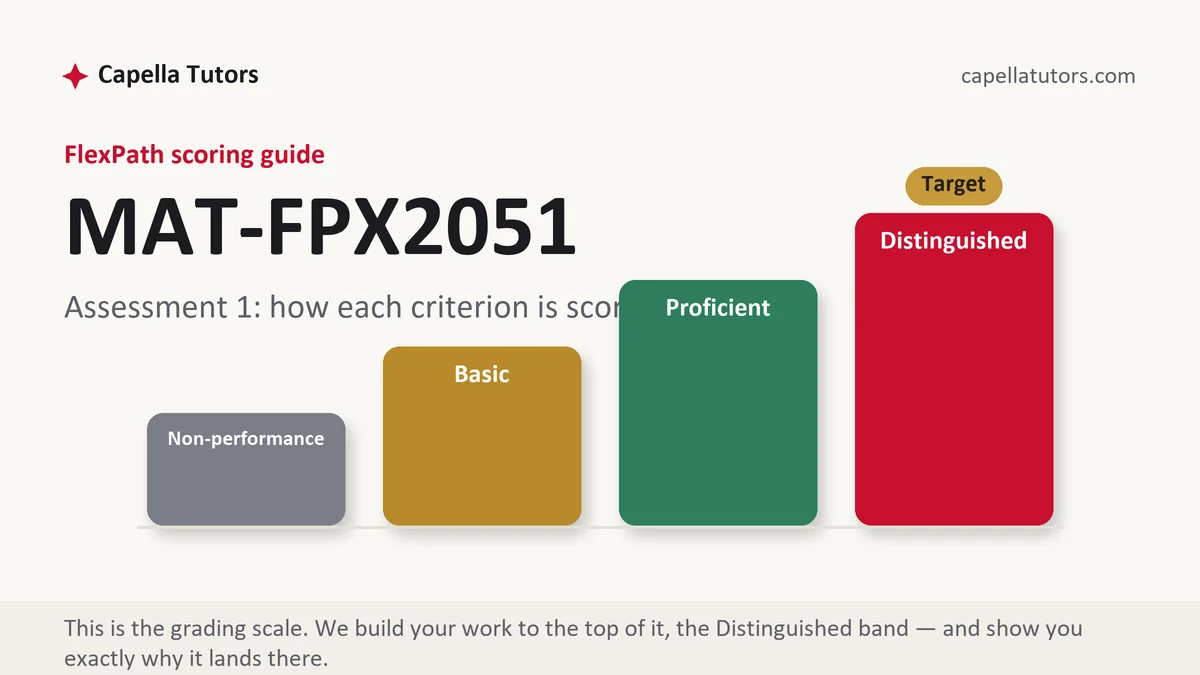
How MAT FPX 2051 Assessment 1 is scored
Marks in this format are level names. Each criterion on your guide takes one of four, and the description in each is the standard being applied:
| Level | What it means on a logic and translation deliverable |
|---|---|
| Distinguished | Every predicate is defined with the set its variable ranges over, the translation is defended clause by clause, the contrapositive and the converse are told apart with a reason, and the negation is used to say exactly what would refute the rule. The further move is named in the row; find it and carry it out. |
| Proficient | The symbolization is correct and the related statements are formed correctly. Accurate work with the defense left implicit. |
| Basic | Symbols produced with no domain attached, or a converse offered where a contrapositive was asked for. Where first attempts in this course tend to land. |
| Non-performance | A required element is absent, most often the domain or the negation. Absence rather than weakness is what drops a row to the floor. |
Two of these statements are equivalent to the original and one is not, and mixing them up is the most expensive error available in this deliverable. The contrapositive negates both halves and swaps them, and it says the same thing. The converse only swaps them, and it is a different claim that may well be false.
The MAT FPX 2051 Assessment 1 method, step by step
-
Turn each criterion into a heading before symbolizing
Copy the rows into an empty document with their top-level wording underneath. Logic criteria pair a translation with a justification, and the justification is the half that gets skipped.
-
Define every predicate with its domain
Write out what each letter stands for and what set its variable ranges over, in words. A symbol string with no domain cannot be judged true or false, so the row about notation has nothing to score.
-
Translate clause by clause, then read it back
Take the sentence in pieces and say which connective each piece became. Then read the finished symbolization back into English and check it against the original wording, because a translation that is slightly wrong is cheapest to catch here.
-
Watch the order of the quantifiers
Saying every patron has an overdue hold and saying there is one hold every patron let lapse use the same words in a different order and make different claims. State which order the rule requires and why.
-
Form the contrapositive and the converse, and label them
Give both, say which is equivalent to the original, and give the reason. Then supply a situation in which the converse fails, since one counterexample settles a universal claim and no number of examples proves one.
-
Negate the rule to say what would break it
The denial of a statement holding for every case is a statement that one case fails, so write the single case that would refute the rule. Then grade yourself row by row and allow two business days for the response.
A structure that maps to the criteria
The counts are planning figures we use on translation tasks rather than requirements; your scoring guide decides which parts deserve room.
| Section | What it must do | Guide word target |
|---|---|---|
| The rule in words | The policy or sentence quoted exactly as it was given, with the setting it applies to. | ~130 words |
| Predicates and domains | Every letter defined in words, with the set each variable ranges over. | ~170 words |
| The symbolization | The finished statement, built clause by clause, with each connective justified. | ~240 words |
| Contrapositive and converse | Both formed, both labeled, the equivalent one identified with a reason. | ~230 words |
| Negation and refutation | The denial written out, plus the single case that would show the rule false. | ~190 words |
| Notation and sources | Symbols consistent with your course's convention, definitions cited to the assigned text in current APA. | as needed |
Annotated sample excerpt
An original model from our team, written to the register the highest level describes. Take its moves and write your own version.
Let the domain be the set of items currently on hold at the branch, with C(x) meaning item x is collected within seven days of the notice and R(x) meaning the hold on item x is released; the posted rule is that for every x, if not C(x) then R(x).1 Its contrapositive says that for every x, if the hold on x was not released then x was collected within seven days, which is the same claim in different words and is therefore equally true.2 Its converse, that every released hold belonged to an uncollected item, is a different claim and a false one, since staff also release holds on items recalled by another branch; and the rule itself would be refuted by a single item left uncollected for eight days with its hold still active.3
- 1The domain is fixed before either predicate is used, and both predicates are defined in words including the time window. A symbol with an unstated domain cannot be graded true or false.
- 2The contrapositive is formed and its equivalence is asserted with a reason rather than left for the reader to notice. That reason is usually its own row.
- 3The converse is shown false by one concrete case, and the negation is expressed as the single counterexample that would break the rule. Both moves are what the top column describes.
The full premium sample for your exact assessment, written fresh to your scoring guide and issue, is free to request. Study it, revise it into your own voice, and submit work you understand.
The five mistakes that cost Distinguished
- Symbols with no domain named. A statement about every x means nothing until the set x runs over has been written down.
- The converse mistaken for the contrapositive. Swapping the halves of an implication produces a different claim with its own truth value, and the row can tell.
- Quantifiers dropped in translation. A sentence stripped of its every or its some is no longer the statement you were handed.
- A universal claim defended with examples. Any number of confirming cases proves nothing, while one failing case settles it, and the row is written around that asymmetry.
- A negation formed by adding not to the front. Denying a universal statement produces an existential one, and the transformation has to happen inside the sentence.
Pre-submission checklist
- Each criterion given a heading, numbered to match the prompt's numbering
- Every predicate defined in words, with the set its variable ranges over
- The symbolization built clause by clause and read back into English
- Quantifier order stated and justified where two quantifiers appear
- Contrapositive and converse both formed, labeled, and the equivalent one explained
- The negation written as the case that would refute the rule, every row self-scored
A logic and translation set due?
Send the problems with their original numbering and the scoring guide. A team of eight, including a research analyst and two QA reviewers, returns a premium original sample in 24 to 48 hours with every domain declared and every step justified, revised free until the rows clear.